Reviewed · VIP
Best of Split & Trogir: Private VIP Tour with Local Guide
Diocletian’s Palace is not a fenced-off ruin. It is the old heart of Split, where Roman columns, medieval homes, shops, cafés, and daily life share the same lanes. This private tour links that remarkable city center with Trogir, a smaller Venetian-style town packed with stonework and sea views.
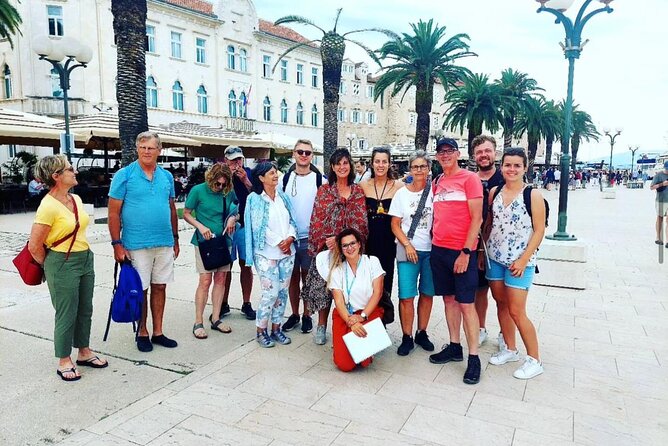
I like the private format, since your group can move at its own pace and avoid getting lost in Split’s maze. I also like the local touch: Kristina has shared personal stories about her home and traditions, while Andrea has helped groups work through busy streets with ease.
The main consideration is time. Six hours is enough for a useful first look, but the schedule gives roughly 15 minutes to each listed stop. Paid entries to the Palace cellars, Trogir Cathedral, Kamerlengo Fortress, and Čipiko Palace are not included, so admission costs can add to the $228.78 price.
Key points to know before booking
- A private route joins two UNESCO-listed old towns: You see Split’s Roman core and Trogir’s medieval and Venetian center in one half-day outing.
- The Palace cellars reveal Diocletian’s private world: These unusually well-preserved substructures once supported the emperor’s apartments.
- Trogir brings a different mood: Its central square, cathedral, loggia, fortress, and noble palace fit into a compact old town.
- Local guides make the difference: Kristina and Andrea have been singled out for clear explanations, personal stories, and calm crowd navigation.
- Admission planning matters: Several major sights require separate tickets, while the Peristyle, Gregory of Nin statue, Trogir square, and town loggia are free.
- You get the whole group to yourself: Pickup is offered, English is available, and group discounts may improve the value for larger parties.
Why this Split and Trogir pairing works
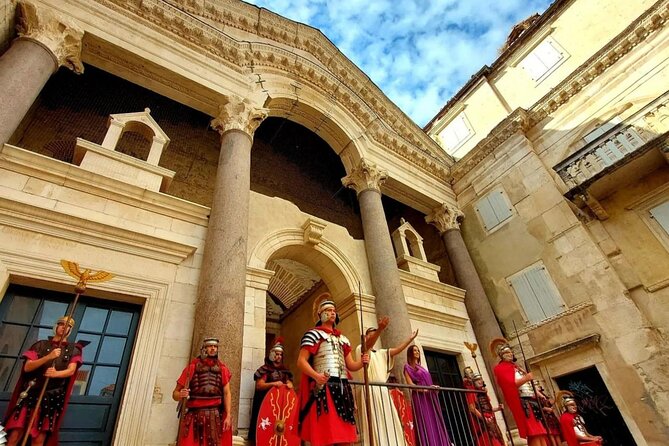
Split and Trogir are close enough to combine, yet they feel quite different. Split is anchored by the palace of Roman Emperor Diocletian, a huge fourth-century complex that later became the town itself. Trogir is smaller and more medieval in feel, with Gothic, Romanesque, and Renaissance buildings gathered around a central square.
That contrast gives this tour a clear purpose. You are not spending six hours looking at variations of the same church façade. Instead, you move from the scale of an imperial residence to the tighter streets of a former maritime town.
A private tour also makes sense here. Split’s old center can be confusing at first, since the palace survives as a working neighborhood rather than a single monument. A guide can point out what belonged to the emperor, what was added later, and how the old structure still shapes the city.
The price is $228.78 per person, which is high for a six-hour walking and sightseeing experience. It makes more sense for a small private group that values a dedicated guide, pickup, and a carefully arranged route. If you are traveling alone or as a couple on a tight budget, public sightseeing and separate entry tickets will cost less. If you are sharing the tour with family or friends, a group discount may improve the calculation.
A few more Split days out worth weighing up
- SPLIT-PRIVATE Walking Tour of Diocletian’s Palace & Old Town
★ 5.0 · 467 reviews - Private Krka Waterfalls tour with 30min Boat Cruse
★ 4.0 · 458 reviews - Split by Private Electric Rickshaw – Palace & Hidden Gems
★ 5.0 · 412 reviews
Entering the Peristyle at Diocletian’s Palace
The Peristyle is the natural opening point. It sits at the crossing of the two main roads inside the palace and was designed as the complex’s central ceremonial court. Its colonnades frame the space, giving you an immediate sense of Roman power and order.
This is one of those places where a guide adds real value. Without context, you may see a handsome stone square. With an explanation of its original purpose, you can picture it as the heart of an imperial residence, not simply a plaza in a Croatian city.
The listed visit lasts about 15 minutes, and admission is free. That short time is enough to get oriented, but you will not have a long, quiet period for close architectural study. Expect people moving through the square, since it remains part of the active old town.
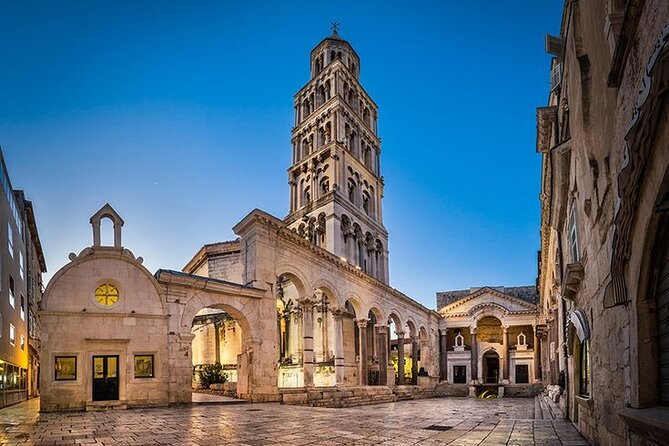
The Cathedral of Saint Domnius is connected to this section of the palace experience. It occupies Diocletian’s former mausoleum and was consecrated around the turn of the seventh century. It is often described as the oldest Catholic cathedral still in use in its original structure, although its bell tower dates from the 12th century.
That layering is what makes the building special. You are not looking at a cathedral built on an empty site. You are seeing a Roman imperial structure adapted for Christian worship, with centuries of use packed into one compact monument.
Jupiter’s Temple and the small details of the palace
The Temple of Jupiter lies on the western side of the palace, close to the Peristyle. Built between 295 and 305, it belonged to the original imperial complex and was dedicated to the Roman god Jupiter.
It is a brief stop, but it helps complete the picture of Diocletian’s residence. The Peristyle shows the public ceremonial side of the palace. The former mausoleum shows imperial power turned into Christian worship. The temple adds the religious world of ancient Rome.
You should expect the guide to connect these places rather than treat them as isolated photo stops. That is especially useful if you have little background in Roman architecture. Split’s old center rewards explanation because later buildings often sit directly on ancient foundations.
The Palace cellars reveal the structure below
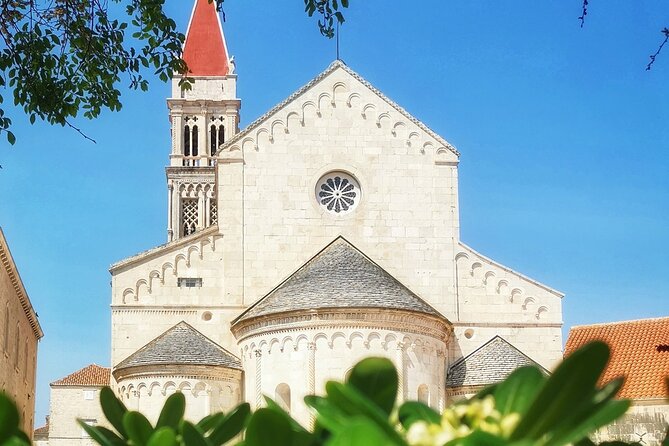
The cellars, also called the basement halls, are one of the strongest parts of the Split visit. They occupy the southern end of Diocletian’s Palace and once supported the emperor’s private apartments above.
These substructures are unusually well preserved. Their arches, corridors, and stone chambers give you a physical sense of how the palace was built. You can also understand the shape of the rooms above by looking at the supporting spaces below.
Admission is not included, so you should allow for an extra ticket cost. The tour description gives about 15 minutes here, which is enough for an introduction but not a slow, detailed exploration of every chamber.
For many people, this will be the most revealing stop in Split. The Peristyle is grand, but the cellars show how the whole building functioned. They also make it easier to understand why the palace still controls the shape of the modern city.
Same coastline, a completely different kind of day:
- Split: Krka Waterfalls Trip with Boat Cruise and Swimming
★ 4.8 · 10,519 reviews - From Split: Krka Waterfalls, Food & Wine Tasting Tour
★ 5.0 · 9,326 reviews - Blue cave, Mamma Mia and Hvar, 5 islands speedboat tour
★ 5.0 · 7,150 reviews - From Split: Krka Waterfalls, Food & Wine Tasting Tour
★ 4.9 · 6,598 reviews
The polished toe of Gregory of Nin
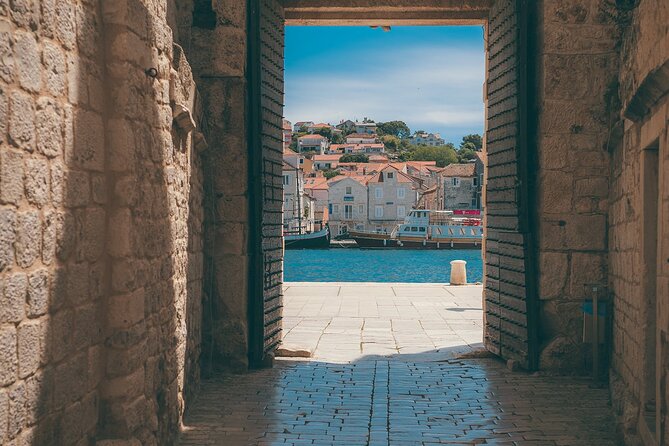
The 8.5-meter statue of Gregory of Nin is one of Split’s most popular quick stops. Sculptor Ivan Meštrović created the imposing figure, which shows the medieval bishop in a powerful, oversized form.
The famous detail is the toe. It has been rubbed smooth and shiny because touching it is said to bring good luck. You can make this a light moment in a tour otherwise filled with emperors, temples, and cathedrals.
The stop lasts about 15 minutes and costs nothing. It is easy to photograph and gives the tour a bit of local ritual. Do not expect a long historical talk at the statue itself, but do expect an entertaining pause and a good chance to see how Split mixes serious heritage with everyday custom.
Trogir’s central square and civic life
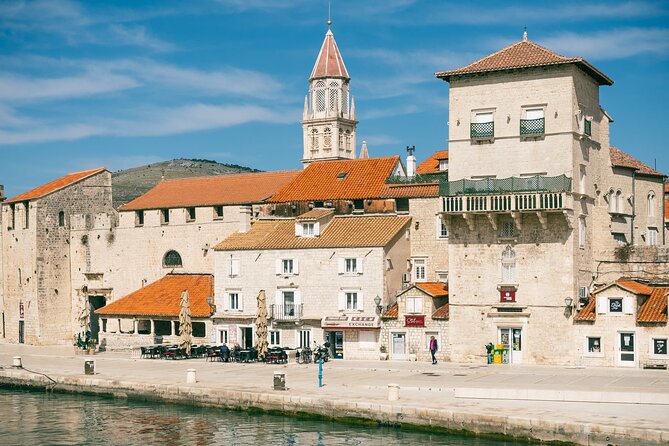
The route then turns to Trogir, unless your guide chooses the reverse order. One review specifically notes that Andrea took the group to Trogir first, so the sequence may vary. That flexibility can help your guide manage crowds and make the most of the day.
Trogir’s central square, also called John Paul II Square, gathers several important buildings in a small space. The town is known for its Venetian character and is included among UNESCO monuments. Its compact size makes it easier to read than Split, since many key buildings face one another.
The Loggia and Clock Tower are prominent here. The Loggia once served as a public courtroom, and its six columns have carved capitals. A relief called The Relief of Justice, made by Nicholas Florentino, is one of the details to look for.
There is a practical catch in summer. A nearby coffee bar can block a clear view of some of the loggia’s columns. You will still see the building and its relief, but do not expect every architectural feature to be fully open to view.
The square is free to visit and the planned stop lasts about 15 minutes. That is enough to hear how public business, legal matters, and town decisions were handled in medieval Trogir.
Saint Lawrence’s Cathedral takes you through several styles
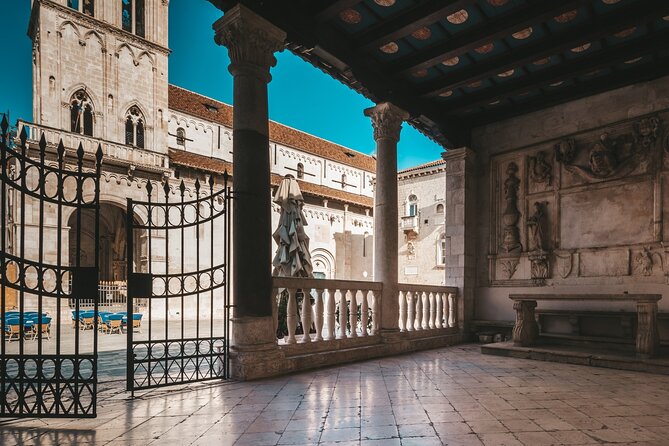
Trogir Cathedral, formally the Cathedral of Saint Lawrence, is the town’s major monument. It is a triple-naved basilica built in Romanesque and Gothic styles, with construction lasting for several centuries.
That long building period is important. Instead of presenting one clean architectural style, the cathedral shows the changes that took place in Dalmatia over time. You can see how a major church developed in stages as tastes, skills, and local fortunes changed.
Admission is not included, and the planned visit is about 15 minutes. That makes this a focused introduction, not a long church study. If you care deeply about medieval sculpture or church interiors, you may want to ask your guide how much time is available inside before moving on.
The cathedral is also a useful counterpoint to Split’s Saint Domnius. Split’s cathedral occupies an adapted Roman mausoleum. Trogir’s cathedral represents centuries of medieval construction and later changes, giving you two very different religious buildings in one tour.
Kamerlengo Fortress and Trogir’s sea-facing side
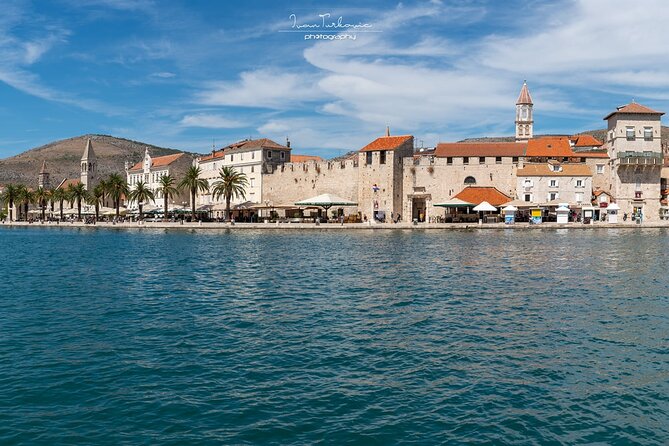
Kamerlengo Fortress brings you to Trogir’s defensive and maritime past. The 15th-century fortress was built during Venetian rule to protect the town from attacks by sea.
The setting matters. From the fortress, you can look toward the old town, marina, and nearby islands. It is one of the better places on this route for broad views rather than close architectural details.
Admission is not included, and the planned stop lasts 15 minutes. That is enough for a look around and photographs, but you should not expect a full fortress exploration at a leisurely pace.
The fortress also helps explain Trogir’s location. This was not simply a pretty stone town. Its position on the Adriatic gave it commercial and strategic value, and the fortifications reflect the need to control access by water.
The Loggia and Čipiko Palace
The Town Loggia was the public meeting place of medieval Trogir. Important decisions were announced there, and legal matters were discussed in the open civic setting.
This stop works well with the central square because it shifts your attention from religious and military buildings to local government. You get a clearer idea of how the town operated, not just how its wealthy families worshipped or defended themselves.
The Čipiko Palace adds the private side of Trogir’s old social order. It was the largest residential palace in the town and belonged to the influential Čipiko family. Its Gothic-Renaissance design reflects the family’s wealth and position.
Admission is not included. The planned visit is another 15 minutes, so treat it as a guided look at an important building rather than an extended museum visit. The value comes from the connection between architecture and power: the palace shows how leading families displayed their place in Trogir.
The guide can make or break the six hours
The most important variable is the person leading your group. Kristina has been praised for clear explanations, a warm manner, local pride, and personal stories that connect the monuments to living traditions. Andrea has been praised for explaining Split well and guiding a group through crowds with ease.
Those details matter more here than they would on a simple bus transfer. Split’s palace is layered and confusing, while Trogir’s old center contains many buildings close together. You need someone who can explain what you are seeing without turning every stop into a lecture.
The tour is offered in English. Since it is private, you can ask for clarification, slow down at a favorite site, or focus more on Roman history, churches, fortifications, or local life, within the limits of the six-hour schedule.
Pickup is offered, and the activity is near public transportation. Service animals are allowed, and most people can participate. These are useful practical points, but the tour still involves old-town sightseeing, where stone surfaces and compact lanes may affect your pace.
Is the $228.78 price fair?
At $228.78 per person, this is not a bargain tour. The price covers the private setup, the guide, the Split and Trogir route, and the convenience of having one organized experience rather than arranging two separate visits.
It does not cover every major admission. You may need separate tickets for the Palace cellars, Saint Lawrence’s Cathedral, Kamerlengo Fortress, and Čipiko Palace. The Peristyle, Gregory of Nin statue, central square, and Town Loggia are listed as free.
I would judge the value by group size and priorities. For a family or group of friends, a private guide who can manage the route and explain both towns may be worth the premium. For a solo visitor, or someone happy to read signs and use a map, the price is harder to defend.
The strong rating of 5 out of 5 from 11 ratings, with 100 percent recommending the experience, supports confidence in the guide-led format. Still, a small rating sample cannot guarantee that every guide or every day will feel identical. The clearest evidence points to strong guiding and useful crowd management, especially from Kristina and Andrea.
Who should book this private tour?
I would choose this tour if you have only one day to understand the Split area and want both Roman and medieval sights. It suits first-time visitors, families who prefer a dedicated guide, and small groups that want pickup and a private schedule.
It is also a good match if history makes more sense to you when someone explains the connections. The route covers an imperial palace, an ancient temple, a converted mausoleum, medieval civic buildings, a cathedral, a noble palace, and a Venetian fortress.
I would hesitate if you want long visits inside each monument. With about 15 minutes assigned to each stop, this is a broad orientation tour, not a slow architectural study. You will see many highlights, but you may need to return independently to the Palace cellars, cathedral, fortress, or Čipiko Palace.
Book at least 24 hours before the start if you want the option of a full refund. Changes or cancellations made less than 24 hours before the start are not accepted for a refund, based on the local cutoff time.
Final call: a strong introduction, not a slow museum day
Book this experience if you want a private, guide-led introduction to two of Dalmatia’s major old towns, especially if your group values local stories and simple logistics. Kristina’s personal connection to Split and Andrea’s calm handling of crowds are exactly the kind of qualities that can turn a busy historic center into a clear, enjoyable visit.
Skip it if your main goal is to spend an hour or more inside every paid site, or if $228.78 per person is beyond your budget. For everyone else, the combination of Diocletian’s Palace, Trogir’s compact square, and the sea-facing fortress gives you a well-shaped view of the region in six hours.
FAQ
How long does the Best of Split and Trogir private tour last?
The tour lasts approximately six hours.
Is this a private activity?
Yes. Only your group participates in the activity.
Is pickup available?
Yes. Pickup is offered.
What language is the tour offered in?
The tour is offered in English.
Are admission tickets included?
Admission is free at the Peristyle, Gregory of Nin statue, Trogir’s central square, and the Town Loggia. Tickets are not included for the Palace cellars, Saint Lawrence’s Cathedral, Kamerlengo Fortress, or Čipiko Palace.
Can I cancel for a full refund?
Yes, if you cancel at least 24 hours before the experience start time. Cancellations made less than 24 hours in advance are not refunded.
Are service animals allowed, and can most people participate?
Yes, service animals are allowed, and most people can participate. The tour is also near public transportation.
Just added around Split
- From Makarska : Wine Tasting Grabovac Tour★ 4.5 · 30 reviews
- Essential Diocletian’s Palace Tour for First-Time Visitors★ 4.8 · 19 reviews
- Unique vintage Tomos moped tour Split – Back to the ’80s★ 4.8 · 17 reviews
- Walking Tour Split★ 4.7 · 61 reviews
- Trogir; Private walking tour of higlights of Trogir★ 4.7 · 3 reviews
- Trogir: White Lagoon, Maslinica & Blue Lagoon Speedboat Tour★ 4.8 · 11 reviews
- Trogir 1.5-Hour City Tour★ 4.4 · 37 reviews
- Split: Trogir Open Top Bus Trip + Free Split Walking Tour★ 4.1 · 17 reviews
VIP, compared.

Luxury Blue Cave, Hvar and Vis Boat Tour from Split and Brac
Read our review →
Blue Cave & Hvar, 5 Islands Speedboat with Luxury Seats in Shade
Read our review →


Private Luxury Boat tour for 12 from Split, Brac, Trogir, Hvar
Read our review →
Luxury Boat – Blue Cave From Split Island-Hopping Full-Day Cruise, Hvar, Vis
Read our review →