Reviewed · PRIVATE
Trogir & Split – Private tour of two UNESCO cities
Trogir’s old town feels like a small stone museum, while Split’s Diocletian’s Palace is a living city where ancient walls frame cafés, shops, and daily life. This private five-hour trip gives you both in one well-planned outing, with pickup, air-conditioned transport, and an English-speaking guide.
I like the private format, which lets your group move at a sensible pace rather than wait for a large coach. I also like the contrast between Trogir’s compact medieval lanes and Split’s grand Roman core. The main drawback is time: five hours covers the highlights, but neither city gets a slow, open-ended visit.
Key points to know before booking
- Two very different historic centers: Trogir offers intimate medieval streets and Romanesque art, while Split places daily life inside a 1,700-year-old palace.
- Private transport from Split: Pickup is included, and a modern air-conditioned vehicle makes the transfer easier in warm weather.
- A strong guide matters here: Boško is named as a guide, and Pablo as a careful driver on one highly rated outing.
- Cathedral entry is included: You visit the interior of St. Lawrence’s Cathedral in Trogir rather than seeing only its exterior.
- Five hours means a brisk visit: The schedule allows time for major sights, but not lengthy museum stops or unplanned wandering.
- Free cancellation is available: You can cancel up to 24 hours before the start for a full refund, subject to the stated weather conditions.
Why pairing Trogir and Split works so well
Trogir and Split are close enough to visit together, but they offer different impressions of Croatia’s past. Trogir is compact, quiet, and built for wandering. Split is larger and more theatrical, with Roman stonework woven into modern streets.
That contrast gives this tour a clear purpose. You are not seeing two versions of the same old town. In Trogir, you focus on a concentrated historic center shaped by more than two millennia of urban life. In Split, you see how an imperial palace became the framework for a working city.
I like this kind of pairing because the second stop gains meaning from the first. After Trogir’s narrow lanes and carefully preserved buildings, Split’s Peristyle and palace gates feel even more imposing. You can compare a small medieval center with a Roman complex that still functions as part of everyday city life.
The tour begins at 9:00 a.m. and lasts about five hours. That is enough time for guided walks, the cathedral interior, the main squares, and the Riva, with private transport between the cities. It is not enough time to stop at every museum, sit over a long lunch, or wander without watching the clock.
A few more Split days out worth weighing up
- SPLIT-PRIVATE Walking Tour of Diocletian’s Palace & Old Town
★ 5.0 · 467 reviews - Private Krka Waterfalls tour with 30min Boat Cruse
★ 4.0 · 458 reviews - Split by Private Electric Rickshaw – Palace & Hidden Gems
★ 5.0 · 412 reviews
Trogir’s stone lanes and central square
The first hour is devoted to Trogir’s historic center, part of the UNESCO World Heritage list. The old town is compact, so the walking portion can cover a lot without requiring a long hike between scattered sights.
This is the kind of place where the atmosphere comes from small details. You pass narrow stone streets, old façades, palaces, and architectural layers built over centuries. The town’s nickname, the Stone Beauty, makes sense once you begin walking through its pale limestone core.
Your guide can help turn the buildings into a readable story. Without guidance, Trogir can seem like a pleasant maze of stone lanes. With context, the town’s long continuity becomes easier to grasp. You begin to see how the street plan, religious buildings, and civic spaces fit together.
The Central Square receives about 15 minutes. It is a good pause in the walking tour because it gathers several important buildings and works of art in one view. You can take in the medieval architecture without spending your first stop racing from one isolated monument to another.
There is also a playful local idea connected with Trogir. A Greek god of happy moments is said to walk the streets, and anyone who catches him by the hair earns a share of good fortune. The reference adds a little humor to a town that might otherwise feel solemn and highly polished.
Do not expect much free time here. The tour’s design is a guided introduction, not a shopping stop or a long café break. If you want time for photographs, ask your guide when the best pauses will be. The private setup should make that request easier than it would be in a large group.
Inside St. Lawrence’s Cathedral
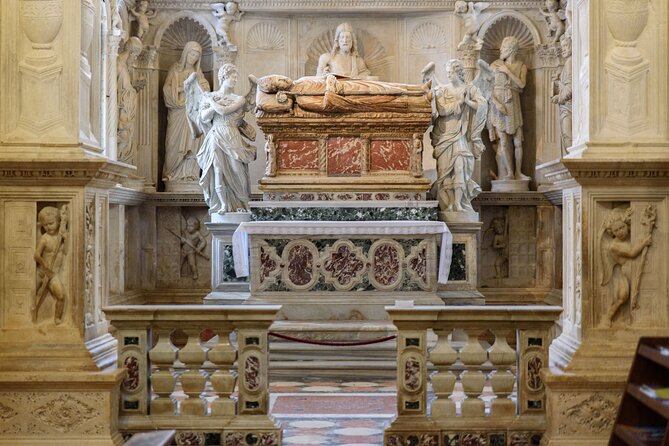
St. Lawrence’s Cathedral is the one attraction with an included entrance fee. You spend about 20 minutes inside, which is short but worthwhile because the interior and the famous portal give Trogir much of its artistic weight.
The cathedral’s entrance is known for its detailed carving and grand presentation. A guide can point out what you are looking at rather than leaving you to admire the stonework without context. That matters in a short visit, especially if you are not familiar with Croatian medieval art.
The cathedral stop also breaks up the outdoor walking. On a hot day, a shaded interior can be welcome. Since admission is included, you do not need to decide on the spot whether this sight fits your budget.
Twenty minutes will not allow a leisurely study of every detail. Think of this as a focused visit to the building’s main features, not a full art-history session. If cathedral interiors are a major interest, you may wish the stop were longer. For most people, the allotted time gives a useful look without taking too much from Split.
From Trogir to Split in a private vehicle
The transfer to Split is handled by a professional driver in a modern, air-conditioned vehicle. Pickup at an agreed location is included, which removes one of the most annoying parts of a two-city outing: figuring out where to meet a bus or how to coordinate public transport with a fixed start time.
Private transport has value beyond comfort. You can keep your belongings with your group, avoid gathering passengers at several stops, and make the journey as a direct transition between the two historic centers. In warm Croatian weather, air conditioning is a practical benefit, not a luxury.
The tour includes an English-speaking licensed guide, so the drive is part of a guided day rather than a simple taxi transfer. Coffee or tea is also included, though the supplied details do not specify exactly when or where it is served.
One tour team includes Boško as guide and Pablo as driver. The available feedback specifically praises Boško’s command of the subject and Pablo’s safe driving. Those are the two qualities I would want most on this outing: clear explanations in crowded old streets and a calm hand behind the wheel.
Because this is private, only your group participates. That makes the tour a good choice for families, couples, or friends who want to ask questions without holding up strangers. It also lets you discuss your walking pace with the guide, though the overall five-hour limit still applies.
Same coastline, a completely different kind of day:
- Split: Krka Waterfalls Trip with Boat Cruise and Swimming
★ 4.8 · 10,519 reviews - From Split: Krka Waterfalls, Food & Wine Tasting Tour
★ 5.0 · 9,326 reviews - Blue cave, Mamma Mia and Hvar, 5 islands speedboat tour
★ 5.0 · 7,150 reviews - From Split: Krka Waterfalls, Food & Wine Tasting Tour
★ 4.9 · 6,598 reviews
Entering Split through the Golden Gate
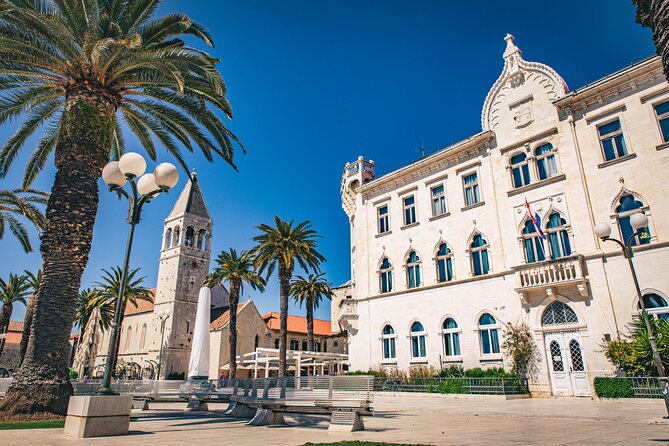
The Split portion begins with the Golden Gate, the main entrance to Diocletian’s Palace. The gate is tied to Emperor Diocletian’s retirement and his arrival at the palace, giving the stop a direct connection to the site’s original purpose.
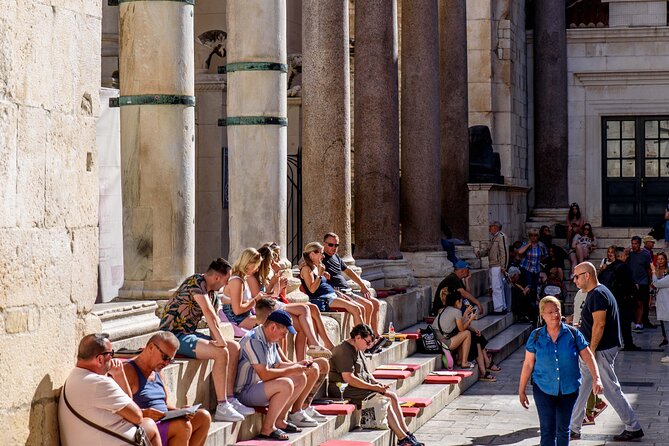
The palace is about 1,700 years old, but it is not an empty archaeological shell. That is the key to understanding Split. People live, work, eat, and meet within and around these ancient walls, so the experience shifts constantly between Roman remains and modern city life.
The Golden Gate is also associated with the statue of Grgur Ninski, the Croatian bishop whose monument overlooks the entrance. The itinerary allows about 15 minutes here, enough to get your bearings and hear why the gate and statue matter before moving toward the palace center.
The short stop works well as an introduction. You see how imposing the palace entrance is, but you do not spend too much of the day at a single threshold. The drawback is that the gate area can feel like a quick photo stop if the guide does not provide enough context. This is one place where the quality of the explanation matters.
The Peristyle, the palace’s great center
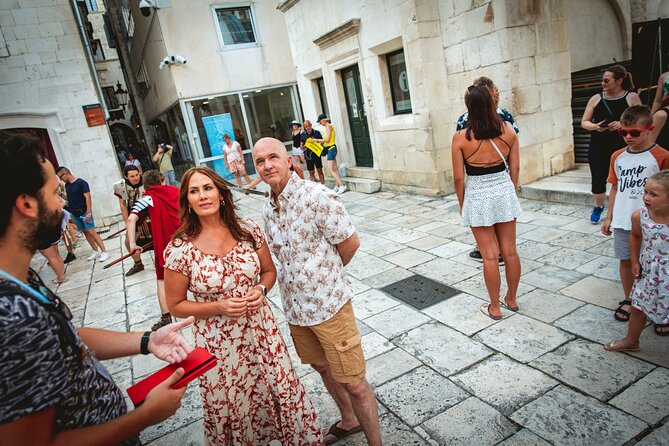
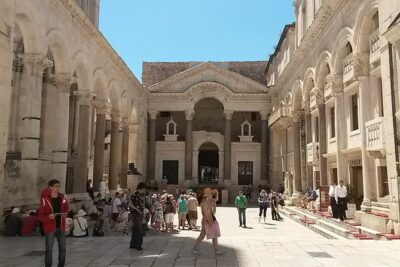
The Peristyle receives about 20 minutes and is the architectural high point of the Split walk. This was the geographical and spiritual center of Diocletian’s Palace, and its scale still makes that role clear.
Surrounding stone, columns, and monumental proportions give the square a strong sense of ceremony. It is one of the rare places where the ancient purpose remains easy to imagine, even though modern Split continues around it.
Your guide can connect the square to Roman power, imperial retirement, and the later life of the palace. The most useful part of a guided visit here is learning how the site changed over time without losing its central role.
Twenty minutes is enough to appreciate the setting and hear the main story. It is not enough for a slow architectural study or extended photography in every corner. If you want to linger, the private format may give you a little flexibility, but you should not count on a long unscheduled stop.
Pjaca and the city’s everyday stage
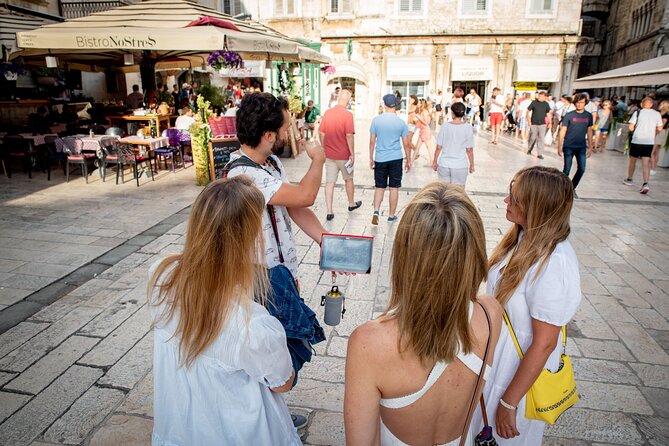
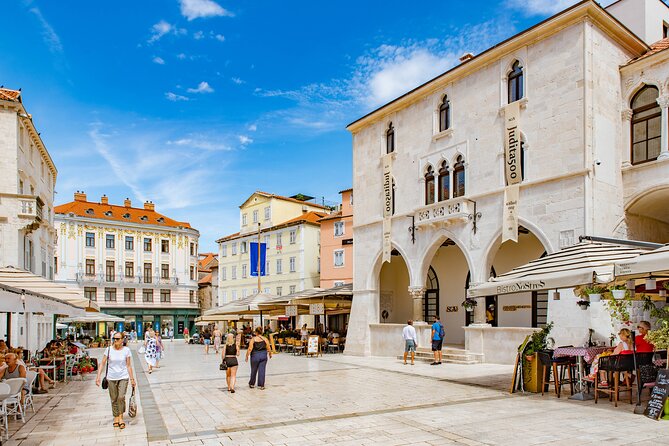
Narodni Trg, usually called Pjaca, is scheduled for about 10 minutes. This is the central stage of Split’s city life, where people meet, pause, and watch one another.
The square gives you a break from the palace’s imperial story. Here, the emphasis shifts to how Split works today. Football, daily appointments, and ordinary conversation are part of the social life of the place. That is useful context because it keeps the tour from treating Split as a collection of ancient stones.
Ten minutes is a fair amount of time for a guided look and a few photographs. It is too brief if you want to sit and observe for a while. If you enjoy people-watching, make a note of the square and consider returning on your own after the tour.
Republic Square and the final walk along the Riva
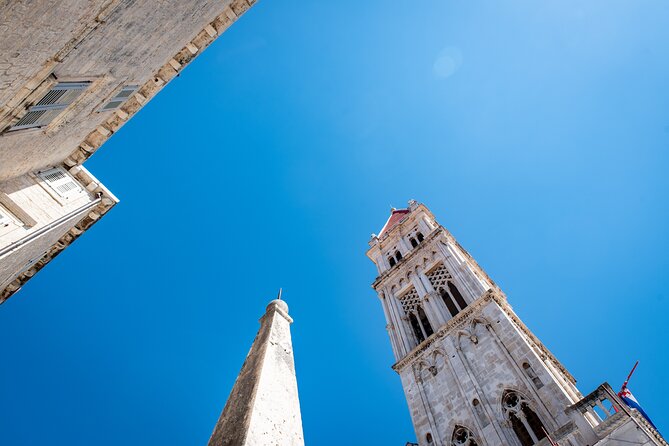
Prokurative, officially Republic Square, receives another 10 minutes. Its design recalls Venice’s St. Mark’s Square, and the open southern side gives views toward the harbor and the Riva.
This stop broadens the tour beyond Roman Split. You get a sense of the city’s later architectural ambitions and its relationship with the waterfront. The square is less about ancient remains and more about civic space, views, and the public face of the city.
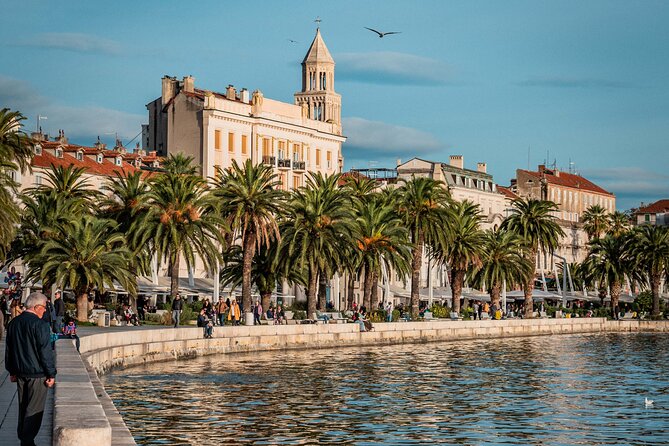
The final stop is the Riva, Split’s waterfront promenade, with about 15 minutes set aside. The Riva functions as the city’s public living room and an important setting for everyday gatherings and major events.
Ending here makes sense. After the enclosed lanes of Trogir and the heavy stone of Diocletian’s Palace, the harbor opens the view and gives the tour a lighter finish. You can walk along the promenade, take in the waterfront, and discuss what you have seen before the outing ends.
Again, 15 minutes is an introduction rather than a full waterfront visit. If you want a meal, a longer coffee, or time to watch the harbor, plan to stay in Split afterward if your schedule allows. The tour itself is designed to keep moving.
What the $161.10 price gets you
At $161.10 per person, this is not the cheapest way to see Trogir and Split. The price makes more sense if you value private transport, a dedicated licensed guide, and the ability to avoid organizing two historic centers on your own.
Included are pickup at the agreed location, private transportation, the English-speaking guide, entry to St. Lawrence’s Cathedral, and coffee or tea. Personal purchases and other expenses are not included.
The value depends heavily on your group size and priorities. A solo visitor may find the cost high compared with independent buses and self-guided walks. A couple or small group can see more value in sharing a private vehicle and guide, especially if convenience matters.
Group discounts are offered, although the amount is not specified. Since the tour is often booked around 110 days ahead, I would not leave it until the last moment if your travel dates are fixed. Confirmation is provided within 48 hours of booking, subject to availability.
The price also buys time. Instead of planning transport, finding the cathedral, mapping the palace, and keeping track of two city centers, you can focus on the stories. That convenience is particularly useful on a short stay in Split.
Who will get the most from this tour
I would choose this outing if you have only one morning or half-day for both cities and want a clear introduction rather than a specialist study. The schedule suits first-time visitors who want the principal sights explained in English.
It is also a good match for families and small groups. Private participation means you do not have to fit your questions into a large group’s rhythm. Pickup and air-conditioned transport simplify the day for anyone who prefers not to manage local connections.
You should think twice if you want long museum visits, extensive shopping time, or a relaxed lunch between stops. The tour covers a lot, but it does so with a firm timetable. People who already know Split may prefer a more focused visit to one city.
Most participants can take part, and service animals are allowed. The experience is near public transportation, though pickup is part of the arrangement. Good weather is required, and poor conditions can lead to a different date or a full refund.
Should you book the Trogir and Split combination?
Book it if you want to compare two historic Croatian cities in one efficient outing, value a private vehicle, and prefer a guide to explain what you are seeing. The best reasons are the sharp contrast between Trogir’s compact medieval center and Split’s ancient palace streets, along with the included cathedral admission and direct pickup.
Skip it if five hours feels too rushed or if you would rather spend a full day in one place. You will see the major sights, but you will not have much time to linger.
For a first visit from Split, I think the combination is sensible. Ask about the day’s pacing when you confirm, and protect some extra time afterward if you want to enjoy Split’s Riva or return to Pjaca at your own speed.
FAQ
How long does the tour last?
The tour lasts approximately five hours.
What time does the tour start?
The stated start time is 9:00 a.m.
Is pickup included?
Yes. Pickup is offered at an agreed location.
Is transportation private?
Yes. Your group travels in private transportation with a professional driver in a modern, air-conditioned vehicle.
Is entry to St. Lawrence’s Cathedral included?
Yes. The entrance fee to St. Lawrence’s Cathedral in Trogir is included.
What is the cancellation policy?
You can cancel up to 24 hours before the experience starts for a full refund. Cancellations or changes made less than 24 hours before the start are not accepted for a refund. If poor weather causes the tour to be canceled, you will be offered another date or a full refund.
Just added around Split
- From Makarska : Wine Tasting Grabovac Tour★ 4.5 · 30 reviews
- Unique vintage Tomos moped tour Split – Back to the ’80s★ 4.8 · 17 reviews
- Walking Tour Split★ 4.7 · 61 reviews
- Essential Diocletian’s Palace Tour for First-Time Visitors★ 4.8 · 19 reviews
- Trogir; Private walking tour of higlights of Trogir★ 4.7 · 3 reviews
- Trogir: White Lagoon, Maslinica & Blue Lagoon Speedboat Tour★ 4.8 · 11 reviews
- Trogir 1.5-Hour City Tour★ 4.4 · 37 reviews
- Split: Trogir Open Top Bus Trip + Free Split Walking Tour★ 4.1 · 17 reviews
Private, compared.
SPLIT-PRIVATE Walking Tour of Diocletian’s Palace & Old Town
Read our review →
Private Krka Waterfalls tour with 30min Boat Cruse
Read our review →
Split by Private Electric Rickshaw – Palace & Hidden Gems
Read our review →
Private Blue cave, Mamma Mia and Hvar, 5 islands tour from Split
Read our review →


Private Boat Tour by local expert – Create Your Itinerary
Read our review →