

Reviewed · GUIDED
Controversies behind Split and Croatia-Anthropologist guide
Split is more than Roman stone and sunny waterfront. This walking tour asks who controlled the city, who was pushed aside, and why old conflicts still shape Croatian identity. Guide Marin uses maps and visuals on an iPad, along with humor and a teacher’s calm way of explaining difficult subjects.
I like the focus on people and power, not just buildings. I also like the small maximum of 12 people, which gives you a better chance to ask about topics such as the Jewish ghetto, Ottoman wars, Yugoslavia, and modern Croatian politics. The main drawback is that you’ll spend much of the two hours standing outdoors, so heat, shade, and comfortable shoes matter.
Key points to know before booking
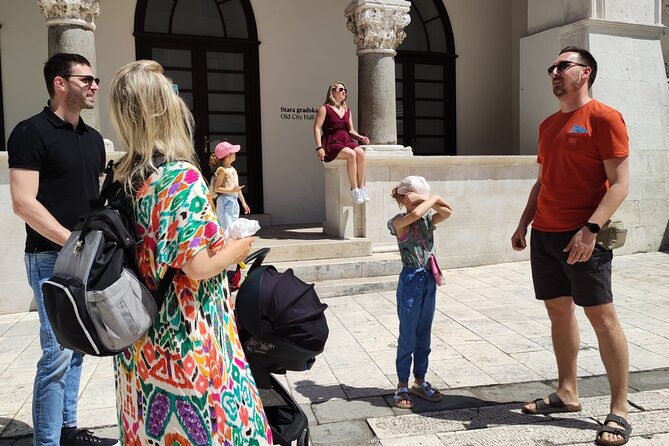
- Split’s controversies take center stage: Diocletian’s Palace becomes a setting for debates about rulers, locals, identity, and public memory.
- Marin brings a teacher’s approach: Expect clear explanations, humor, maps, iPad visuals, and thoughtful answers to questions.
- The route covers seven central locations: You’ll walk from Ul. kralja Tomislava to Matejuška, ending near one of Split’s best-known views.
- This is a small-group experience: The maximum group size is 12 people, useful when the subject is complex and discussion matters.
- The tour costs $35 per person: That is a fair price if you want context about Croatian society, not just a quick introduction to landmarks.
- Plan for outdoor listening: The pace is manageable, but some people may find standing tiring, especially in strong sun.
Why this Split tour looks beyond Roman ruins
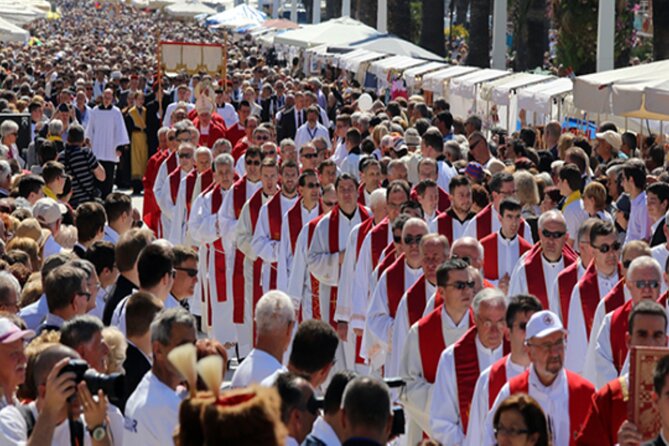
Many city walks in Split naturally focus on Diocletian’s Palace, the cathedral, and the maze of Roman streets. This one uses those places as evidence in a larger story. You’ll hear about the people who lived here, the groups that passed through, the rulers who changed the city, and the arguments that still have no neat ending.
That approach suits you if you want to understand why Split feels the way it does today. It also gives familiar sights more weight. A square is no longer only a pretty place for coffee. It may also be a former burial ground, a frontier site, a political stage, or a neighborhood shaped by exclusion.
The word controversies is important here. This is not a tour built around scandal for its own sake. The difficult subjects include war, ethnic and religious identity, political memory, and the way one period of Croatian history is taught. You should expect a serious look at competing points of view, presented with balance rather than a single heroic storyline.
Marin is the guide named in the available information, and his style seems especially suited to this material. He is described as warm, prepared, open to questions, and comfortable using maps and visuals on an iPad. His background as a teacher comes through in the structure: facts are explained, connections are made, and humor keeps the discussion from becoming a lecture with no air in it.
A few more Split days out worth weighing up
- From Split: Plitvice Lakes National Park Guided Tour
★ 5.0 · 3,002 reviews - From Split: Plitvice Lakes Guided Tour with Entry Tickets
★ 4.9 · 2,468 reviews - From Split: Plitvice Lakes National Park Guided Tour
★ 5.0 · 2,355 reviews
Starting at Ul. kralja Tomislava 12
The walk begins at Ul. kralja Tomislava 12 in central Split. From there, you move into the city’s main historic core and begin with the place that gives the tour its strongest subject: Diocletian’s Palace.
The meeting point is near public transportation, and the route remains in the center. You will not need a separate admission ticket for the listed stops. The experience is conducted in English, and confirmation is provided when you book.
Because the route includes several stops and lasts about two hours, I would choose a time that gives you comfortable weather. The experience requires good weather, and poor conditions can lead to a different date or a full refund. A morning or later afternoon time may be easier for standing outside, though the available schedule can vary.
Diocletian’s Palace and the problem of ownership
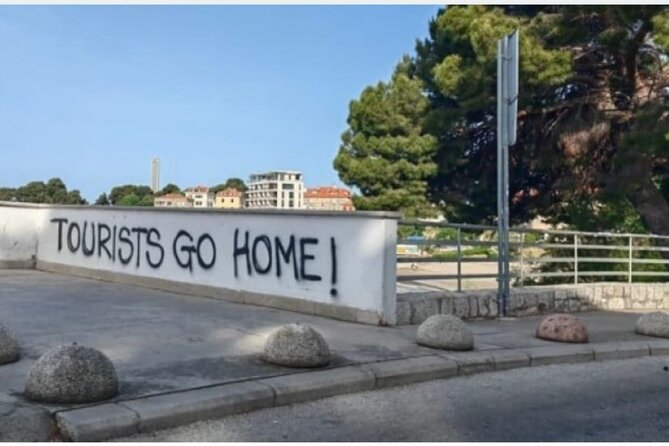
The first stop lasts about 35 minutes and includes admission. It is the longest pause on the route, and that makes sense. Diocletian’s Palace is not just a preserved Roman monument. It is also part of the living city, with homes, businesses, religious sites, public spaces, and generations of local memory packed into the same area.
The tour treats the palace as a contested place. Different periods brought different rulers, residents, priorities, and ideas about what should happen to the site. You’ll hear how the palace has been understood by locals across time, rather than receiving only a standard account of Roman construction.
This is where the tour’s anthropological angle becomes clear. Anthropology, in practical terms here, means looking at how communities live, remember, argue, and define themselves. The stonework matters, but so do the people who adapted the palace and gave it new uses.
I would pay close attention to Marin’s maps and iPad images at this point. They help put past boundaries and changing city patterns into view. That is useful in Split, where the present-day streets can make earlier divisions hard to picture.
The palace section may also appeal to you if you have already seen the main Roman features but want a different reading of them. Instead of racing from one architectural fact to another, you’ll be asked to consider what the site meant to different groups. That makes the next stops easier to follow.
Riva: public life on the waterfront
The second stop is Obala Hrvatskog narodnog preporoda, better known as Riva. The pause lasts about 15 minutes and requires no admission ticket.
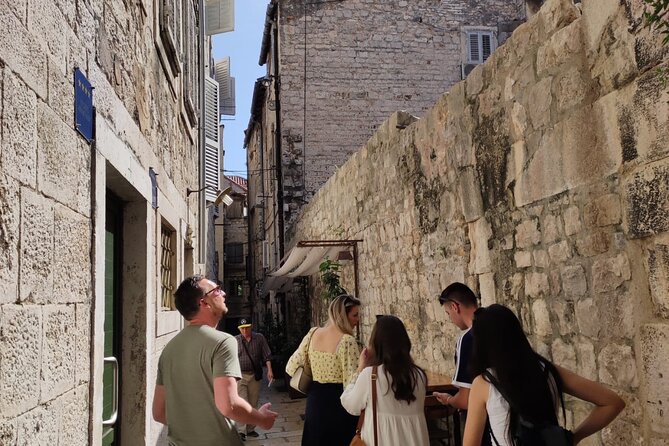
Riva is the classic Mediterranean promenade, but the tour does not treat it as mere scenery. It is a public stage where daily life, civic activity, and major events meet. That makes it a good place to discuss how Split presents itself and how public spaces become tied to memory.
You can expect a shift in tone here. After the enclosed and layered setting of the palace, the waterfront opens the story toward modern Split. The promenade helps explain how a city’s identity is performed in public, through gatherings, ceremonies, political moments, and ordinary social life.
The Riva stop also gives you a chance to reset your feet and take in the setting. Still, this is a walking tour, not a seated talk. You’ll want water and shoes that are comfortable for standing on hard surfaces.
Same coastline, a completely different kind of day:
- Split: Krka Waterfalls Trip with Boat Cruise and Swimming
★ 4.8 · 10,519 reviews - From Split: Krka Waterfalls, Food & Wine Tasting Tour
★ 5.0 · 9,326 reviews - Blue cave, Mamma Mia and Hvar, 5 islands speedboat tour
★ 5.0 · 7,150 reviews - From Split: Krka Waterfalls, Food & Wine Tasting Tour
★ 4.9 · 6,598 reviews
Trg Braće Radić and Split’s frontier story
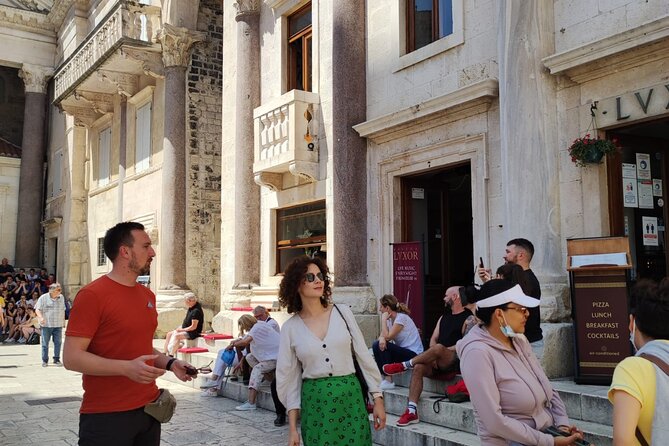
At Trg Braće Radić, the old Venetian square, the focus turns to the period when Split was a frontier facing the Ottoman Empire. The stop lasts about 15 minutes.
This part should be especially useful if you want more than a date-filled military account. The important question is not only what happened during those conflicts, but how that period is understood now. Stories about defense, danger, loyalty, and belonging can shape local identity long after the fighting ends.
The square provides a strong setting because it connects architecture with memory. You can look at a historic urban space while considering how modern politics still draws on older ideas of threat and protection.
Marin’s balanced approach matters here. Subjects involving empire, religion, borders, and national identity can easily become oversimplified. The tour instead aims to show how the same period may be remembered differently by different communities.
Narodni trg, buried remains, and uncomfortable memories
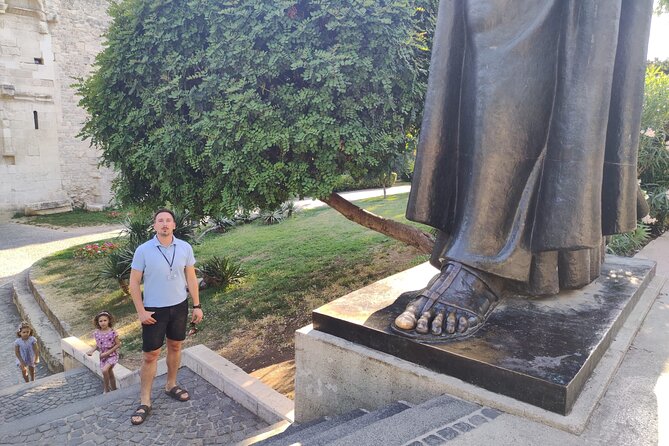
Narodni trg brings another sharp change in subject. The square sits over an ancient graveyard, so human remains are beneath the ground where people now walk and gather. The stop lasts about 15 minutes.
That detail alone changes how you see the square. It reminds you that Split’s public spaces have layers that are not always visible. The tour also covers later events connected with the location, including some of the city’s darker episodes.
This is one of the stops where the experience moves well beyond a conventional sightseeing walk. You are not simply told that the square is old. You are encouraged to think about who was present, who was remembered, who disappeared from the public story, and how places acquire new meanings.
The subject may feel heavy, but that is part of the value. Split’s past is not made only of grand rulers and attractive facades. A serious tour must also address buried people and difficult events.
Šperun and the story behind a popular neighborhood
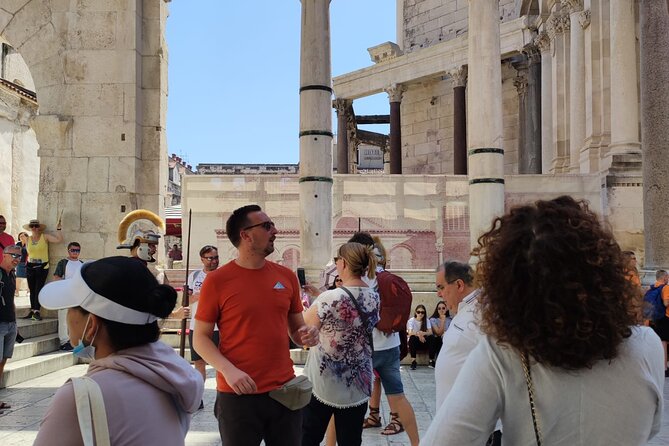
Šperun is one of Split’s best-known neighborhoods and a popular area for visitors to stay. The stop lasts about 15 minutes, but its importance comes from the contrast between its present image and its less familiar past.
You may recognize Šperun as a pleasant, central part of town. The tour asks you to look behind that current reputation and consider how the neighborhood developed, who lived there, and what its identity has meant over time.
This is a useful reminder that popular areas do not explain themselves. A neighborhood can become a favored base for short stays while its older social story fades from view. If you are staying near Šperun, this stop gives you a more grounded sense of the place around you.
Trg Franje Tuđmana and Croatia’s modern divisions
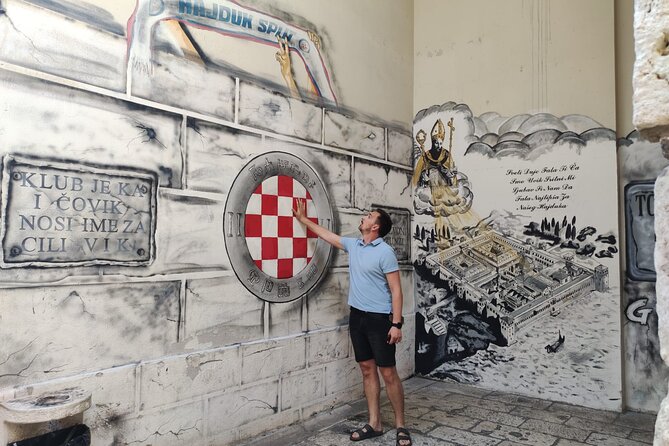
At Trg Franje Tuđmana, the route moves into the late 20th century. The square is named after Franjo Tuđman, Croatia’s first president, and that name opens a discussion of the period that remains especially difficult in Croatian schools and public life.
This is likely the most politically sensitive section of the walk. The subjects involve the end of Yugoslavia, the formation of modern Croatia, and disagreements that still divide society. You should not expect a polished national story with every question resolved.
Instead, the value is in seeing how recent events continue to influence public places and local identity. A square named for a major political figure is not neutral ground. Its name reflects choices about whom a society honors and how it tells its own story.
If you have little background in Croatian modern history, this section may feel dense. That is where questions help. Marin is described as open to them and able to explain the material with maps, visuals, and clear connections. His teaching style should make the subject more manageable than trying to sort it out from isolated plaques.
Matejuška and the final view of modern Split
The tour ends at Matejuška, after about 10 minutes at the final stop. From here, you get one of Split’s most famous views, and the setting gives Marin a natural place to pull the story together.
The ending turns back toward present-day Split. After Roman rule, Venetian influence, Ottoman frontier tensions, religious and social divisions, and 20th-century political conflict, you are left with a city still negotiating its identity.
Matejuška works well as a final stop because it is not simply an old monument. It lets you consider how the city lives now, how locals and visitors share the center, and how modern Split carries its past into everyday life.
The walk ends at Trumbićeva obala 2. That makes the tour easy to combine with more time along the waterfront afterward. You can continue exploring on your own, find a place to eat, or simply pause with the view before moving on.
What the $35 price gets you
At $35 per person, this is priced above a bare-bones orientation walk but below many longer specialist tours. The value depends on what you want from Split.
If you only need the basic layout of the old center, you may find the price harder to justify. You can see the main squares and waterfront without a guide. But if you want the political and social context behind those places, the fee pays for a more focused interpretation and a small group capped at 12 people.
The included palace admission also helps, though the main value is the way the stops connect. You are not paying simply to stand beside old walls. You are paying for a guided argument about how Split developed and how people continue to remember it.
The strongest value comes for visitors who enjoy asking questions. Marin’s preparation, visuals, humor, and open discussion make the experience more useful than a script delivered at fixed points. It is also a good choice early in your time in Split because the information can sharpen everything else you see afterward.
Pace, group size, weather, and comfort
The tour takes about two hours and includes seven stops. The pace is not described as rushed, and the available information suggests a steady rhythm that allows time for explanation. Still, you will be standing for much of the experience.
One group of 10 found the standing tiring, even though the pace felt well judged. That is a fair warning, especially in summer. Wear supportive shoes, carry water, and use shade whenever it is available. Marin makes an effort to find shade, but the route is outdoors and the amount of shelter can change from stop to stop.
The maximum group size is 12. That is small enough for a more personal exchange without making the tour feel like a private booking. It also matters because the subjects invite questions. In a large crowd, a discussion of modern political divisions can become rushed or hard to hear.
Most people can participate, and service animals are allowed. The tour is near public transportation. These details make it fairly straightforward for many visitors, but the standing time remains the main physical consideration.
Who should book this experience?
I would choose this tour if you want to understand Split through its people, conflicts, and political memory. It suits curious visitors who have already seen standard Roman attractions elsewhere and want something less predictable.
It is also a good match if you enjoy a guide who teaches rather than performs. Marin’s use of maps and iPad visuals, his humor, and his willingness to handle questions are strong reasons to choose this particular walk. The material covers tribes, communities, religious groups, social divisions, and modern politics, so you should be ready for more than dates and architectural labels.
Families with older children or teenagers may find the format useful if they enjoy social studies and discussion. The tour is not presented as a children’s activity, though, and the modern political material may be better suited to older participants.
I would choose another option if you want a relaxed, purely scenic stroll or if you dislike political subjects. This is also not the best pick for anyone who cannot comfortably stand outdoors for two hours.
Should you book the controversies tour?
Book it if you want Split to make sense beyond its famous stones. The route covers Diocletian’s Palace, Riva, Venetian-era Split, Ottoman frontier memory, buried remains, Šperun, modern Croatian politics, and Matejuška in one compact walk.
The $35 cost is reasonable for a small group and an English-language guide who brings preparation, visuals, humor, and a clear teaching style. Just plan for outdoor standing and choose good weather. If you leave Split wanting to understand its arguments as well as its monuments, this is the tour I would put near the top of your list.
FAQ
How long does the controversies behind Split tour last?
The experience lasts approximately two hours.
Where does the tour begin and end?
It begins at Ul. kralja Tomislava 12 in Split and ends at Trumbićeva obala 2 near Matejuška.
What language is the tour conducted in?
The tour is offered in English.
How many people can join the tour?
The maximum group size is 12 people.
Is admission to Diocletian’s Palace included?
Yes, admission for the Diocletian’s Palace stop is included. The other listed stops do not require an admission ticket.
Can I cancel for a full refund?
Yes. You can cancel at least 24 hours before the experience starts for a full refund. Cancellations or changes made less than 24 hours before the start time are not refunded or accepted. If poor weather causes the tour to be canceled, you will be offered another date or a full refund.
Just added around Split
- From Makarska : Wine Tasting Grabovac Tour★ 4.5 · 30 reviews
- Essential Diocletian’s Palace Tour for First-Time Visitors★ 4.8 · 19 reviews
- Unique vintage Tomos moped tour Split – Back to the ’80s★ 4.8 · 17 reviews
- Walking Tour Split★ 4.7 · 61 reviews
- Trogir; Private walking tour of higlights of Trogir★ 4.7 · 3 reviews
- Trogir: White Lagoon, Maslinica & Blue Lagoon Speedboat Tour★ 4.8 · 11 reviews
- Split: Trogir Open Top Bus Trip + Free Split Walking Tour★ 4.1 · 17 reviews
- Trogir: Old Town Guided Walking Tour★ 4.6 · 76 reviews
Guided, compared.
From Split: Plitvice Lakes National Park Guided Tour
Read our review →
From Split: Plitvice Lakes Guided Tour with Entry Tickets
Read our review →From Split: Plitvice Lakes National Park Guided Tour
Read our review →
Plitvice Lakes National Park Guided Day Tour from Split
Read our review →
Krka National Park Tour with tour Guide & Wine tasting from Split & Trogir
Read our review →
Split: Self-Guided Plitvice Lakes Day Tour with Boat Ride
Read our review →
Split: Diocletian Palace & Old Town Guided Walking Tour
Read our review →