
Reviewed · EVENING EXPERIENCES
Split: Magical Evening Sightseeing Private Tour
Split’s old town is not a museum behind glass. It is a living Roman palace, with homes, shops, cafés, church bells, and narrow lanes built into the remains of Emperor Diocletian’s retirement residence. This private evening walk gives you two hours to make sense of that wonderfully mixed-up center, from the palace cellars to the waterfront Riva.
I like the personal pace and the way the tour joins Roman, medieval, Venetian, and modern Split in one walk. I also like that the guide can adjust the route to your interests, with Zrinka receiving special praise for her clear explanations, friendly manner, restaurant advice, and well-judged pace. The main drawback is simple: many interiors will be closed in the evening, so you may see the cathedral and other buildings from outside only.
Five useful things to know before you book
- A private group for one fixed price: The $129 rate covers a group of up to 20 people, making it good value for a family or larger party.
- The Roman palace is still city life: You walk through streets, squares, shops, and cafés rather than a quiet archaeological park.
- The cellars and Peristyle are the core experience: These sections give you the clearest sense of Diocletian’s unusual palace plan.
- Evening timing has a trade-off: Summer streets and the Riva come alive, but the Cathedral of St. Domnius will likely be closed.
- The route can be adapted: You can ask for more history, more architecture, or a gentler pace, and steps can be avoided if needed.
Why Split makes such a good evening walk
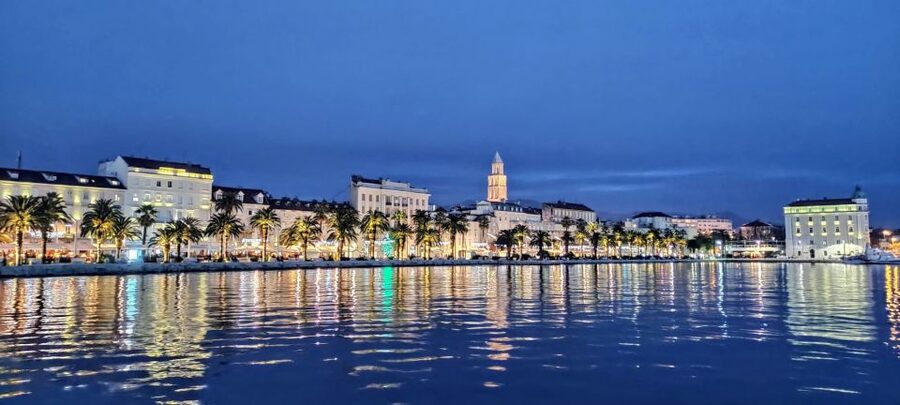
Split rewards a guide because the old center can feel confusing at first. Roman walls, medieval houses, Venetian-era squares, and modern cafés all occupy the same compact area. A casual stroll can be fun, but it may leave you wondering which stones belong to Diocletian and which came much later.
This tour gives that jumble a clear order. You begin near the Riva and move into the palace, then out through the medieval and Venetian parts of town before returning to the waterfront. The route is short enough for an evening outing, yet it covers the major sights that define central Split.
I especially like the timing. Summer evenings bring people into the shopping streets, markets, and squares, so you see Split as a living town rather than a set of empty monuments. The trade-off is that the best atmosphere comes after some sights have closed. If entering the cathedral or palace interiors is your top aim, a daytime visit may suit you better.
A few more Split days out worth weighing up
- Split: Illuminated Evening Guided Kayaking Tour
★ 4.8 · 1,622 reviews - Split: Stand Up Paddleboard Night Glow Tour
★ 4.9 · 916 reviews - Split: Sunset Boat Party with Live DJs and Blue Lagoon Swim
★ 4.5 · 638 reviews
Meeting the guide beside Diocletian’s cellars
The meeting point is in front of the entrance to the cellars of Diocletian’s Palace at Obala Hrvatskog narodnog preporoda 23. This is a useful starting place because the cellars sit right beneath the palace apartments and ceremonial areas. You begin at one of the sites that explains the whole complex.
Your guide leads the walk in English, French, or Croatian. Since this is a private group, you do not have to follow the speed of strangers. You can ask questions, pause for photographs, or request more attention to Roman engineering, religious history, or city life.
The tour is also wheelchair accessible, and steps can be avoided if necessary. Tell the guide at the start if you need a route without stairs. Comfortable shoes are still important, since the old center involves walking over historic paving and through uneven streets.
Riva: a practical start on Split’s waterfront
The first stop is Riva, Split’s long waterfront promenade. It is a natural place to get your bearings. On one side, you have the sea and cafés. On the other, the old town presses close behind its stone walls.
The guided stop lasts about 15 minutes. Use it to look back toward the palace area and understand how the waterfront connects with the old city. It also gives you an easy opening for photographs before moving into the tighter lanes.
Riva is especially pleasant in the evening, when restaurants and cafés begin to fill and the town’s social life moves outdoors. This is not a formal monument stop, and that is part of its value. You see how Split functions today before the tour turns to the emperor’s world.
Diocletian’s Palace and the Roman cellars
The main section lasts about an hour and focuses on Diocletian’s Palace. Built for the Roman emperor Diocletian, the complex was both an imperial residence and a fortified compound. Its scale is easier to grasp when you enter through the lower levels and then climb toward the ceremonial spaces.
The cellars are among the most useful places to begin. They preserve the basic shape of the palace and help explain how the upper rooms were arranged. The lower chambers also make the palace feel less like a single grand building and more like a complete Roman district with gates, corridors, storage areas, temples, and apartments.
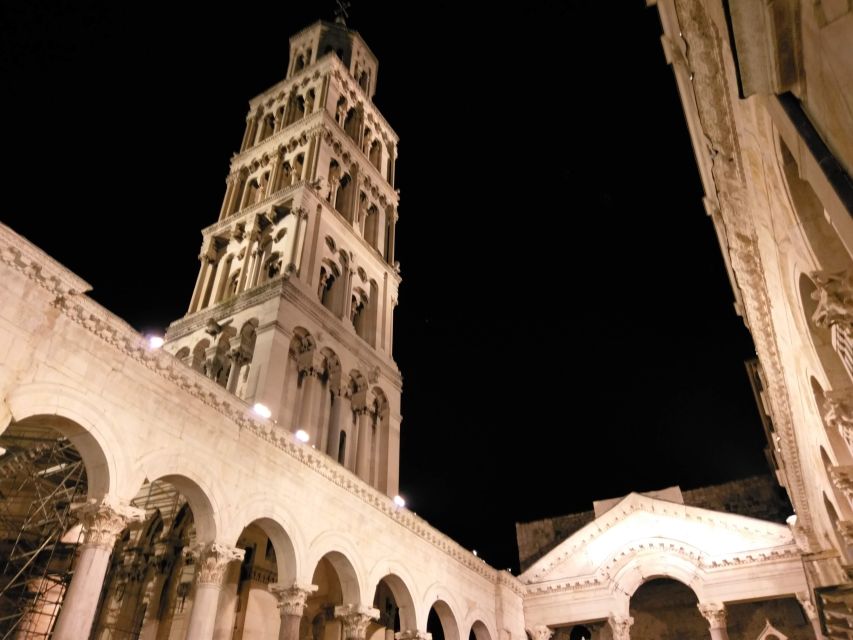
From the cellars, you walk up toward Peristyle, the palace’s central ceremonial court. This is the point where the imperial design becomes clear. The open court was meant to impress, and the surrounding stone columns and surviving architectural details still give it a strong sense of ceremony.
The route also includes the Jupiter Temple. As you move through the palace, your guide can explain how Roman religious buildings and later Christian use overlap in this small area. That change of purpose is one of the most interesting parts of Split. The city did not simply abandon the palace after Diocletian. Later residents adapted it, built into it, and gave old spaces new meanings.
Because the tour is private, you can spend more time on the palace section if this is your main interest. If you have already read about Diocletian or want a quick overview before dinner, you can keep moving at a brisker pace. The guide’s ability to adjust the walk matters here, since one person may want Roman details while another mainly wants an introduction to the city.
Same coastline, a completely different kind of day:
- Split: Krka Waterfalls Trip with Boat Cruise and Swimming
★ 4.8 · 10,519 reviews - From Split: Krka Waterfalls, Food & Wine Tasting Tour
★ 5.0 · 9,326 reviews - Blue cave, Mamma Mia and Hvar, 5 islands speedboat tour
★ 5.0 · 7,150 reviews - From Split: Krka Waterfalls, Food & Wine Tasting Tour
★ 4.9 · 6,598 reviews
St. Domnius Cathedral and Diocletian’s mausoleum
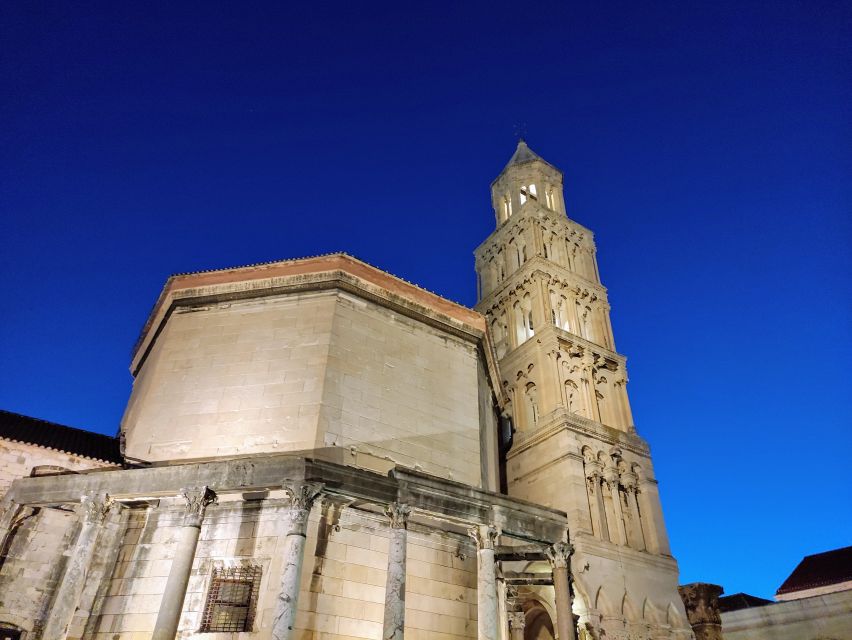
The Cathedral of St. Domnius, also called St. Duje, is one of Split’s most striking examples of old and new uses sharing one building. It was originally built as Diocletian’s mausoleum. It later became a Christian cathedral dedicated to Split’s patron saint.
That shift gives the building unusual historical weight. You are not looking at a cathedral that replaced a Roman structure nearby. The cathedral occupies the emperor’s former mausoleum, linking imperial Rome and Christian Split in one compact site.
The tour allows about 15 minutes for a photo stop. The cathedral is said to be the oldest cathedral in the world, though the evening schedule matters. Due to its operating hours, it will likely be closed during this tour. You should therefore expect to admire the exterior and hear its story rather than count on entering.
The bell tower is another important part of the view. It rises beside the cathedral and adds a strong vertical marker to the otherwise low, stone-built center. If you want interior access, check opening hours separately and plan another visit earlier in the day.
Golden Gate and the palace entrances
The Golden Gate is one of the palace’s four major entrances and receives about 15 minutes for photographs. Its position helps you understand that Diocletian’s complex was not just a private villa. It was fortified, planned, and designed with controlled entrances.
A guide is useful here because the gate can look like another attractive piece of stonework when you pass it alone. With context, it becomes part of the Roman plan and a clue to the palace’s original scale.
This stop is also a good place to pause for photographs without rushing through the next narrow lane. Keep your comfortable shoes on and expect regular walking between sights. There is no transport during the experience, which is exactly what you want in the compact old town, but the pavement can be less forgiving than a modern sidewalk.
People’s Square and the Venetian chapter
After the Roman center, the walk moves outside Diocletian’s Palace into the medieval part of Split. People’s Square, known as Piazza during the period of Venetian rule, shows how the city grew beyond the palace walls.
This change in setting is one of the tour’s strengths. You are not left with the impression that Split begins and ends with Diocletian. The city continued to develop, and its later squares and buildings are just as important to understanding local life.
The stop includes a short guided visit and photo time. Look for the contrast between the enclosed Roman lanes and the more open public space. The square provides a useful pause in the walk and a chance to see how Split’s social center shifted over time.
Evening is a good moment for this part of the route because shops, cafés, and public spaces are active. If you prefer solemn archaeological sites without modern activity around them, the setting may feel busy. If you want to see how the old center works after dark, it is a strong part of the walk.
Fruit Square and the route back to Riva
Fruit Square, or Voćni trg, is the final town-center stop. It has about 15 minutes for a visit and photographs. The name points to its market role, while the square itself helps show another layer of Split’s urban development beyond the Roman palace.
By this stage, you have moved from imperial architecture to medieval streets and Venetian public spaces. Fruit Square helps complete that transition before the walk returns to the waterfront.
The tour ends back at Obala Hrvatskog narodnog preporoda 15b, close to the Riva. That is convenient if you want to continue the evening with dinner or a drink. Guide Zrinka is also noted for offering restaurant recommendations, which can be useful when you reach the end of the walk and are ready to eat.
What the private format is worth at $129
The price is $129 per group of up to 20 people, not $129 per person. For a full group, that works out to less than $6.50 per person. Even for a smaller family or party, the fixed price buys something useful: your own guide, your own questions, and no need to match a large group’s pace.
The value is strongest for families, friends, cruise groups, and extended parties who want a shared introduction to Split. A private tour can also help if some people in your group walk slowly, need to avoid stairs, or want to focus on a particular period.
For one or two people, the cost is higher per person than a shared walking tour. The benefit is control. You can ask for a slower pace, spend more time on the palace, or move quickly through stops that interest you less.
Entrance fees to the cathedral and Diocletian’s Palace are not included. In practice, the evening schedule means you may not be able to enter the cathedral during this walk anyway. Check the current opening arrangements if interior access is essential, and treat this experience mainly as a guided orientation through the old city and its exterior sights.
Who will get the most from this tour
I would choose this walk if you have only one evening in Split and want a clear introduction without giving up the pleasure of wandering. The route covers the essential center, but it also leaves you at Riva, where you can continue on your own.
It suits first-time visitors especially well. Split’s old town has layers that are easy to miss, and the guide connects the palace to the later squares rather than presenting each sight as an isolated stop.
Families may appreciate the private format and the option to avoid stairs. Larger groups get good value from the group price. Couples and small groups should choose it if personal attention matters more than finding the lowest possible per-person cost.
I would look elsewhere if your chief aim is to enter every major building. The cathedral will likely be closed, and entry fees are separate. A daytime visit or a tour designed around interior access would be a better match for that goal.
Practical details for a smoother evening
Wear comfortable shoes. The tour is only two hours, but it includes steady walking through the palace, squares, and old streets.
The starting point is in front of the palace cellar entrance at Obala Hrvatskog narodnog preporoda 23. Arrive ready to identify the guide there, since the old town has several nearby entrances and busy evening foot traffic.
French, English, and Croatian are available. If you need to avoid stairs, mention it before the route begins. The tour is private, and the route can be adjusted when necessary.
You can cancel up to 24 hours in advance for a full refund, and you can reserve now and pay later. Those terms help if your Split plans depend on weather, ferry timing, or a changing travel schedule.
Should you book the Magical Evening Sightseeing Private Tour?
Book it if you want a well-paced introduction to Split’s Roman and medieval center, especially with family or a larger private group. The palace cellars, Peristyle, Jupiter Temple, cathedral exterior, Golden Gate, People’s Square, Fruit Square, and Riva make a sensible two-hour route.
Skip it if you mainly want cathedral interiors or a long archaeological visit. For everyone else, the private format, flexible pace, evening atmosphere, and useful restaurant advice make this a practical first look at Split. Just set your expectations correctly: you are buying a guided walk through a living old town, not a late-night museum visit.
FAQ
How long does the Split evening tour last?
The tour lasts two hours.
How much does the private tour cost?
The price is $129 per group of up to 20 people.
Which languages are available?
The live guide can conduct the tour in English, French, or Croatian.
Where does the tour meet?
Meet in front of the entrance to the cellars of Diocletian’s Palace at Obala Hrvatskog narodnog preporoda 23, 21000 Split.
Are palace and cathedral entrance fees included?
No. Entrance fees to the Cathedral of St. Domnius and Diocletian’s Palace are not included. The cathedral will likely be closed during the evening tour because of its operating hours.
Is the tour accessible for wheelchair users?
Yes, the activity is wheelchair accessible, and steps can be avoided if necessary.
Just added around Split
- From Makarska : Wine Tasting Grabovac Tour★ 4.5 · 30 reviews
- Essential Diocletian’s Palace Tour for First-Time Visitors★ 4.8 · 19 reviews
- Unique vintage Tomos moped tour Split – Back to the ’80s★ 4.8 · 17 reviews
- Walking Tour Split★ 4.7 · 61 reviews
- Trogir; Private walking tour of higlights of Trogir★ 4.7 · 3 reviews
- Trogir: White Lagoon, Maslinica & Blue Lagoon Speedboat Tour★ 4.8 · 11 reviews
- Trogir 1.5-Hour City Tour★ 4.4 · 37 reviews
- Split: Trogir Open Top Bus Trip + Free Split Walking Tour★ 4.1 · 17 reviews
Evening Experiences, compared.

Split: Sunset Boat Party with Live DJs and Blue Lagoon Swim
Read our review →

Split: Riviera Sunset Cruise & Swim with Summer Vibes
Read our review →

Split Riviera Panoramic Sunset Cruise with Summer Vibes on Boat
Read our review →
Split: Guided Sunset Sea Kayaking & Snorkeling Tour
Read our review →Browse the lists this tour appears in