
Reviewed · DIOCLETIAN'S PALACE TOURS
Split: Old Town and Diocletian Palace Walking Tour
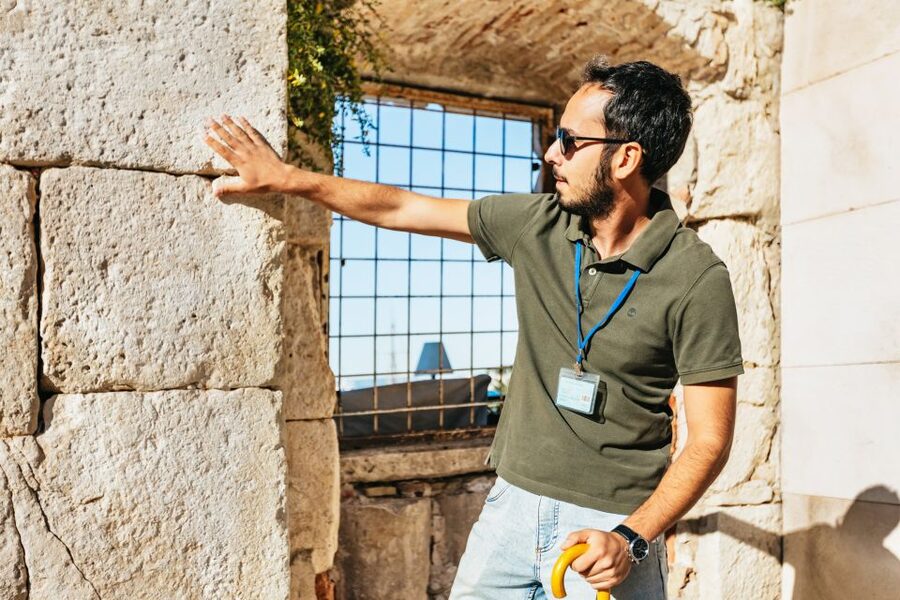
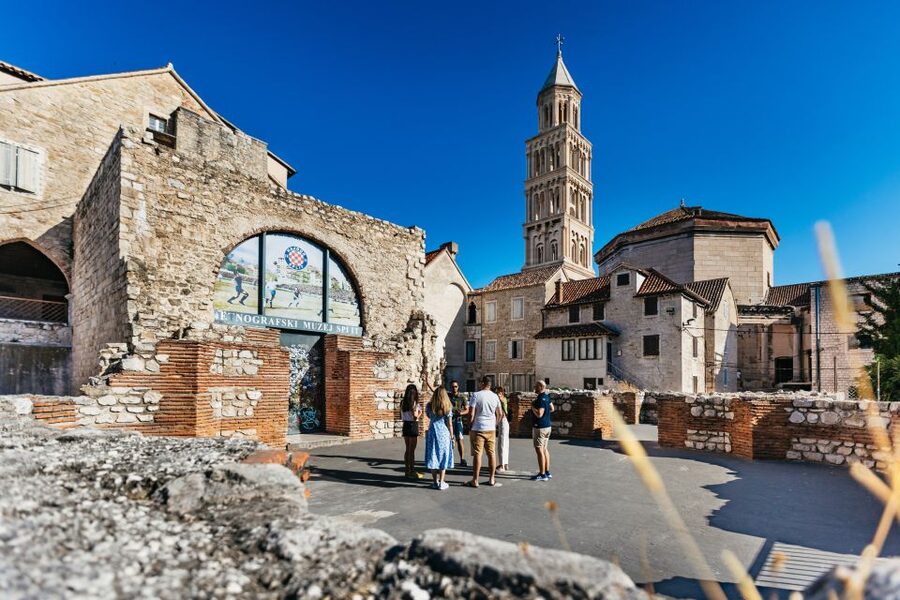
Split’s Old Town is not a museum sealed behind glass. It is a living city built into the remains of a Roman emperor’s retirement palace. That is the main reason this tour works: a local guide helps you read the streets, walls, courtyards, and homes that can otherwise look like a jumble of old stone.
I like the way the route joins Diocletian’s Palace to everyday Split, especially the walk from the Peristyle to the Riva promenade. I also like the local advice built into the experience. Guides such as Mia, Slavko, Antonia, and Ivana have helped visitors choose restaurants, avoid tourist traps, and get their bearings early in a stay.
The main consideration is the range of options. The basic walk lasts about 90 minutes, while some bookings run as long as six hours and may include food, wine, or a trip to Trogir. Check exactly what your chosen option includes, since the meeting point and price can vary.
Key points to know before booking
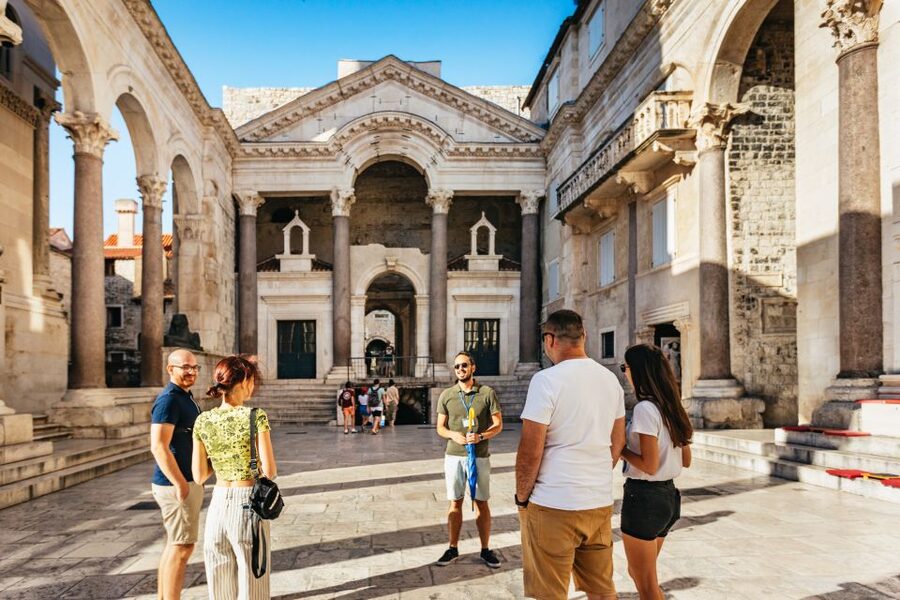
- The palace is still a neighborhood: You walk through Roman remains mixed with shops, homes, cafés, and narrow lanes.
- The Peristyle is the visual center: Open colonnades frame the palace’s grand central square.
- Local guides add the missing context: Mia, Slavko, Antonia, Ivana, and others explain architecture, Croatian history, and modern Split.
- The Riva gives the tour breathing room: Finish beside the Adriatic with views toward Marjan Hill.
- Optional add-ons change the day: Depending on your booking, food tasting, wine tasting, or Trogir may be included.
- Plan for walking on old surfaces: Comfortable clothes are advised, and the tour is not suitable for wheelchair users.
Why Diocletian’s Palace makes a better walking tour than a quick photo stop
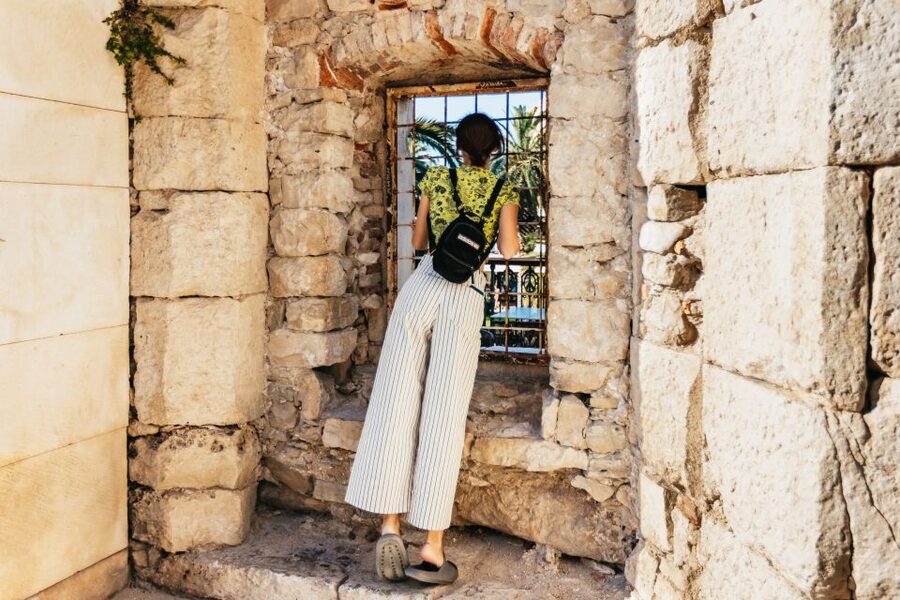
You can walk into Split’s Old Town without paying for a tour. You can also take plenty of photographs without knowing what you are looking at. The problem is that Diocletian’s Palace has been altered, reused, and absorbed into the city for roughly 1,700 years. Its Roman purpose is not always obvious at street level.
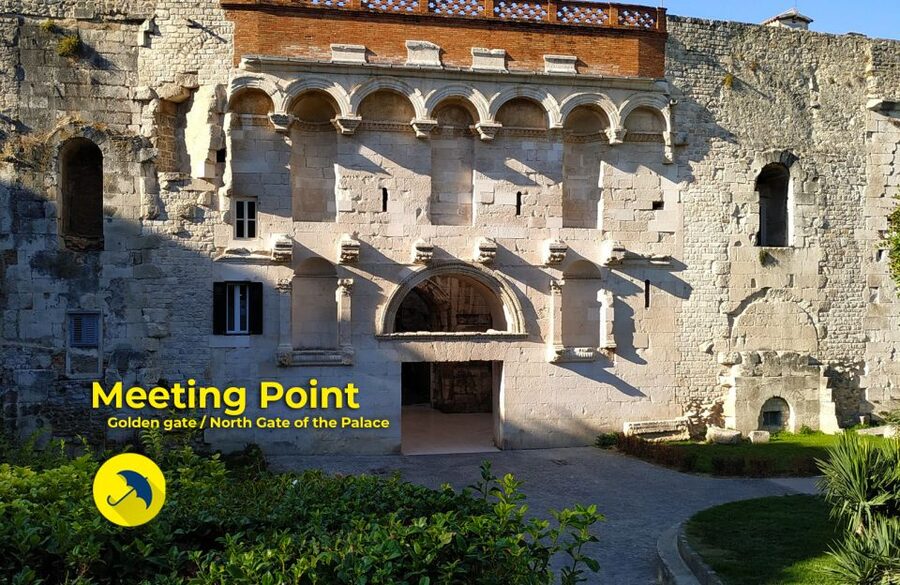
A guide gives you a basic map of the place. The Golden Gate, where the tour begins and ends, is one of the palace’s main entrances. From there, the route leads toward the Peristyle, the central square with open colonnades, and then through later parts of the complex.
That sequence matters. You are not simply ticking off monuments. You are seeing how an imperial residence became the core of a medieval town and then the center of modern Split. Homes, businesses, religious buildings, and public spaces share the same ancient framework.
I especially value this kind of explanation for first-time visitors. Several guides use stories, humor, personal memories, and local examples rather than giving a dry list of dates. Slavko is often praised for combining Roman history with wider Dalmatian and Croatian context, while Mia is known for a friendly style and practical suggestions. Antonia is described as a lively storyteller, and one guide, Ivana, brings personal stories and enthusiasm for her country.
The large number of five-star ratings, with an overall score of 4.9 from 4,727 ratings, points to a consistent strength: the guides make the history easier to follow and more enjoyable to hear. That does not mean every guide will use the same style, but the experience clearly depends on the person leading it.
More ways to see Diocletian's Palace:
- Walking Tour of Split and Diocletian’s Palace
★ 5.0 · 2,588 reviews - Split & Diocletian’s Palace Walking Tour
★ 5.0 · 1,125 reviews - Split: Diocletian Palace & Old Town Guided Walking Tour
★ 4.7 · 882 reviews
Starting at the Golden Gate
The Golden Gate is a sensible meeting place because it gives you an immediate sense of the palace’s scale. Confirm the exact meeting point on your booking, since it may differ by option, but the main route begins here.
The gate is more than a place to gather. It helps you understand that Diocletian’s Palace was planned as a fortified imperial residence, not just a grand house. As you move inside, the clean Roman idea of a palace gives way to the untidy charm of a lived-in Old Town.
This is also where a guide can help you avoid a common mistake: expecting the palace to look like a single preserved building. It does not. The complex forms about half of Split’s Old Town, and later generations built into it. The result is fascinating, but it can be confusing without a guide pointing out which parts belong to the Roman plan and which parts reflect later use.
If you arrive before the tour, take a moment to notice how people use the area. Split’s ancient core is not removed from local life. That everyday setting is one of the experience’s best features.
The Peristyle and the palace’s Roman center
The Peristyle is likely to be the tour’s strongest visual moment. Its open colonnades surround a formal central square and give you a feel for the palace’s original grandeur.
Here, the guide can explain how the square fit into the imperial complex and why its design still matters. You get architecture, political history, and a useful sense of scale in one stop. The Peristyle also shows why a short guided visit is more useful than wandering with only a phone map. The stones are impressive, but the arrangement and purpose are not always self-explanatory.
Expect some time standing while the guide talks. In warm weather, that can matter. One guide, Martha, was praised for finding shaded places for the group, which is a practical touch on a sunny day. Still, bring comfortable clothing and be ready for uneven or old walking surfaces.
The tour is suitable for all ages, but it is not suitable for wheelchair users. The historic setting includes narrow routes and surfaces that can make access difficult.
Saint Domnius Cathedral and the layers of time
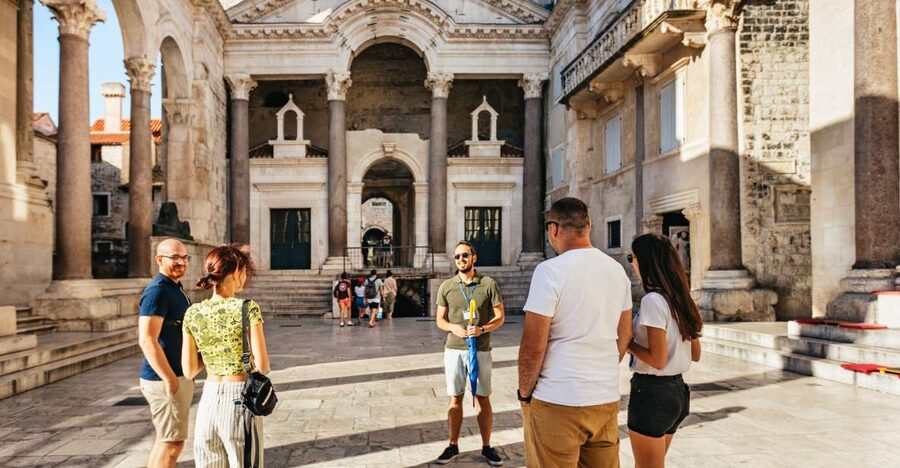
The route continues to Saint Domnius Cathedral, one of Split’s key landmarks. It is presented as the oldest Catholic cathedral in the world that remains in use in its original form.
The important point is not only the age of the building. The cathedral helps show how the palace changed function. A structure created for an emperor became part of a Christian city, and the old Roman setting gained new religious meaning.
Your guide will place the cathedral within the larger route rather than treating it as an isolated stop. That context is useful because the Old Town can otherwise feel like a collection of unrelated monuments. The cathedral, the palace, and the streets around them all belong to the same long story.
If you want a detailed interior visit, check what your selected option covers. The supplied tour details promise a guided walk and the sights along the route, but they do not state that every admission or extended interior visit is included.
More walks through the old quarter in Split:
- Krka Waterfalls tour with Trogir Walking tour and Krka panoramic boat cruise
★ 5.0 · 1,659 reviews - Walking Tour of Split with a ‘Magister’ of History
★ 5.0 · 1,122 reviews - Split Walking Tour with Professor of History
★ 5.0 · 926 reviews - From Split: Krka Waterfalls Cruise & Trogir Walking Tour
★ 4.7 · 681 reviews
Gregory of Nin and the human side of Split

At Giardin Park, the tour pauses by the statue of Gregory of Nin. This stop adds a local figure to the grander Roman and religious history.
Gregory of Nin is connected to the Bishopric of Nin, and his statue has become one of the city’s familiar sights. The guide explains the story behind it and gives you a break from looking only at walls and columns.
This is the sort of stop I appreciate on a city walk. It shifts the focus from emperors and monuments to Croatian identity and local memory. The statue also gives the guide room to discuss Split as a Croatian city, not merely as an ancient site preserved for visitors.
Several guides have been praised for going beyond palace facts and explaining Croatian and Dalmatian history. That wider setting makes the tour more useful if you are staying in the region for several days.
Along the Riva toward Marjan Hill
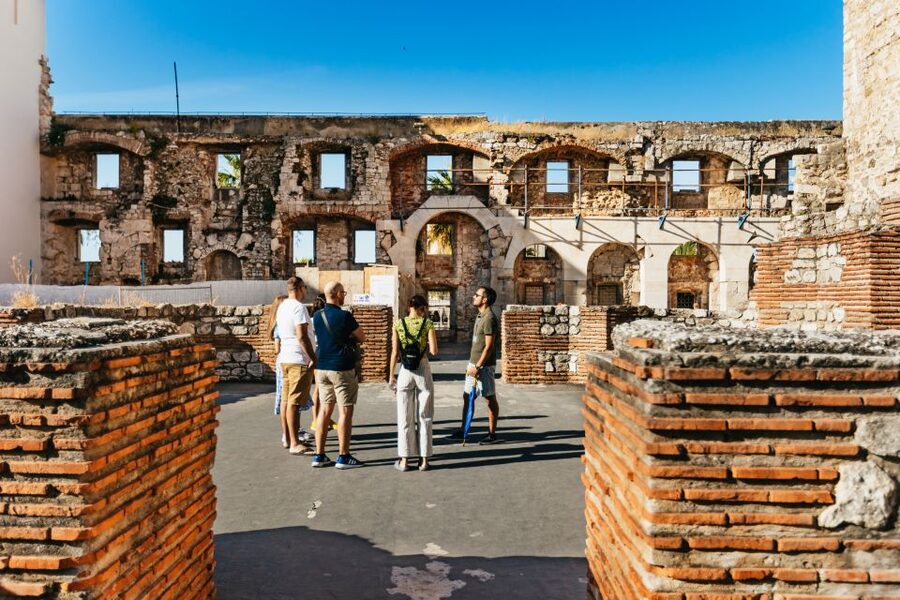
The walk eventually reaches the Riva promenade, Split’s broad waterfront. After the enclosed lanes of the Old Town, the open view is a welcome change.
From the Riva, you can look toward Marjan Hill and the Adriatic Sea. The stop gives the tour a clear ending point and lets you see how the palace sits within the modern city. Split is not only its Roman core. It is also a coastal city with an active public waterfront.
This part of the walk is less about ancient stone and more about orientation. If you take the tour near the start of your stay, you will have a better sense of where the Old Town ends and the waterfront begins. Guides also often offer suggestions for places to eat and other sights to visit, which can help you plan the rest of your time.
One practical tip from the available feedback is to consider a sunset departure if you are not visiting Split from a cruise ship. That timing may offer cooler conditions and fewer people, though starting times depend on availability.
The tour finishes back at the Golden Gate. Returning to the starting point makes it easy to continue exploring on your own afterward.
What the guides add to the experience
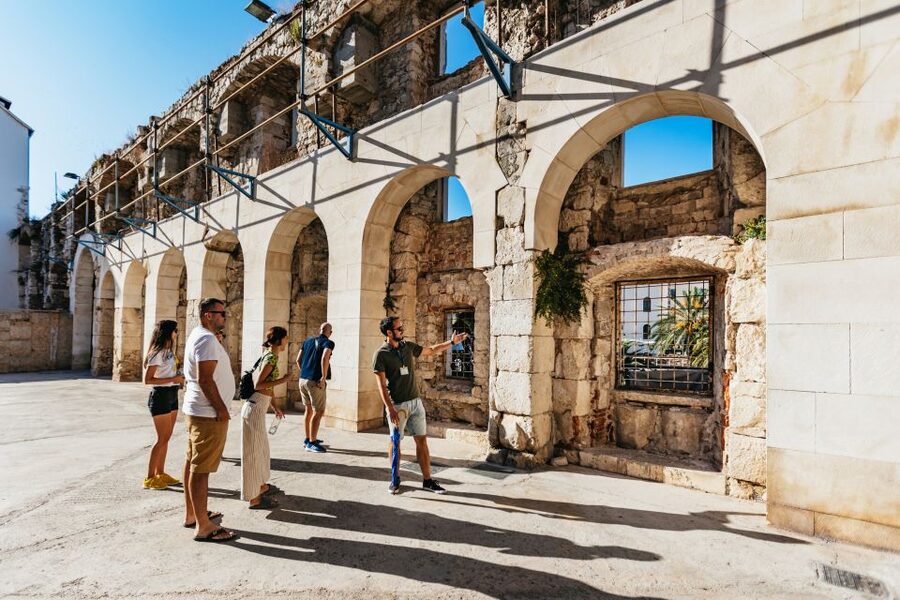
The guide is the heart of this tour. The route itself is compact, but the quality of the explanation determines whether it feels like a history lesson or a walk through a living city.
The strongest pattern in the feedback is the combination of clear information and humor. Slavko is repeatedly praised for his command of Diocletian’s Palace, Croatian history, and architecture. Mia is described as friendly, funny, and easy to understand. Antonia is often noted for her storytelling and practical food advice.
Local background can add another layer. One guide grew up inside Diocletian’s Palace, and another guide was described as a Split resident who knew the area exceptionally well. Those details matter because they connect the monument to ordinary life. You are not only hearing what the palace was in 305 CE. You are also hearing how Split understands it today.
The guides speak English, Italian, Spanish, German, and French. Private groups are available, so you can choose a more personal format if that option suits your group. The standard experience may be more social, and some groups are small. One group had only six people, while another last-minute booking ended up with just two guests and a guide.
Do not assume that every guide will use the same stories or pace. The names assigned to tours can vary, and your guide may be Mia, Slavko, Antonia, Ivana, Ante, Tino, Frane, Martha, or another member of the team. The repeated praise for different guides suggests a broad strength across the staff, but the individual style will still differ.
Choosing between 90 minutes and a longer option
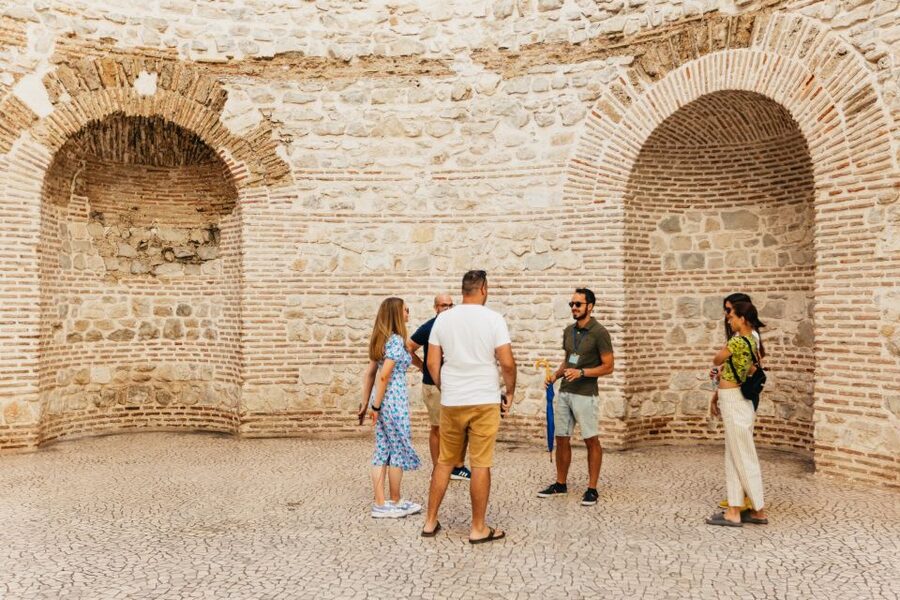
The 90-minute walk is the clearest choice if you want an introduction to Split’s Old Town and Diocletian’s Palace. It covers the central sights and should leave you with enough time to explore independently.
I would choose this version for a first afternoon, a short stay, or a cruise port visit. It gives you the palace’s basic structure, the cathedral, Gregory of Nin, and the Riva without taking over your day.
Longer options can last up to six hours. These may include food tasting, wine tasting, or an arranged trip to Trogir, depending on the option selected. One extended booking included Trogir, described as a worthwhile 40-minute drive with a different character and feel from Split.
The longer format makes sense if you want one organized day rather than several separate activities. It is less suitable if you prefer to stop whenever you like or spend a long time inside one monument. Read the option details carefully, especially for inclusions, meeting point, and total duration.
Food and wine tasting are not part of every booking. They are listed as included only if the selected option contains them. Hotel pickup is not included, so you will need to reach the meeting point yourself.
Is the $17 price good value?
At $17 per person, the basic tour is priced modestly for a guided introduction to one of Croatia’s most important historic centers. The value comes from interpretation rather than transport or admission extras.
You are paying for a local guide, a walking route, and a clear explanation of places that can be difficult to understand alone. If you only want photographs, you can spend less by walking independently. If you want the palace’s Roman plan, later religious use, and modern Croatian setting explained in one go, the fee is reasonable.
The price comparison changes when you select a longer option with food, wine, or Trogir. Those extras can make the day more useful, but check the exact contents before paying. The advertised price of $17 should not automatically be assumed to cover every extended format.
Free cancellation is available up to 24 hours before the start time, and you can reserve now and pay later. Those terms are useful if your Split schedule may shift, though you should still confirm the conditions for the specific option you choose.
Who will get the most from this tour?
I would recommend the tour most strongly to first-time visitors who want a fast, clear introduction to Split. It is also a good fit for anyone who sees old stone but wants help understanding how the pieces connect.
Families can use it as a structured way to cover the Old Town, since the activity is suitable for all ages. The guides’ use of humor, stories, and questions can help keep the walk moving for younger visitors, although the tour still involves standing and walking.
History fans will appreciate the Roman and religious context. Food-focused visitors may prefer an option that includes tasting, while people with a full day free can consider the Trogir extension.
You may not need it if you already have a strong background in Split and prefer to explore quietly at your own pace. You should also think carefully about accessibility, since the tour is not suitable for wheelchair users.
Should you book the Split Old Town and Diocletian Palace Walking Tour?
Book it if you want context, local advice, and an efficient first look at Split. The 90-minute version is especially good value at $17 and leaves you free to return to the places that catch your interest.
Choose a longer option only if you specifically want the food, wine, or Trogir additions. For the best balance, I would take the basic walk early in your stay, listen for restaurant and sightseeing suggestions, then explore the palace again on your own. The stones are impressive by themselves, but the guide helps you see the city that grew around them.
FAQ
Where does the tour begin?
The standard route begins at the Golden Gate of Diocletian’s Palace and finishes there. The exact meeting point may vary depending on the option booked.
How long does the tour last?
Available options range from about 90 minutes to six hours. Check the selected option for the exact duration and starting time.
What sights are included?
The route includes Diocletian’s Palace, the Peristyle, Saint Domnius Cathedral, Gregory of Nin’s statue in Giardin Park, and the Riva promenade. You also get views toward Marjan Hill and the Adriatic Sea.
Which languages are available?
Live guides are available in English, Italian, Spanish, German, and French.
Is hotel pickup included?
No. Hotel pickup is not included, so you need to reach the designated meeting point.
Are food and wine included?
Food tasting and wine tasting are included only if you select an option that offers them. They are not part of every tour.
Is the tour suitable for children?
Yes. The activity is stated to be suitable for all ages.
Can wheelchair users join?
No. The tour is not suitable for wheelchair users.
Just added around Split
- From Makarska : Wine Tasting Grabovac Tour★ 4.5 · 30 reviews
- Walking Tour Split★ 4.7 · 61 reviews
- Essential Diocletian’s Palace Tour for First-Time Visitors★ 4.8 · 19 reviews
- Unique vintage Tomos moped tour Split – Back to the ’80s★ 4.8 · 17 reviews
- Trogir; Private walking tour of higlights of Trogir★ 4.7 · 3 reviews
- Trogir: White Lagoon, Maslinica & Blue Lagoon Speedboat Tour★ 4.8 · 11 reviews
- Trogir 1.5-Hour City Tour★ 4.4 · 37 reviews
- Split: Trogir Open Top Bus Trip + Free Split Walking Tour★ 4.1 · 17 reviews
Diocletian's Palace Tours, compared.
Walking Tour of Split and Diocletian’s Palace
Read our review →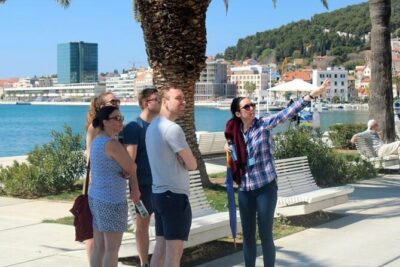
Split: Diocletian Palace & Old Town Guided Walking Tour
Read our review →
Split: Game of Thrones Tour with Diocletian’s Palace Cellar
Read our review →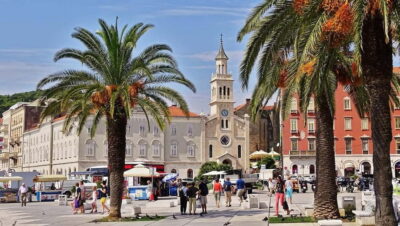
Diocletian’s Palace and Old Town SMALL GROUP Walking Tour
Read our review →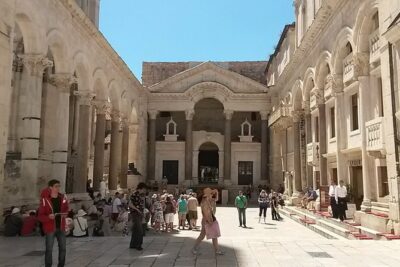
SPLIT-PRIVATE Walking Tour of Diocletian’s Palace & Old Town
Read our review →

Split: Diocletian’s Palace Virtual Reality Experience
Read our review →Browse the lists this tour appears in