
Reviewed · SPLIT OLD TOWN WALKING TOURS
Walking Tour of Split with a ‘Magister’ of History
Split is easiest to understand when you stop treating Diocletian’s Palace as a single ancient monument. It is a living city built inside Roman walls, with medieval lanes, Renaissance courtyards, Venetian palaces, and everyday cafés tucked among the ruins. Toni Šare makes that long story readable, using his own 3D reconstructions to show what the palace looked like before time and later residents changed it.
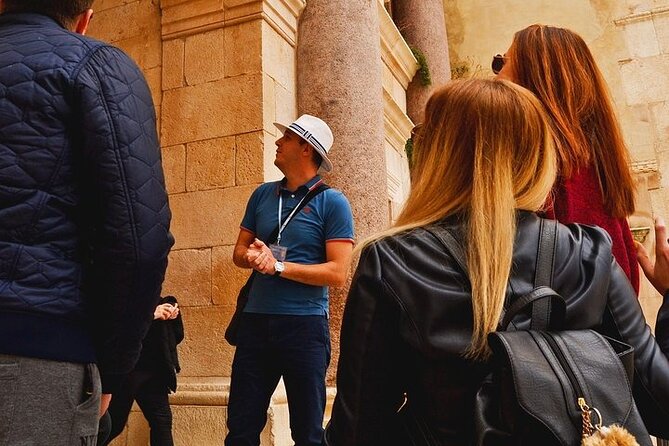
I like the tour’s strong historical focus and its compact route through the old center. I also like that Toni was born in Split, studied and taught history, and brings local culture into the story rather than giving you only a list of Roman dates. The main consideration is that paid interiors are not included, so you will see the Cathedral of Saint Domnius and the Temple of Jupiter from outside.
- See Diocletian’s Palace through 3D reconstructions, not just surviving stones.
- Walk from the Riva to Pjaca, covering the palace, gates, squares, and noble courtyards.
- Hear Roman, medieval, Renaissance, Venetian, and modern history in one connected story.
- Meet Toni Šare, the owner of DiocleSpot Tours and a Split-born historian.
- Keep the group manageable, with a maximum of 18 people and a private-tour upgrade available.
- Use the tour as an orientation walk, then return to the places you want to explore inside.
Why Toni’s 3D Palace Images Matter
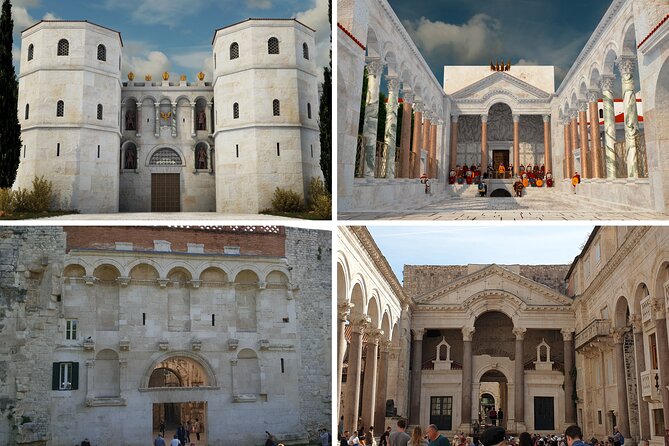
The best part of this experience is not simply reaching the Peristyle or standing beneath the Golden Gate. You can do that on your own. The real gain is learning how to read what you are seeing.
Roman ruins can be hard to picture. A broken wall does not always tell you where a statue once stood, how a courtyard was decorated, or how an emperor’s residence connected to the rest of the complex. Toni uses his own 3D reconstructions to fill in those gaps. The images give you a clearer sense of Diocletian’s Palace in its imperial period, before later residents adapted its rooms and passageways.
I find this especially useful in Split because the palace is not preserved as a quiet archaeological site. It became part of the town. People live, work, eat, shop, and walk through it. That is part of the charm, but it can also make the original plan difficult to follow.
Toni also brings in the centuries after Diocletian. You will hear about the palace as a medieval settlement, later Renaissance buildings, Venetian influence, and the way local families used Roman structures. This broader approach gives the walk more balance than a tour focused only on the emperor and his retirement residence.
Starting Beside the Riva at the Brass Gate
The tour begins at the Brass Gate, also called Porta Aenea, on the Riva Harbor. This is a practical meeting point near Split’s waterfront, and the opening view immediately puts the palace in context.
The Riva is Split’s main promenade and a central gathering place for local life. From here, you can look toward the southern wall of Diocletian’s Palace, which faces the sea. Toni uses models and graphic material to explain what you will see once you enter the palace.
That introduction matters because the southern wall looks less like a traditional fortress than the northern, eastern, and western sides. The palace was designed as both an imperial residence and a fortified complex, with the sea forming one edge. Starting outside helps you understand the whole structure before the narrow streets begin to break it into pieces.
The opening stop lasts about 15 minutes. It is also a good place to get oriented if Split is new to you. The tour then moves into the old center on foot, with no transport between stops.
More walks through the old quarter in Split:
- Split: Old Town and Diocletian Palace Walking Tour
★ 4.9 · 4,727 reviews - Walking Tour of Split and Diocletian’s Palace
★ 5.0 · 2,588 reviews - Krka Waterfalls tour with Trogir Walking tour and Krka panoramic boat cruise
★ 5.0 · 1,659 reviews
The Peristyle, Split’s Roman Center
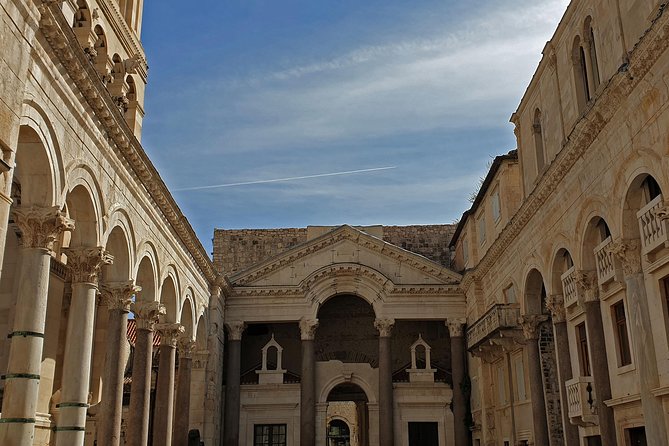
The Peristyle is the ceremonial heart of Diocletian’s Palace and one of the most important public spaces in modern Split. The square contains some of the city’s best-preserved Roman remains, but its present-day use is just as interesting. You are standing in an ancient imperial setting that still functions as part of the city.
Toni’s reconstructions help you picture the original decoration and arrangement. Look closely at the stonework and the surrounding walls while he explains which parts remain Roman and which belong to later periods.
The stop lasts around 10 minutes. That is enough for an introduction, though not enough for a slow architectural study. If you want quiet photographs, you may need to return later on your own. The tour is designed to explain the space, not give you unlimited time to linger at every column.
Saint Domnius and the Former Imperial Mausoleum
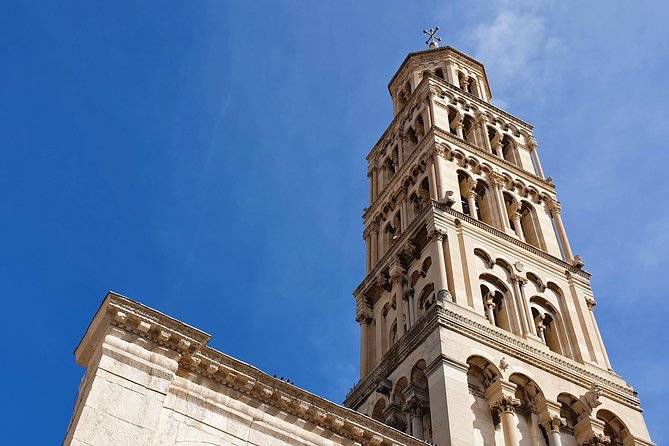
The Cathedral of Saint Domnius began life as the mausoleum of Emperor Diocletian. Its continued use as a cathedral makes it one of Split’s clearest examples of changing purpose over time.
Toni explains how Christians converted the imperial tomb and how the bell tower relates to the building. You will learn about the shift from Roman imperial monument to Christian place of worship without entering the interior.
That last point is important. Admission is not included, and the tour does not go inside. You get the historical explanation and an exterior view, then you can decide if you want to pay for a separate visit later.
I like this arrangement for an introductory walk because it keeps the price under control. Still, if your priority is the cathedral interior or bell tower views, allow extra time and money after the tour. The walk itself does not cover those paid experiences.
The Temple of Jupiter and Roman Building Errors
The Temple of Jupiter is another well-preserved late Roman structure. From outside, Toni points out details that are easy to miss, including construction irregularities and mistakes made by the Roman builders.
That is a useful change of pace. Ancient sites are often presented as if every stone was placed perfectly. Seeing flaws and oddities makes the building process feel more human. It also gives you something specific to look for when you return.
The temple interior is not included. Toni covers the relevant points from outside, so you will need a separate ticket if you want to enter. The stop lasts about 15 minutes, enough for explanation and questions without turning the walk into a lengthy architectural lecture.
More history walks in Split:
- Split Walking Tour with Professor of History
★ 5.0 · 926 reviews - Split: History and Heritage Walking Tour
★ 4.9 · 650 reviews - Split History and Gastro Small-Group Tour with Food and Drinks
★ 5.0 · 375 reviews - SPLIT-PREMIUM Emperor’s Walking Tour for History Lovers + Museum
★ 5.0 · 333 reviews
The Silver Gate and a View of the Original Road
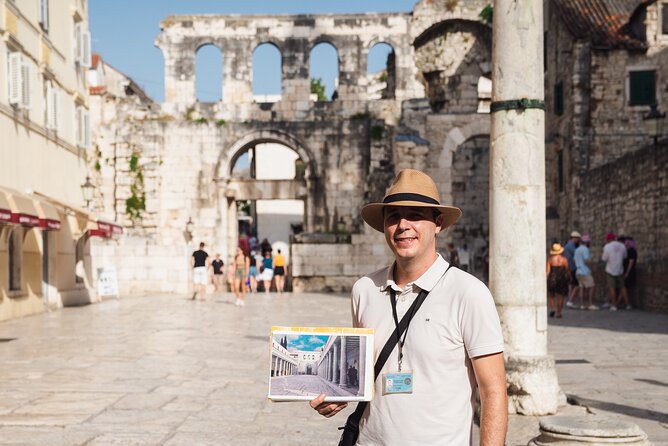
At the Eastern, or Silver, Gate, the route opens into one of the best viewpoints over the palace complex. From here, you can see the Cathedral on one side, the gate on the other, and a surviving section of the original Roman road below.
This is one of the stops where the pieces begin to connect. The palace was not just a collection of attractive ruins. It had entrances, routes, defensive walls, and a clear internal plan. The gate also shows how later Split continued to use the Roman structure rather than discarding it.
The stop is brief, about five minutes. Toni uses it as a sharp visual explanation rather than a long pause, which keeps the walk moving.
Grgur Ninski and the Croatian Story
The statue of Grgur Ninski is a familiar Split landmark. Toni explains the figure’s importance to Croatian language and culture during the early medieval period.
This stop helps widen the story beyond Rome. Split’s identity did not end with Diocletian, and the city’s medieval period shaped its language, politics, and public memory. The statue also gives you a connection to Croatian history that you might miss if you focus only on the palace stones.
The stop lasts about five minutes. It is a short explanation, but it provides a useful bridge between the Roman and later chapters of the city.
The Vestibule and Diocletian’s Private Residence
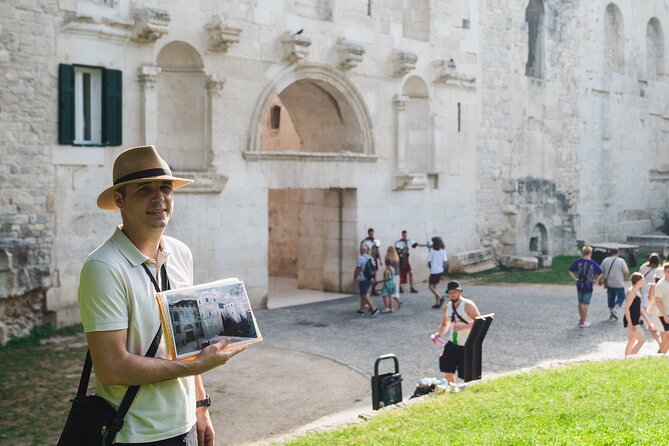
The Vestibule was an entrance to Diocletian’s private residential area. From here, Toni leads you around the remains of the emperor’s personal section of the palace.
This is where the 3D material becomes especially useful. It can be difficult to understand how a private residence operated when only fragments remain. Toni’s reconstructions help you imagine the scale and arrangement without pretending that every missing detail is certain.
The visit to this area takes about 10 minutes. Expect close views of ancient structures and an explanation of how the imperial residence fitted into the wider palace. The route also passes a number of noble palaces from later periods, showing how Split’s residents reused and built over the old complex.
Noble Palaces and Venetian Split
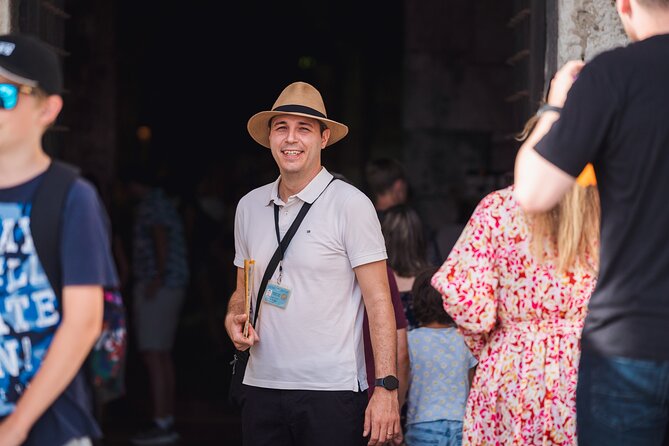
One of the quieter strengths of this tour is its attention to the later buildings inside and around the palace. Split is famous for Roman remains, but the city also contains medieval, Renaissance, and early modern architecture.
As you walk, Toni points out the palaces of noble families. You also visit the courtyard of the City Museum of Split, which occupies a well-preserved Renaissance noble palace. The museum itself is not included, but the courtyard gives you a chance to see the building from within.
Toni uses this setting to explain Venetian influence. That is a valuable addition because the city’s architecture cannot be understood through Roman history alone. The later palaces show how wealth, power, and changing political control shaped Split after antiquity.
If Renaissance courtyards and local urban history interest you, this section may be one of the most rewarding parts of the walk. If you want only Roman archaeology, it may feel like a detour, but it is a necessary one for seeing the city as a lived-in place.
Game of Thrones Locations Along the Route
The walk passes several filming locations associated with Game of Thrones. Toni points them out if the group is interested, and the route also passes the fan shop.
This is an optional layer, not the central purpose of the experience. The historical material comes first. Still, fans will appreciate seeing how the old streets and palace spaces were used on screen. Those locations make more sense when you know the buildings were not created as a film set. They are real parts of Split’s old center.
The fan shop is simply passed on the route, not presented as a separate attraction. If your main reason for visiting Split is the show, this walk can add context, but you may want a more specialized film-focused activity for a full television-location experience.
The Golden Gate and the City’s Northern Wall
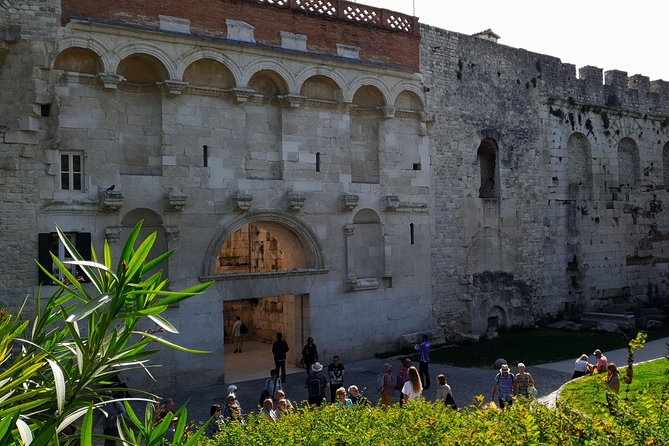
The Golden Gate is the most decorated and best-preserved of the palace’s four main entrances. It is also one of the clearest places to see the northern wall.
Toni explains how the medieval city continued to use Roman structures for defense. You can also see evidence of later changes, including parts removed because they were no longer needed. This is a practical lesson in urban history: old walls survive not because a city leaves them untouched, but because later residents find new uses for them.
The stop lasts about 15 minutes. It is a good place for photographs and for taking in the scale of the northern side. The Golden Gate can be busy, so stay close enough to hear Toni, especially if the group reaches the gate during a crowded period.
Finishing at Pjaca and the Old Town Hall
The tour ends at Narodni trg, known locally as Pjaca or Piazza Square. This has been the main square of the city since medieval times.
The 14th-century Old Town Hall and nearby structures give the final stop a different character from the Roman sections. You finish with the city’s medieval civic center rather than beside another imperial ruin.
I like this ending because it gives you a useful base for the rest of your day. From Pjaca, you can easily reach other parts of the old center, return to the palace, find a restaurant, or continue on your own. Toni’s recommendations after the walk can also help you choose what deserves a closer look.
Price, Pace, and Group Size
The tour costs about $34.83 per person and lasts roughly 1 hour 40 minutes to 1 hour 50 minutes. For that price, the main value is Toni’s interpretation, not admission to monuments. You are paying for a guided explanation of the city’s layers, plus his own visual material.
That is a fair trade if you want context and do not need every paid interior included. It is less useful if you prefer to move independently, take long photographs, or spend most of your time inside museums.
The group can include up to 18 people. That is not a private walk, but it is small enough for questions if everyone stays together. A private upgrade is available for people who want more control over the pace or a more personal format. Group discounts may also help if you are booking for several people.
The route is on foot through the old center. Wear comfortable shoes, and consider booking an early or evening departure in warm weather. One evening walk was specifically valued for avoiding the summer heat, while a morning outing can help you learn the city’s layout before exploring independently later.
Who Will Get the Most From This Walk
I would choose this tour for a first visit to Split, especially if you want to understand what you are seeing before returning to individual sites. It suits history fans, architecture lovers, and anyone who prefers a clear story to a quick photo stop.
It is also a good fit for people who enjoy a guide with a strong personal connection to the city. Toni’s local background adds modern and cultural context, while his training in history gives the Roman and medieval material structure.
Families and mixed-interest groups may also find the route useful because it covers several eras and can include Game of Thrones locations when wanted. The 100 percent recommendation rate and 5 out of 5 score from 1,122 ratings show unusually strong satisfaction, but the practical limits still matter: paid sites are excluded, and the walking route may feel brisk if you want to stop everywhere.
Most people can take part, and service animals are allowed. Confirmation arrives at booking. Free cancellation is available up to 24 hours before the start time, while poor weather may lead to another date or a full refund.
Should You Book Toni’s Split Walking Tour?
Book it if you want Split to make sense, not just look impressive. Toni’s 3D reconstructions, local background, and attention to Roman, medieval, Renaissance, Venetian, and modern stories give you a useful framework for the old center.
Skip it if you already know the palace well, want to enter several paid attractions during the walk, or prefer exploring without a fixed route. For most first-time visitors, though, this is a strong opening activity. Take it early, use the final stop at Pjaca to plan the rest of your day, and return later to the cathedral, temple, museum, or palace corners that caught your eye.
FAQ
How long does the Walking Tour of Split with a Magister of History last?
The tour lasts approximately 1 hour 40 minutes to 1 hour 50 minutes.
Where does the tour begin?
It begins at the Brass Gate, also called Porta Aenea, at Obala Hrvatskog narodnog preporoda 22 in Split.
Where does the tour end?
The walk ends at Narodni trg, known as Pjaca or Piazza Square, the main square of Split.
Who guides the tour?
The guide is Toni Šare, owner of DiocleSpot Tours. He was born in Split and studied and taught history.
Are museum and monument admission fees included?
No. The tour does not enter museums or paid sites. The Cathedral of Saint Domnius and Temple of Jupiter are explained from outside.
Does the tour include Game of Thrones locations?
The route passes Game of Thrones filming locations. Toni points them out if the group is interested, and the walk also passes the fan shop.
How many people can join the group?
The maximum group size is 18 travelers. A private-tour upgrade is also available.
Can I cancel the tour for a refund?
You can cancel at least 24 hours before the start time for a full refund. Cancellations or changes made less than 24 hours before the start time are not refunded, and poor weather may result in a new date or full refund.
Just added around Split
- From Makarska : Wine Tasting Grabovac Tour★ 4.5 · 30 reviews
- Essential Diocletian’s Palace Tour for First-Time Visitors★ 4.8 · 19 reviews
- Unique vintage Tomos moped tour Split – Back to the ’80s★ 4.8 · 17 reviews
- Walking Tour Split★ 4.7 · 61 reviews
- Trogir; Private walking tour of higlights of Trogir★ 4.7 · 3 reviews
- Trogir: White Lagoon, Maslinica & Blue Lagoon Speedboat Tour★ 4.8 · 11 reviews
- Trogir 1.5-Hour City Tour★ 4.4 · 37 reviews
- Split: Trogir Open Top Bus Trip + Free Split Walking Tour★ 4.1 · 17 reviews
Split Old Town Walking Tours, compared.
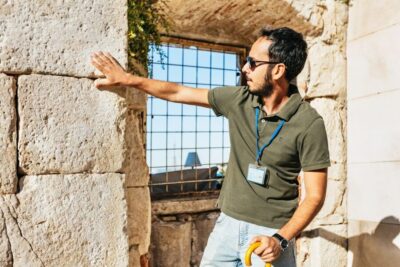
Split: Old Town and Diocletian Palace Walking Tour
Read our review →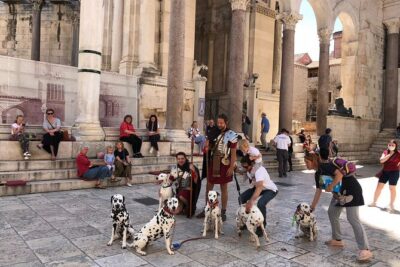
Walking Tour of Split and Diocletian’s Palace
Read our review →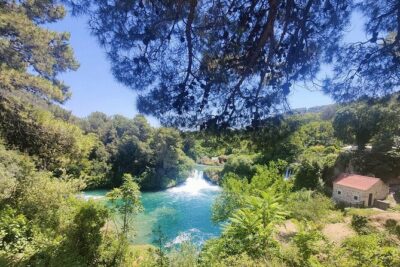
Krka Waterfalls tour with Trogir Walking tour and Krka panoramic boat cruise
Read our review →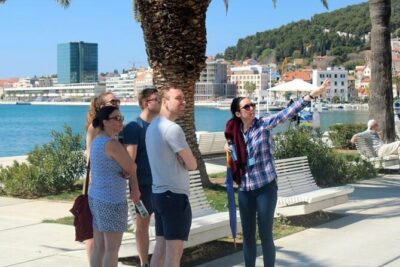
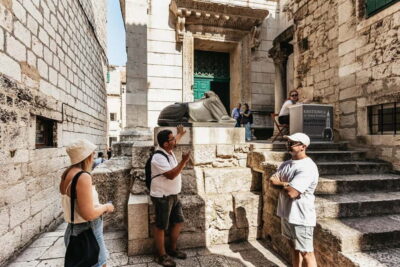
Split: Diocletian Palace & Old Town Guided Walking Tour
Read our review →
From Split: Krka Waterfalls Cruise & Trogir Walking Tour
Read our review →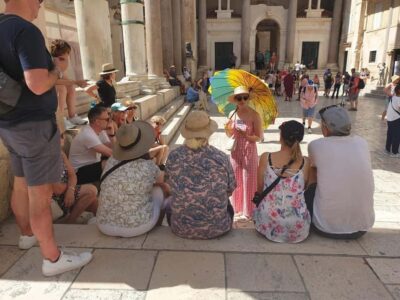
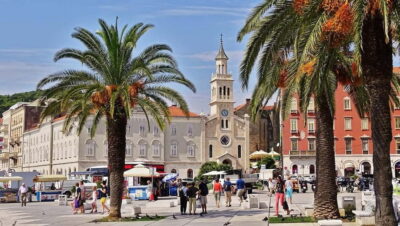
Diocletian’s Palace and Old Town SMALL GROUP Walking Tour
Read our review →Browse the lists this tour appears in