
Reviewed · SPLIT OLD TOWN WALKING TOURS
History Split Walking Tour in German – Small group
Diocletian’s Palace is not a quiet ruin behind a ticket gate. It is Split’s living center, with homes, cafés, lanes, and shops built into the remains of a Roman emperor’s retirement palace. This German-language walking tour gives you a fast, clear way to understand that unusual mix.
I like the route’s strong focus on the palace and its immediate surroundings, and I like that the guides leave room for questions. Antonella, Josip, and Marko are named in the tour feedback, with special praise for their humor, energy, and ability to explain both ancient and modern Split. The main drawback is the pace: 90 minutes is enough for an overview, not a slow archaeological study, and high steps may be difficult for some people.
Key points at a glance
- Roman palace, living city: See how Diocletian’s ancient complex still forms the heart of Split.
- Seven useful stops: The route covers the Peristyle, Vestibule, substructures, Golden Gate, Riva, Fruit’s Square, and the synagogue area.
- German-language guiding: Ask for the German tour if you want history explained in German rather than through an audio guide.
- Small group setting: The maximum is 20 people, a size that should make questions easier than on a large coach tour.
- Strong guide focus: Antonella, Josip, and Marko are among the guides praised for clear explanations and a good sense of humor.
- A compact first look: At about 1 hour 30 minutes, this works well near the start of a Split visit.
Why Diocletian’s Palace is the right place to start

The best thing about this walk is its setting. Diocletian’s Palace is not simply one attraction among many in Split. Its streets and courtyards shape the old town, so a guide can explain Roman planning, medieval change, local identity, and daily city life without sending you across town.
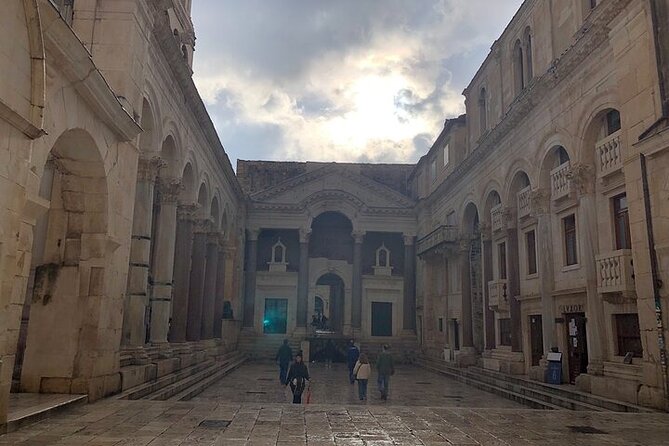
The tour begins on the Peristyle, the palace’s central square. From here, you can reach many other parts of the complex, and the guide can show how the palace was organized around this open space. The setting also helps you grasp the scale of the project before you move into narrower passages and enclosed rooms.
The central story is Emperor Diocletian himself. You will hear how a man who began with little status rose to become one of the most powerful figures in the Roman world. That rise gives the tour a human thread. Instead of hearing only dates and building terms, you get a reason to care about the person who ordered this enormous residence.
I especially like the way this route links Roman remains with later Croatian culture. At the Golden Gate, the story shifts from imperial architecture to Gregory of Nin and his importance to Croatian history and language. At Fruit’s Square, Marko Marulić introduces you to the father of Croatian literature. The tour is not limited to Rome, and that makes it more useful for understanding Split as a city shaped by many periods.
More walks through the old quarter in Split:
- Split: Old Town and Diocletian Palace Walking Tour
★ 4.9 · 4,727 reviews - Walking Tour of Split and Diocletian’s Palace
★ 5.0 · 2,588 reviews - Krka Waterfalls tour with Trogir Walking tour and Krka panoramic boat cruise
★ 5.0 · 1,659 reviews
Peristyle: the palace’s grand entrance point
The Peristyle receives about 15 minutes, the longest stop on the first part of the route. That makes sense. This is the main meeting point within the palace and one of the places where the original purpose of the complex is easiest to picture.
Your guide can explain how the square connected important parts of Diocletian’s residence. You may also hear about the emperor’s position, the palace’s construction, and the way later generations adapted the site. The value here is orientation. Once you understand the Peristyle, the rest of the walk becomes easier to follow.
Take a moment to look up and around rather than focusing only on the guide. The square is compact, but it contains layers of architecture and use. The tour does not include a separate admission charge at this stop, so you are paying for interpretation rather than entry to a monument.
The Peristyle can also be a busy place. A group of up to 20 people may need to gather close to the guide, and street activity can compete with quiet conversation. If you have questions, ask them early. The guides praised for this tour, including Antonella and Josip, are noted for welcoming questions and giving answers beyond the basic route.
The Vestibule and a taste of Dalmatian culture
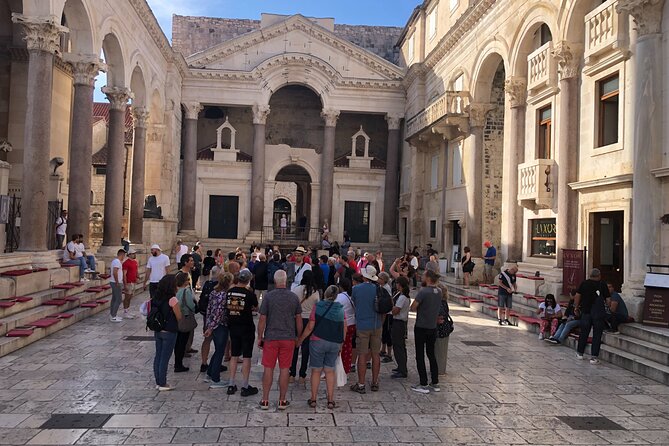
The Vestibule is a short five-minute stop, but it adds an atmospheric change. This was the emperor’s vestibule, a transition point before entering more private areas of the palace.
The guide explains its past use and place in the palace plan. You might also hear traditional Dalmatian singing here, depending on what is taking place at the time. That possibility is one of the more distinctive details of the walk. It connects the old building with a living local tradition rather than treating the palace as a dead monument.
Do not expect a long musical performance to be the main event. The singing is a possible extra, not a guaranteed scheduled part of the tour. Still, the stop gives the walk some variety after the open Peristyle.
The substructures: the palace beneath the palace
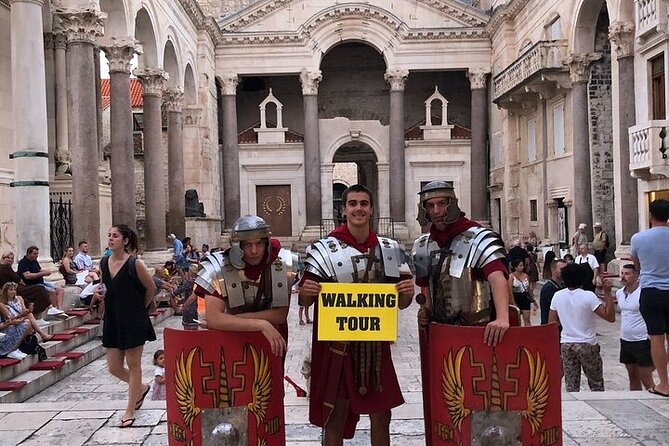
The substructures receive around 10 minutes. This is one of the most useful parts of the route because it helps explain how the upper palace was supported and how the lower spaces were used over time.
You will hear about their construction and changing function. The substructures are also a practical lesson in archaeology: what survives below can show you how the original upper rooms were arranged. Once you understand that relationship, Diocletian’s Palace feels less like a random collection of old walls.
The tour does not include the museum section of the substructures. That is important when you plan your day. You can visit the museum afterward, but you should not assume that this guided walk covers every exhibit or paid area below the palace.
For many people, this stop will be brief. Ten minutes is enough for a clear explanation, but not enough to examine every display or ask about every construction detail. I would treat it as an introduction, then return on your own if the underground spaces catch your interest.
More history walks in Split:
- Walking Tour of Split with a ‘Magister’ of History
★ 5.0 · 1,122 reviews - Split Walking Tour with Professor of History
★ 5.0 · 926 reviews - Split: History and Heritage Walking Tour
★ 4.9 · 650 reviews - Split History and Gastro Small-Group Tour with Food and Drinks
★ 5.0 · 375 reviews
The Golden Gate and Gregory of Nin
The Golden Gate is the main entrance to Diocletian’s Palace and receives about 10 minutes. Its role in the palace plan is clear, but the most memorable part for many people is the nearby statue of Gregory of Nin.
The guide explains why Gregory matters to Croatian history and language. This is a useful change of subject. You move from imperial Rome to a figure tied to Croatian identity, and you see how Split’s central monuments represent more than one era.
This stop also gives you a simple way to connect the palace with the city outside it. The gate was built for controlled access to the imperial complex, but today it is part of the ordinary old-town route. That contrast is exactly what makes a guided walk worthwhile. Without explanation, you may see a gate and a statue. With context, both become part of a larger story.
Riva Harbor: the palace meets the waterfront
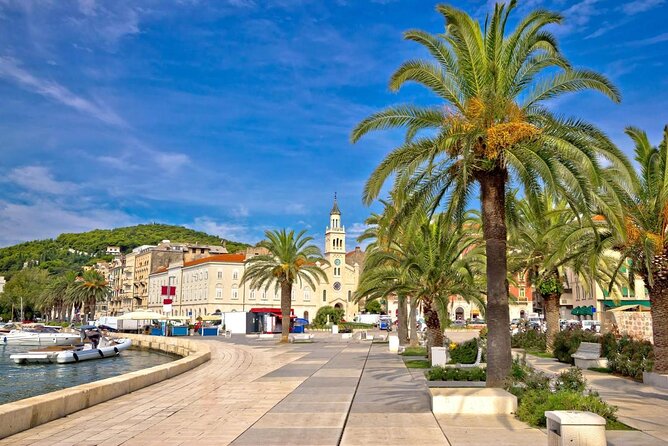
The walk then reaches Riva Harbor for about 15 minutes. Riva is Split’s famous waterfront promenade, and the stop gives you a different view of the palace and the city’s connection to the sea.
A bronze model of Diocletian’s Palace helps you understand the layout from above. This can be especially useful after walking through tight lanes. On the model, the overall design becomes easier to read: the central areas, entrances, and relationship between the palace and waterfront make more sense.
Your guide also explains the history of the Riva promenade. This widens the tour beyond Roman remains and shows how Split developed as a port city and public gathering place.
The Riva stop is also a natural place to pause and reset. The tour remains short, but the route does not feel locked inside stone corridors from start to finish. I like that balance. You get architecture, city history, and a chance to look outward toward the harbor.
Fruit’s Square and Marko Marulić
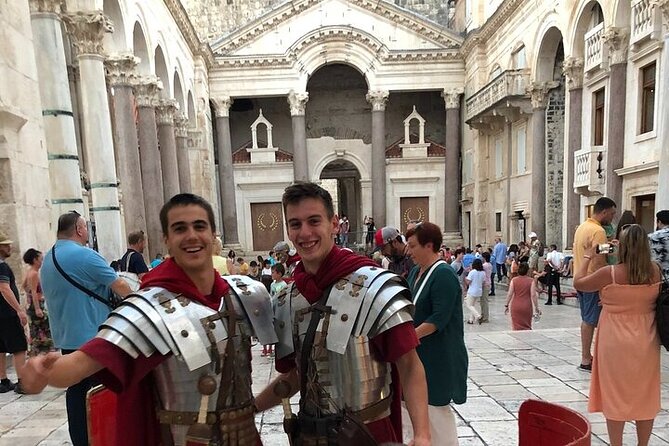
Fruit’s Square, or Trg Braće Radić, receives about 10 minutes. Here you will learn about a 15th-century Venetian citadel and the importance of Marko Marulić, often called the father of Croatian literature.
This stop shows how strongly Venetian influence shaped Split after the Roman period. The old town is not only an imperial site. It also reflects later powers, local writers, military needs, and the growth of a Croatian cultural identity.
The square helps you see how Split’s past is spread through ordinary urban spaces. A fortification can sit beside cafés and modern pedestrian traffic, while a writer’s legacy remains part of the city’s public memory. You do not need a specialist background to appreciate the point. The guide supplies the connections that are easy to miss while walking alone.
If literature and local culture interest you, this may be one of the more valuable stops. If your main goal is Roman archaeology, it may feel like a short detour, but it gives the tour better balance.
The synagogue area and Split’s Jewish history
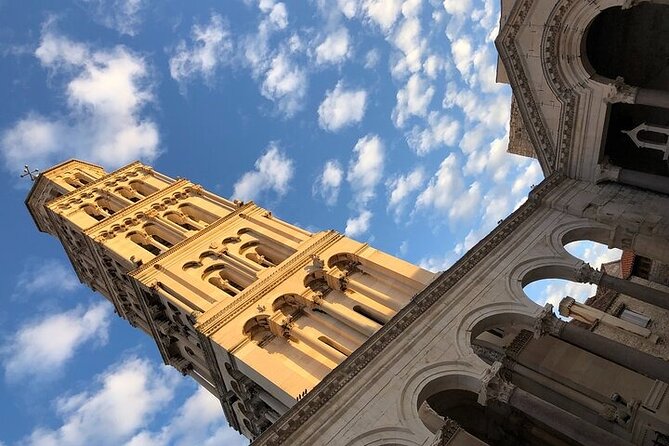
The final listed stop is the Split Synagogue, where the route passes by the 16th-century synagogue and discusses the history of the city’s Jewish people. The stop lasts about 10 minutes.
This is a reminder that Split’s story includes communities and traditions beyond the Roman, Venetian, and Croatian subjects covered earlier. A brief explanation of Jewish life in the city adds social history to the architectural tour.
The synagogue admission is not included, and the route description identifies this as a pass-by stop rather than a full interior visit. Plan on hearing about the site from outside. If you want more time with the synagogue itself, ask the guide what can be visited separately, but the tour price does not cover that entry.
German guiding and the people leading the walk
The German-language format is the key reason to choose this tour over a general English-language walk. Historical names, political changes, and architectural terms are easier to follow when the explanation comes in the language you use most comfortably.
The guides named in the feedback include Antonella, Josip, and Marko. Antonella is repeatedly described as entertaining, open to questions, and able to make a short tour feel lively. Josip is praised for friendliness and for handling many different questions. Marko is described as a history teacher who tells interesting stories about the palace.
The exact guide is not specified in advance in the information provided, so you should not book expecting one particular person. The useful point is that the experience depends strongly on the guide’s storytelling. This is not a ticket that gives you access to a large collection of exhibits. You are buying a person’s explanation of the city.
The maximum group size is 20 people. That is still a real group, but it is far more manageable than a large bus excursion. You should be able to hear the guide more easily, and the format is better suited to questions. Some stops are tight, so staying close matters.
Does the $165.08 price offer good value?
At $165.08 per person, this is an expensive 90-minute walking tour. I would not call it a bargain if you are comparing it with a free city walk or exploring the palace on your own.
The value depends on how much you need German-language guidance and how much context you want. The route covers several of Split’s most important sites in a compact period, and the guide explains connections that are easy to miss when you simply wander from one courtyard to another.
The listed stops do not include separate admission charges, and the museum part of the substructures is not included. Gratuities are also extra. So the price is mainly for the guide’s time, language ability, organization, and historical interpretation.
For a couple or family that wants a private tour, $165.08 per person may feel high. For someone who values a German-speaking guide, a small maximum group, and a clear first introduction to Split, the cost can be easier to justify. Group discounts are available, so check the final price for your party rather than assuming every booking will cost the same.
Timing, meeting point, and practical concerns
The walk begins at Peristil ulica, at the Peristyle in Split. The ending point is in Diocletian’s Palace, not far from the start. If you want to return to the Peristyle, the guide can take you back when you ask.
Allow about 1 hour 30 minutes. The listed stop times add up to roughly 75 minutes, so the remaining time allows for walking, transitions, and questions. That also means the schedule may feel full. Arrive ready to keep moving and listen while standing.
The meeting point is near public transportation, and a mobile ticket is available. Confirmation is sent within 48 hours of booking, subject to availability. Service animals are allowed, and most people can take part.
High steps are the main physical warning. The tour is on foot and takes place in an old palace complex, so anyone with trouble handling high steps should think carefully before booking. The information does not describe the route as wheelchair accessible, so ask the provider if that is important for you.
Free cancellation is available until 24 hours before the start time. Inside that window, the amount paid is not refunded, and changes are not accepted. The tour also requires a minimum number of bookings, so a cancellation by the operator would result in another date or experience, or a full refund.
Who should book this Split walking tour?
I would choose this tour if you want a structured first look at Split and prefer German explanations. It suits couples, families, and small groups who want the main palace story without spending half a day on a long historical program.
It also works well near the start of your stay. After the tour, you will know where the Peristyle, Golden Gate, Riva, and Fruit’s Square are, and you can return later to places that deserve more time. The substructures museum is an obvious follow-up if the underground section interests you.
I would be more cautious if you want a detailed archaeological tour, a long palace interior visit, or a very slow photography walk. The route is compact, the group can contain up to 20 people, and several stops receive only five or ten minutes.
Should you book it?
Book this tour if German is your preferred tour language, you want the major sights in one short walk, and you value a guide who can answer questions rather than simply recite dates. Antonella, Josip, and Marko are associated with the strongest comments about humor, clarity, and historical storytelling.
Skip it if $165.08 feels too high for 90 minutes or if you are happy to explore independently with a map. The price is not for admission-heavy sightseeing. It is for focused interpretation of Split’s Roman, Venetian, Croatian, Jewish, and modern layers.
For the right reader, this is a useful orientation walk: short, central, and full of names and places you will keep encountering during your time in Split.
FAQ
How long does the History Split Walking Tour last?
The tour lasts approximately 1 hour 30 minutes.
What language is the tour conducted in?
This experience is a German-language walking tour.
Where does the tour begin?
It begins at Peristil ulica, at the Peristyle of Diocletian’s Palace in Split.
Where does the tour end?
It ends in Diocletian’s Palace, not far from the starting point. The guide can take you back to the Peristyle if you ask.
What places are included on the route?
The route includes the Peristyle, Vestibule, palace substructures, Golden Gate, Riva Harbor, Fruit’s Square, and the area of the Split Synagogue.
Is entry to the substructures museum included?
No. The tour visits the palace substructures but does not include the museum section. You can visit that part after the tour.
What is the cancellation policy?
You can cancel for a full refund up to 24 hours before the experience starts. Cancellations or changes made less than 24 hours before the start time are not refunded or accepted.
Just added around Split
- From Makarska : Wine Tasting Grabovac Tour★ 4.5 · 30 reviews
- Walking Tour Split★ 4.7 · 61 reviews
- Essential Diocletian’s Palace Tour for First-Time Visitors★ 4.8 · 19 reviews
- Unique vintage Tomos moped tour Split – Back to the ’80s★ 4.8 · 17 reviews
- Trogir; Private walking tour of higlights of Trogir★ 4.7 · 3 reviews
- Trogir: White Lagoon, Maslinica & Blue Lagoon Speedboat Tour★ 4.8 · 11 reviews
- Trogir 1.5-Hour City Tour★ 4.4 · 37 reviews
- Split: Trogir Open Top Bus Trip + Free Split Walking Tour★ 4.1 · 17 reviews
Split Old Town Walking Tours, compared.
Split: Old Town and Diocletian Palace Walking Tour
Read our review →
Walking Tour of Split and Diocletian’s Palace
Read our review →
Krka Waterfalls tour with Trogir Walking tour and Krka panoramic boat cruise
Read our review →
Walking Tour of Split with a ‘Magister’ of History
Read our review →
Split: Diocletian Palace & Old Town Guided Walking Tour
Read our review →
From Split: Krka Waterfalls Cruise & Trogir Walking Tour
Read our review →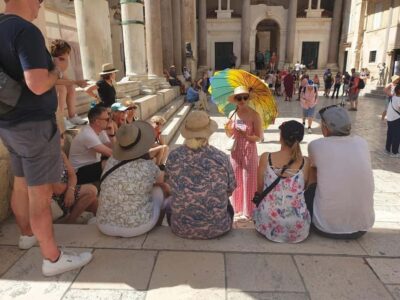
Browse the lists this tour appears in