
Reviewed · SPLIT OLD TOWN WALKING TOURS
Private Walking Tour in Split Old Town (ENG, FRA, ITA, ESP)
Split’s Old Town is not a museum behind ropes. It is a living city built inside and around a Roman emperor’s palace. This private walk with licensed guide Sanja takes you from the Riva into Diocletian’s Palace, then through medieval, Venetian, French, and Austro-Hungarian parts of Split.
I like the private format, which lets your group ask questions and keep a pace that works for adults or children. I also like the stop at the Palace Substructures, the best-preserved Roman section, though its €10 entrance fee is extra. The main consideration is time: 17 listed stops in 1 hour 45 minutes means several places receive only a quick look.
Key points at a glance
- See a city built inside a Roman palace: Diocletian’s Palace is still part of daily Split life, with homes, shops, squares, and cafés inside its old walls.
- Enter the Palace Substructures: This optional paid visit gives you the clearest view of the palace’s original construction and purpose.
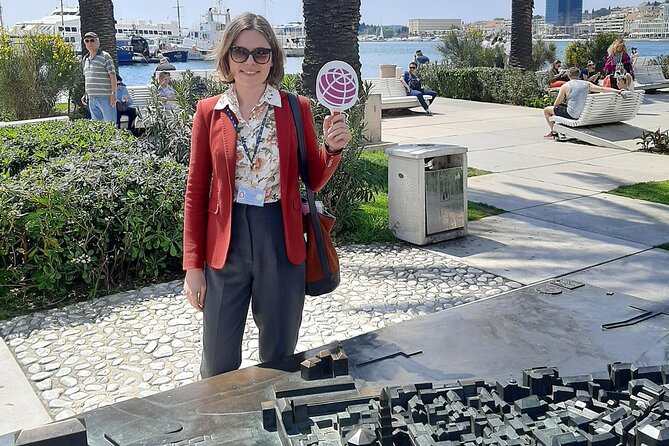
- Start and finish on the Riva: The harbor promenade gives you an easy meeting place and broad views toward the palace and Marjan Hill.
- Follow Split through several eras: The walk includes Roman, medieval, Venetian, French, and Austro-Hungarian landmarks.
- Get practical local guidance: Sanja shares suggestions about places to eat, drink, and explore after the walk.
- Pay by group, not by person: At $156.19 for up to 15 people, the price makes the most sense for families or small groups traveling together.
A Roman palace that became a city
The best part of this walk is the way it explains Split as a place that changed uses rather than simply preserving old monuments. Diocletian’s Palace covers about nine acres, but you will not experience it as one fenced-off archaeological site. Streets run through it. People live and work within it. Roman stone sits beside medieval lanes and later European architecture.
You meet at the Riva, Split’s waterfront promenade, at 9:00 a.m. From here, Sanja gives you the broad view first. You can see the palace, the medieval town, and Marjan Hill and Park from the harbor side. This opening helps you understand the shape of Split before the route turns into the narrow streets.
The meeting point is at Obala Hrvatskog narodnog preporoda 22. The tour returns to this same location, which is handy if you are planning lunch, a harbor walk, or another activity afterward.
More walks through the old quarter in Split:
- Split: Old Town and Diocletian Palace Walking Tour
★ 4.9 · 4,727 reviews - Walking Tour of Split and Diocletian’s Palace
★ 5.0 · 2,588 reviews - Krka Waterfalls tour with Trogir Walking tour and Krka panoramic boat cruise
★ 5.0 · 1,659 reviews
Inside Diocletian’s Palace
The palace is the main event, and the route spends much of its time moving through its different parts. The first palace stop is brief, but it sets up the central idea: this was an imperial residence and military complex, yet modern Split now uses its spaces for ordinary city life.
That contrast is worth paying attention to. You are not just looking at columns and walls. You are seeing how an ancient complex adapted over centuries. Sanja’s role is especially useful here because the details can otherwise blur together. Her explanations connect the stonework, rooms, gates, and squares to the people who used them.
The walk then turns to the Palace Substructures for about 20 minutes. These underground rooms are the best-preserved part of the Roman palace, making them one of the most useful stops for understanding the original plan. You discuss their former functions and the way they relate to the imperial rooms above.
Admission is not included. The fee is €10 per person. I would budget for this extra, since skipping it removes one of the strongest historical parts of the tour. The route allows only a short visit, so do not expect every available room to receive a long explanation, but the stop gives the palace a solid physical foundation.
The cathedral, mausoleum, and imperial center
The Cathedral of Saint Domnius is visited from outside. Its importance is unusual: it is a Roman Catholic cathedral housed in what was originally the mausoleum of Emperor Diocletian. That pairing gives you a clear example of how Split’s ancient and later religious identities occupy the same building.
Next comes Triklinij, the area linked to the emperor’s apartments and dining hall complex. The visit lasts only a few minutes, so you will get the purpose and setting rather than a long architectural study. Still, it helps fill out the picture of palace life beyond the grand public spaces.
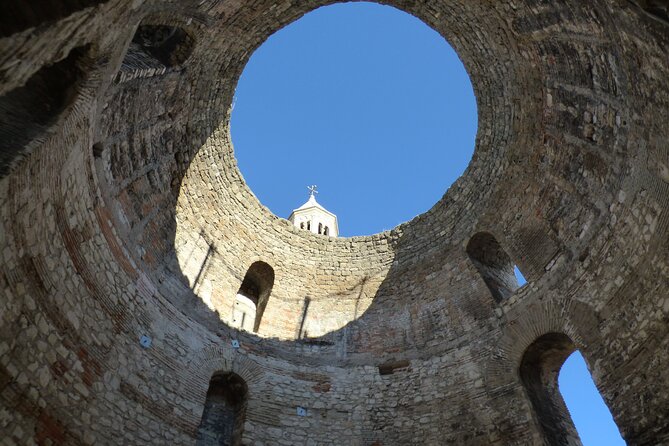
The Vestibulum belonged to the emperor’s chambers. It is also known for its acoustics. During summer, traditional Dalmatian singing can sometimes be heard here. The possibility is seasonal and not guaranteed, so treat it as a pleasant extra rather than part of the promised program.
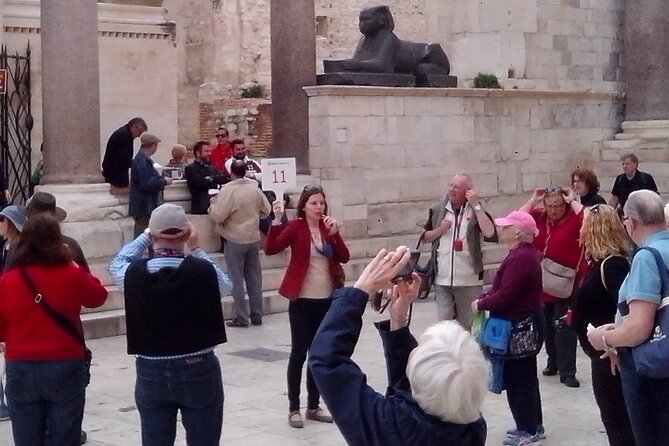
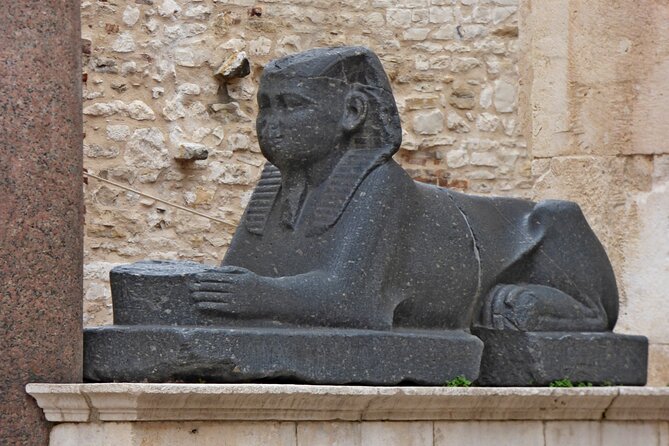
The Peristyle receives more time. This was the palace’s imperial square, and it offers one of the clearest visual moments on the route. From here, you can look toward the former mausoleum, now the cathedral with its belltower, and see an original Egyptian sphinx.
That sphinx is a useful reminder that Diocletian’s palace was not a modest local project. Its design drew on imperial power, religion, and material from far beyond the Adriatic. The Peristyle is also one of the places where the scale of the palace becomes easier to grasp.
Jupiter’s Temple and the Golden Gate
The Temple of Jupiter is an exterior stop. It was dedicated to the main Roman god, and Sanja explains its place within the palace’s religious setting. The visit is short, so you should expect an outside view and context rather than an extended interior examination.
The Golden Gate was the palace’s main entrance. Passing through it brings you to the outer view of the fortifications, where the heavy stone walls make more sense as part of a defended imperial complex. The route does not treat the gate as an isolated photo stop. It links the entrance to the palace’s broader design.
Just outside the gate, you see the large statue of Grgur Ninski, an iconic Split landmark. The stop lasts only two minutes, but it is enough to point out the monument and explain why it matters to the city. This is the sort of quick orientation that helps you recognize the statue later if you return on your own.
More walking tours in Split:
- Split & Diocletian’s Palace Walking Tour
★ 5.0 · 1,125 reviews - Walking Tour of Split with a ‘Magister’ of History
★ 5.0 · 1,122 reviews - Split Walking Tour with Professor of History
★ 5.0 · 926 reviews - Split: Diocletian Palace & Old Town Guided Walking Tour
★ 4.7 · 882 reviews
Medieval Split beyond the palace walls
After the Roman core, the walk moves into the medieval town. Narodni Trg, or People’s Square, was the main square of medieval Split. This change in setting matters. The palace was the starting structure, but the city continued to grow around it, producing its own public spaces and civic buildings.
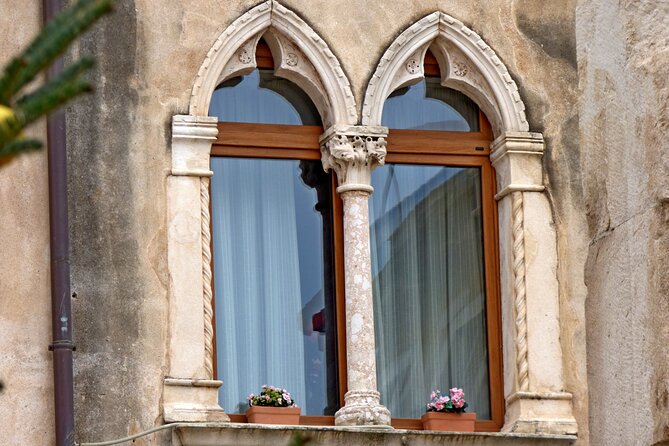
The Old Town Hall on Pjaca square comes next. It dates from the period when Split was part of the Republic of Venice. The stop is brief, but the building gives you a useful marker for Venetian influence and the city’s later political life.
Fruit’s Square, officially Trg Brace Radic, adds another layer. Here you see a large tower that once formed part of the medieval town fortifications. Sanja also discusses noble families and their role in Split. The nearby statue of Marko Marulic honors a major Croatian writer and provides a quick cultural note amid the architecture.
These short stops work best if you want a clear map of the Old Town rather than a specialist lecture on one monument. If you prefer slow photography, long interior visits, or detailed art history, the pace may feel brisk.
Fish Market, Marmontova Street, and Prokurative
The Split Fish Market has occupied the same location since the 19th century. It is open only in the morning, so the 9:00 a.m. start gives you the best chance of seeing it operating. The tour may pass by or visit it, depending on the conditions at the time.
This is a good example of the tour’s practical side. A market stop gives you a look at ordinary city life, not just palace history. If you want to spend time browsing, buying, or taking photographs, remember that the tour schedule allows about five minutes here.
Marmontova Ulica reflects the period when Split was under French rule in the 19th century. The street helps show that the city’s story did not end with Rome or Venice. You continue through different layers of government and urban design without leaving the compact center.
The final major stop is Prokurative, a well-known square from the period of Austro-Hungarian rule. Its name and design point to another chapter in Split’s past. After this, the walk returns to the Riva, where you began.
A private guide and a practical pace
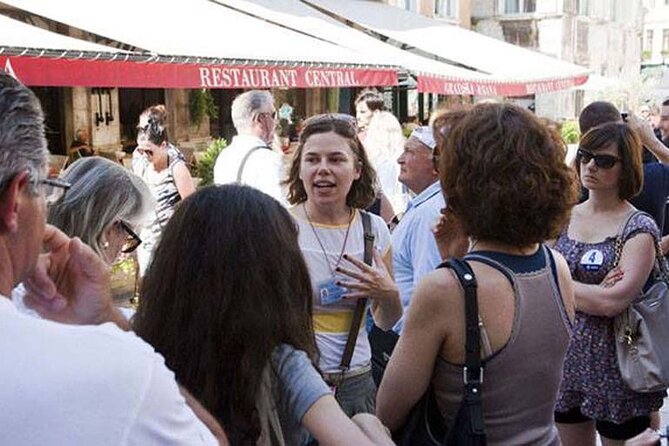
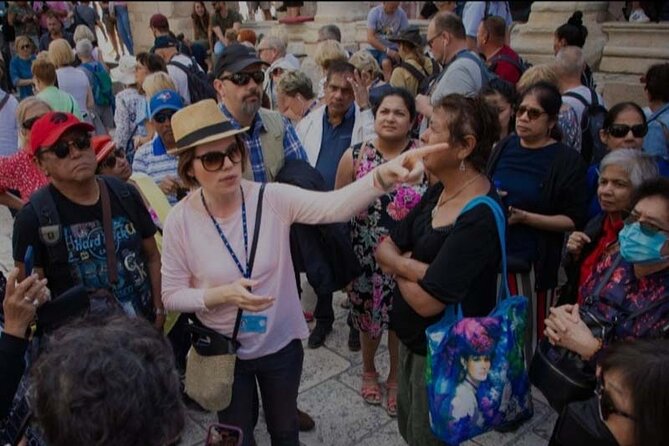
The private setup is the strongest reason to choose this experience instead of a larger group walk. Only your group takes part, with a maximum of 15 people. That suits a family, a group of friends, or a small organization that wants one guide without splitting up.
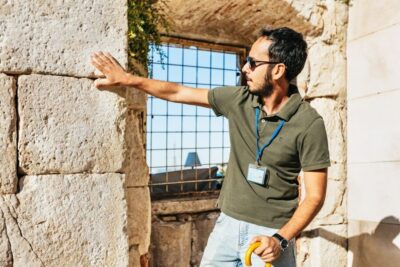
Sanja is a licensed local guide with a master’s degree. The praise surrounding her centers on clear English, friendly presentation, good time management, and explanations that work for children as well as adults. One useful detail is that she gives just the right amount of information for a general introduction, rather than turning every stop into a long academic talk.
The stated duration is about 1 hour 45 minutes. That is enough to get your bearings and learn what deserves a second look, but it is not enough for extended visits at every stop. The schedule lists many locations, including several two to seven minute visits. I would think of this as a guided orientation followed by independent exploring, not as a slow museum tour.
The activity is offered in English according to the booking details. The title also lists English, French, Italian, and Spanish, so confirm your preferred language when booking if that matters to your group.
What the $156.19 price really means

The price is $156.19 per group of up to 15 people. For one or two people, that is a fairly high cost for less than two hours. For four people, the per-person cost becomes much easier to justify, and for a larger family or group it can be good value.
The fee includes a professional licensed guide, the private format, commission, and commission tax. It does not include entry to the Palace Substructures, which costs €10 per person.
I would compare the price with your alternative. A free self-guided walk costs nothing, but you will likely miss the connections between Roman, medieval, Venetian, French, and Austro-Hungarian Split. A larger group tour may cost less per person, but you give up the ability to ask questions freely and keep your own group together.
The most valuable part is not the number of stops. It is the local explanation of how the palace became a working town. If that is what you want from Split, the cost can be reasonable, especially when shared across several people.
Who should book this walk?
I would choose this tour for a first morning in Split. It gives you the basic layout quickly, points out places you might otherwise pass, and leaves you at the Riva with useful suggestions for eating, drinking, and further exploring.
It also suits families. The pace has been described as workable for children, and a private group lets you avoid holding up strangers if a child needs a short pause. People interested in Roman architecture will want to add the Palace Substructures fee.
This is less suitable if you want a long cathedral visit, extensive interior access, or a slow photographic walk. Several locations are exterior views, and many stops are short. You should also plan around the weather. The tour requires good weather, and a cancellation for poor conditions leads to a new date or a full refund. The booking itself is non-refundable and cannot be changed for other reasons, so check your plans carefully.
The route is near public transportation, service animals are allowed, and most people can participate. Those details make it a straightforward city-center activity, but the supplied information does not give a specific accessibility assessment for every old-town surface or room.
Should you book Sanja’s Split tour?
Book it if you want a private, well-paced introduction to Split’s layered past, especially if you are traveling with three or more people and want a guide’s help on your first day. Sanja’s clear English, local knowledge, and practical suggestions are strong reasons to begin here.
Add the €10 Palace Substructures visit if you can. It is the one paid part of the route and the clearest way to understand the palace beneath the modern city.
Skip it if your priority is a long, detailed visit inside each monument. This walk covers a lot of ground in 105 minutes. For most first-time visitors, though, that brisk survey is useful: you finish with a mental map, a handful of places to revisit, and a better sense of why Split feels like several cities occupying the same stone walls.
FAQ
Where does the tour start?
It starts at Obala Hrvatskog narodnog preporoda 22, 21000 Split, Croatia, on the Riva promenade.
What time does the tour begin?
The scheduled start time is 9:00 a.m.
Where does the tour end?
The activity ends back at the meeting point on the Riva.
How long does the tour last?
The walking tour lasts approximately 1 hour and 45 minutes.
How many people can join the private tour?
The private tour is available for your group of up to 15 people.
Is the Palace Substructures entrance fee included?
No. Entrance costs €10 per person and is paid separately.
Is the Cathedral of Saint Domnius visited inside?
The cathedral is listed as an external visit. The tour explains its role as both a Roman mausoleum and a Roman Catholic cathedral.
What language is offered?
The booking information states that English is offered. The activity title also lists French, Italian, and Spanish.
Is the tour suitable for children?
The tour information says most people can participate, and the pace has been described as suitable for children.
What happens if bad weather cancels the tour?
If poor weather causes cancellation, you will be offered a different date or a full refund. The experience is otherwise non-refundable and cannot be changed for other reasons.
Just added around Split
- From Makarska : Wine Tasting Grabovac Tour★ 4.5 · 30 reviews
- Essential Diocletian’s Palace Tour for First-Time Visitors★ 4.8 · 19 reviews
- Unique vintage Tomos moped tour Split – Back to the ’80s★ 4.8 · 17 reviews
- Walking Tour Split★ 4.7 · 61 reviews
- Trogir; Private walking tour of higlights of Trogir★ 4.7 · 3 reviews
- Trogir: White Lagoon, Maslinica & Blue Lagoon Speedboat Tour★ 4.8 · 11 reviews
- Trogir 1.5-Hour City Tour★ 4.4 · 37 reviews
- Split: Trogir Open Top Bus Trip + Free Split Walking Tour★ 4.1 · 17 reviews
Split Old Town Walking Tours, compared.
Split: Old Town and Diocletian Palace Walking Tour
Read our review →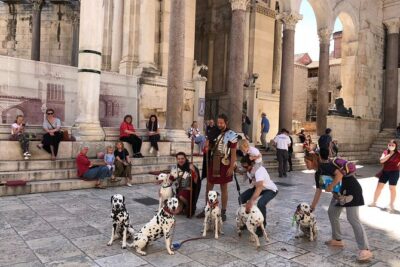
Walking Tour of Split and Diocletian’s Palace
Read our review →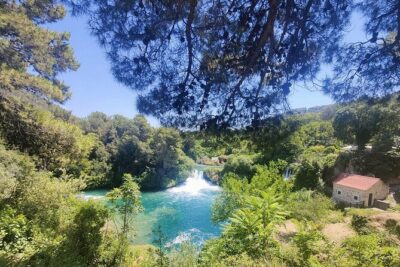
Krka Waterfalls tour with Trogir Walking tour and Krka panoramic boat cruise
Read our review →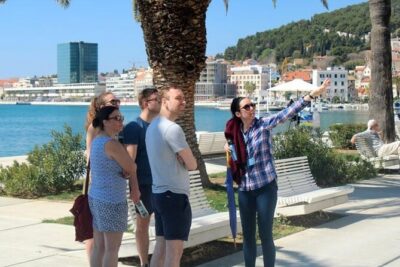
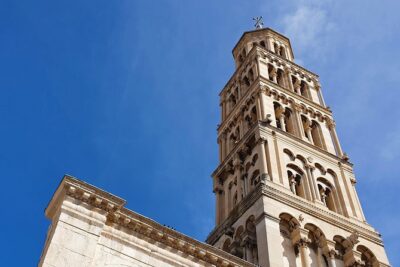
Walking Tour of Split with a ‘Magister’ of History
Read our review →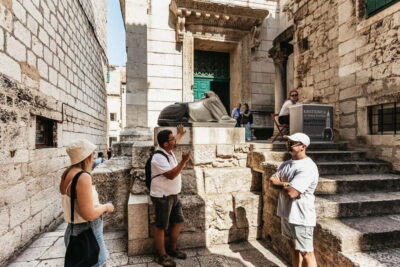
Split: Diocletian Palace & Old Town Guided Walking Tour
Read our review →
From Split: Krka Waterfalls Cruise & Trogir Walking Tour
Read our review →
Browse the lists this tour appears in