
Reviewed · SPLIT OLD TOWN WALKING TOURS
Walking tour of Split old town and craft beer tasting
Split’s ancient palace is not a fenced-off monument. It is the center of modern Split, with homes, shops, cafés, churches, and busy streets tucked inside Roman walls. This tour makes that unusual mix the main event, then shifts from emperors to small-batch beer at Leopolds Craft Beer Bar.
I like the small group of no more than eight because narrow palace lanes are easier to handle, and you have a fair chance to ask questions. I also like the pairing of history with a local brewery visit, especially with a guide such as Darijo, who is described as conversational and ready to explain Diocletian’s Palace in detail. The main drawback is that beer is not included in the $30.04 price, and some important interiors may require separate admission.
Key points at a glance

- Roman palace, living city: Walk through Diocletian’s Palace while seeing how its ancient streets still serve daily life in Split.
- A compact evening tour: The experience lasts about two hours and begins at 6 p.m., a useful time for sightseeing after the day’s heat.
- Eight-person limit: The small party size should make it easier to hear the guide and ask about the palace.
- History followed by beer: End at Leopolds Craft Beer Bar, a Split pub that makes its own beer.
- Mostly exterior sightseeing: The route includes the palace cellars and many public spaces, but some interiors cost extra.
- Flexible cancellation: You can receive a full refund if you cancel at least 24 hours before the start time.
Why Split’s palace is more than an ancient ruin
Diocletian’s Palace covers much of Split’s old town, but it does not feel like a single archaeological site. Roman columns support later buildings. Medieval streets cross the old palace roads. Laundry, doorways, restaurants, and cafés occupy spaces that once served an emperor.
That is the central value of this walk. Instead of looking at isolated stones and trying to imagine the past, you see how the palace changed over 1,700 years. The guide explains why the waterfront became the Riva promenade, how the palace operated as a military complex and imperial residence, and how later residents adapted its rooms.
The route is especially useful if you are new to Split. You get the basic map of the old town, learn the names of the principal squares and gates, and finish near a craft beer bar. You can then return to the places that caught your attention.
The tour is offered in English and begins at 6 p.m. That timing matters. You are not trying to study sunlit stone during the hottest part of the afternoon, and the final stop at a beer bar feels natural at the end of an evening walk.
More walks through the old quarter in Split:
- Split: Old Town and Diocletian Palace Walking Tour
★ 4.9 · 4,727 reviews - Walking Tour of Split and Diocletian’s Palace
★ 5.0 · 2,588 reviews - Krka Waterfalls tour with Trogir Walking tour and Krka panoramic boat cruise
★ 5.0 · 1,659 reviews
Starting on the Riva waterfront
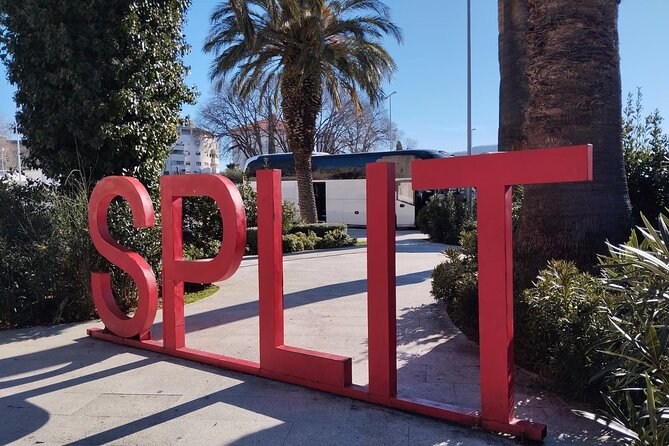
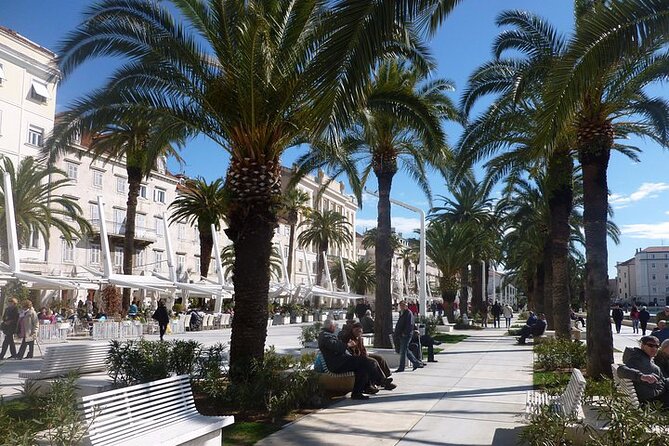
The meeting point is at the Split sign near the Riva, the city’s famous harbor promenade. The opening explanation focuses on how this waterfront changed from the edge of an imperial palace into something like Split’s public living room.
That idea gives you a useful introduction to local life. The Riva is not simply a scenic strip for visitors taking photographs. It has an important place in the daily rhythm of the city. Starting here also helps you understand the palace’s original position beside the sea.
The first stop is brief, about 10 minutes. Do not expect a long waterfront lecture. Instead, use it to get oriented before heading toward the palace interior.
The cellars reveal the palace plan
The palace substructures, often called the cellars, are one of the strongest parts of the route. Even a visit to the central section shows why these vaulted rooms are considered among the best-preserved late-antique complexes in the world.
These rooms are valuable because they help you read the layout above them. The palace’s lower level follows much of the plan of the imperial residence that once stood overhead. Arches, corridors, and stone walls make the original design easier to picture than a few scattered foundations would.
The cellars also offer a more solid sense of scale. Diocletian did not build a modest retirement home. The palace was both a residence and a fortified compound, and the lower rooms make its size and engineering clear.
Admission to the cellars is listed as included in the tour, but the supplied details do not give a separate ticket arrangement. I would still confirm exactly what is covered when booking, particularly if you want access to more than the central section.
The Peristyle and the emperor’s public stage
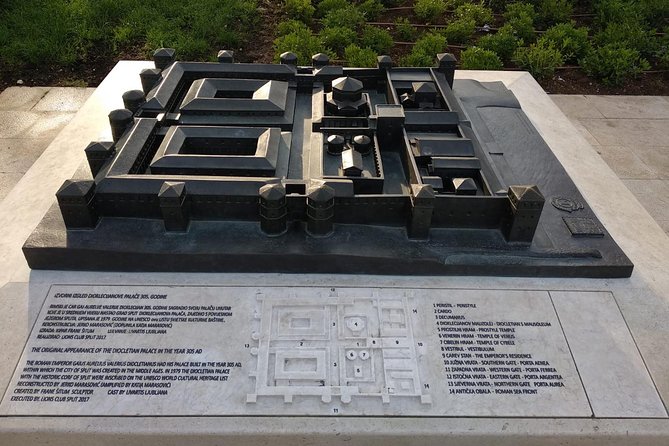
The Peristyle is the visual center of the palace tour. Columns frame the square, and the space gives you a direct sense of how Roman power was presented.
The guide explains the role of the emperor’s appearance beneath the Protiron, after leaving the Vestibule. That detail helps you understand the square as a stage for ceremony, not merely an attractive old plaza. Cardo and Decumanus, the palace’s main streets, meet this grand setting, and later building styles have altered the original Roman plan.
You get about 15 minutes here. That is enough for a focused explanation and photographs, but not enough for every architectural detail. If you care deeply about Roman design, you may want to return independently after the tour.
A notable nearby feature is described as one of Europe’s most beautiful monuments by the 18th-century British architect Robert Adam. It is tucked among later houses, which is typical of Split’s old town. Its interior requires an additional fee, so this is another place where the tour points out a feature without covering every possible admission.
A few more Split days out worth weighing up
- Tower Pub Crawl in Split
★ 4.5 · 418 reviews - From Split: Brač Island Beach Bar and Pool Party
★ 4.5 · 87 reviews - Omiš, Croatia: Cetina River Glassboat Cruise And Beer Garden
★ 4.3 · 61 reviews - Bike, Beer & Poljud Stadium Tour
★ 5.0 · 9 reviews
The Vestibule, where stone carries sound
The circular Vestibule once served as a lobby for Diocletian’s residential rooms. Its open ceiling and rounded walls make it one of the most memorable spaces on the walk.
The acoustics are a major part of the explanation. Dalmatian klapa groups, known for a cappella singing, often use the space. This singing tradition is protected by UNESCO, and the building’s shape helps you understand why music works so well there.
The stop lasts around 10 minutes. You may find that the room is more striking when the guide explains its original function rather than treating it as a photo stop. It was designed to impress people approaching the emperor’s private quarters, and it still does that job in a different way.
Roman dining in the Triklinij

At the Triklinij, you see what remains of the emperor’s dining room. The stop gives the tour a more personal angle: how Romans ate, how reclining at meals worked, and why the Roman dining experience could involve frequent trips to the vomitorium.
The subject is a useful reminder that palace life was not only ceremonies and military walls. It also involved food, status, excess, and elaborate social customs. The guide connects these details to the familiar phrase Carpe Diem, giving you a lighter moment after the more formal architecture.
This stop lasts about 10 minutes. The remains may not be as immediately impressive as the Peristyle, so the quality of the explanation matters here. A conversational guide such as Darijo can make this kind of smaller room worthwhile by answering questions rather than simply naming it.
Mausoleum, cathedral, and layers of belief
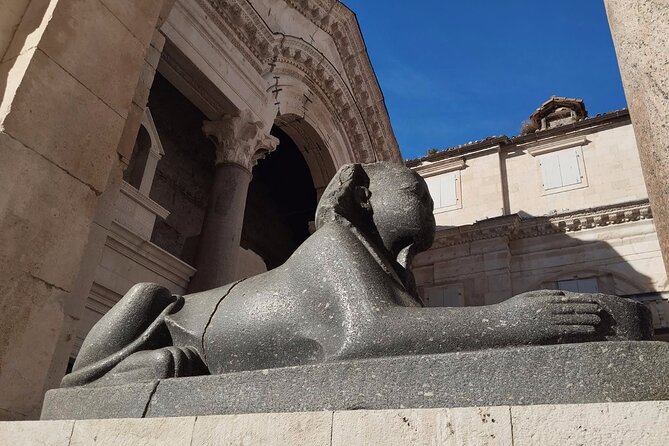
The route also explains how Diocletian’s Mausoleum became a cathedral. That change captures one of the clearest shifts in Split’s story: a building created for an emperor was later given a Christian purpose.
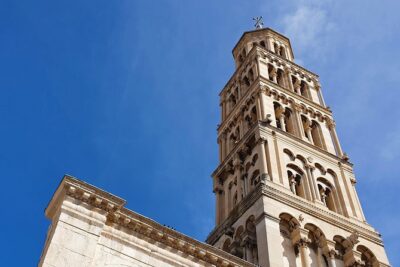
The cathedral’s bell tower is described as one of the most elegant on the Dalmatian coast. The tour gives you the historical connection between the mausoleum and the cathedral, but interior admission is not clearly listed as included. If entering the cathedral is important to you, ask about the current fee and access before the walk.
The point is not just that one building changed use. The palace survived because each period found a way to use it. That is why Split feels like a real town inside an ancient complex rather than a museum frozen in time.
A chocolate record and a lighter local story
One part of the walk turns briefly away from Roman stone. You hear how a small chocolate producer in Split won a Guinness World Record for the largest chocolate slab in the world.
This is a modest detail, but it adds variety to the route. It also links the old town to contemporary local businesses. You are not spending two hours hearing only about emperors and monuments.
The supplied details do not identify the producer or say whether chocolate tasting is included, so do not book this tour expecting a food tasting beyond the beer stop.
The Golden Gate and the palace as a fortress
The Golden Gate shows the palace’s defensive side. You enter the area once known as a propugnaculum, and the guide explains why entering the imperial compound was not a casual affair in Roman times.
The monumental gate and the best-preserved section of the palace wall help you picture the site as a military camp as well as a residence. That balance is important. Diocletian’s Palace was grand, but it was also built to control access and protect the emperor.
The stop lasts about 10 minutes. It is also a practical place for photographs, though the main benefit is the explanation of how the gate fitted into the larger fortification system.
Gregory of Nin and the famous bronze toe
The statue of Gregory of Nin offers a short change of pace. The sculptor Ivan Meštrović created the famous figure, and a local tradition says that touching the statue’s golden toe brings good luck.
You have about five minutes here. It is a quick stop, but the statue is easy to recognize and makes a natural photo point. Touch the toe if you like, but remember that the more useful part of the stop is learning who Gregory of Nin was and why Meštrović is regarded as one of the world’s leading sculptors.
Because the stop is brief, you should not expect a full study of Meštrović’s work. Think of it as a memorable introduction.
Pjaca and Fruit’s Square
Pjaca is the old town’s main square today, though it has carried different names over time. The guide points out its architectural layers and explains how its role changed as Split developed.
This is a good place to notice the contrast between public life and palace remains. You are still inside the old center, but the setting feels like a civic square rather than an imperial courtyard.
Fruit’s Square, officially Trg Brace Radic, follows with a different architectural mood. It contains Split’s finest example of Baroque architecture, and the guide connects the area to the Venetian Republic’s defense of Split against Ottoman attacks.
You also hear about Marko Marulić, often called the father of Croatian literature. These stories widen the tour beyond the Roman period and show how Venetian, Croatian, and Ottoman-era forces shaped the city.
Finishing at Leopolds Craft Beer Bar
The final stop is Leopolds Craft Beer Bar on Dosud ul 5. It is described as one of Split’s leading craft beer destinations and as a pub that brews its own beer.
The beer portion lasts about 30 minutes. You learn about local craft beer and can order drinks, but beers and other beverages are not included in the tour price. This is important when judging the total cost. The $30.04 covers the guide and sightseeing, while your final bill depends on what you choose at the bar.
I like the concept because the change from ancient palace to modern microbrewery feels natural. Split is not only a historic city. It also has present-day makers, bars, and local tastes. The ending gives you somewhere to continue the evening, though you should not assume a formal tasting flight is included unless the operator confirms it.
One direct review praises guide Darijo for explaining Diocletian’s Palace clearly, answering questions, and keeping the conversation going before the group heads to the brew pub. That makes the guide’s personality an important part of the experience. If you want a silent, scripted walk, this may feel too informal. If you like asking questions, it should suit you well.
Is $30.04 a fair price?
At $30.04 per person, the tour is reasonably priced for a two-hour guided introduction to Split’s UNESCO-listed palace, especially with a maximum of eight people. The value comes from the route and the explanation, not from included food or drinks.
You should budget extra for beer at Leopolds and for any optional monument interiors. If you already plan to walk the palace alone and are comfortable researching the Roman layout yourself, the price may not be necessary. But the palace is confusing at first, and a local guide can connect the cellars, streets, gates, squares, and later buildings in a way that a map cannot.
The small party limit is a real advantage. Split’s old town has tight passages and irregular spaces, so eight people is far easier to manage than a large coach group. The start time also lets you use the daytime for other sights.
The experience is booked an average of 53 days ahead, so I would reserve early if your Split dates are fixed. Confirmation arrives at booking, and free cancellation is available until 24 hours before the start time. Cancellations or changes inside that final 24-hour period are not refunded or accepted.
Who should book this Split walking tour?
I would choose this for a first evening in Split, a couple who wants history without a full-day commitment, or anyone who likes pairing monuments with a local drink. It also suits you if you prefer a small group and want direct access to a guide.
Families and most people with ordinary walking ability can participate, and service animals are allowed. The tour is near public transportation, but the provided information does not specify the walking surface, step count, or interior access details. Ask ahead if those points affect your plans.
Beer enthusiasts should note that the stop is at a craft beer bar, not a stated brewery tour. You can learn about local beer and order drinks, but the exact tasting lineup is not provided.
Should you book it?
Book this tour if you want a clear introduction to Split’s palace, prefer a small English-speaking group, and like the idea of ending at a local craft beer bar. The route gives you Roman cellars, ceremonial spaces, medieval and Venetian layers, a famous statue, and lively old-town squares in a short period.
Skip it if you want extensive cathedral interiors, a long archaeological lecture, or included beer tastings. For most first-time visitors, though, the combination is sensible: two hours of guided orientation, a local perspective, and an easy place to continue the night.
FAQ
Where does the tour begin?
It begins at the Split sign, 21000, Grad, Split, Croatia.
What time does the tour start?
The start time is 6 p.m.
How long does the experience last?
The tour lasts approximately two hours.
What language is the tour offered in?
The tour is offered in English.
How large is the group?
The maximum group size is eight participants.
Is Diocletian’s Palace included?
Yes. Sightseeing of the 1,700-year-old Diocletian’s Palace, a UNESCO-protected world heritage site, is included.
Are beers included in the price?
No. Beers and other drinks at Leopolds Craft Beer Bar are not included.
Where does the tour end?
It ends at Leopolds Craft Beer Bar, Dosud ul 5, 21000 Split, Croatia.
Can I cancel for a full refund?
Yes, if you cancel at least 24 hours before the experience start time. Cancellations made less than 24 hours before the start are not refunded.
More Food and Drink Tours in Split
- From Split: Krka Waterfalls, Food & Wine Tasting Tour
★ 5.0 · 9,326 reviews - From Split: Krka Waterfalls, Food & Wine Tasting Tour
★ 4.9 · 6,598 reviews - Split: Blue Lagoon and 3 Island Cruise with Food and Drinks
★ 4.8 · 1,969 reviews - Krka National Park Tour with tour Guide & Wine tasting from Split & Trogir
★ 5.0 · 1,625 reviews
Just added around Split
- From Makarska : Wine Tasting Grabovac Tour★ 4.5 · 30 reviews
- Essential Diocletian’s Palace Tour for First-Time Visitors★ 4.8 · 19 reviews
- Unique vintage Tomos moped tour Split – Back to the ’80s★ 4.8 · 17 reviews
- Walking Tour Split★ 4.7 · 61 reviews
- Trogir; Private walking tour of higlights of Trogir★ 4.7 · 3 reviews
- Trogir: White Lagoon, Maslinica & Blue Lagoon Speedboat Tour★ 4.8 · 11 reviews
- Trogir 1.5-Hour City Tour★ 4.4 · 37 reviews
- Split: Trogir Open Top Bus Trip + Free Split Walking Tour★ 4.1 · 17 reviews
Split Old Town Walking Tours, compared.
Split: Old Town and Diocletian Palace Walking Tour
Read our review →
Walking Tour of Split and Diocletian’s Palace
Read our review →
Krka Waterfalls tour with Trogir Walking tour and Krka panoramic boat cruise
Read our review →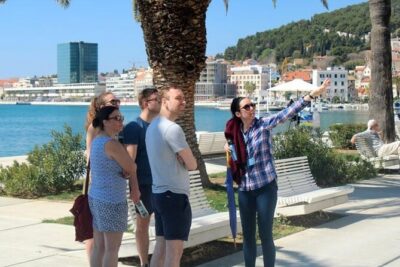
Walking Tour of Split with a ‘Magister’ of History
Read our review →
Split: Diocletian Palace & Old Town Guided Walking Tour
Read our review →
From Split: Krka Waterfalls Cruise & Trogir Walking Tour
Read our review →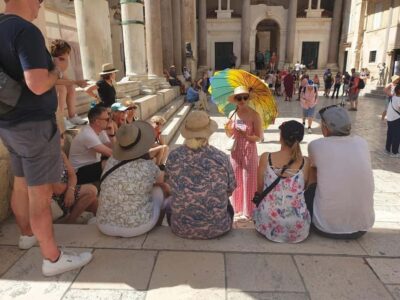
Browse the lists this tour appears in