
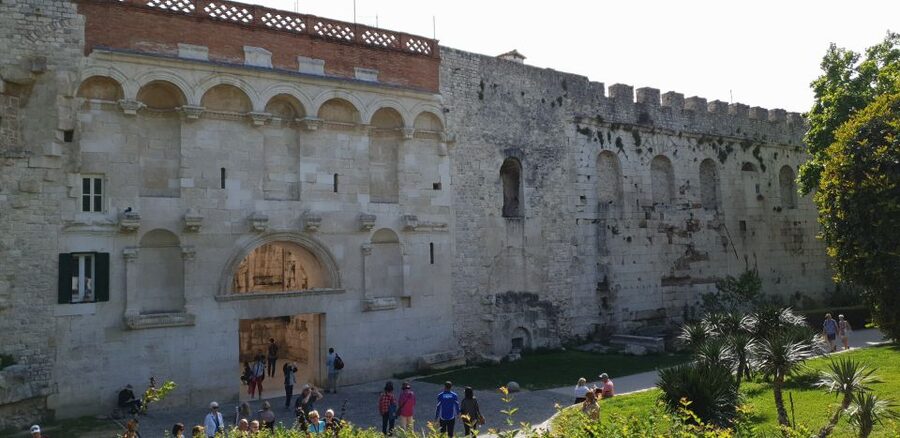
Reviewed · SPLIT OLD TOWN WALKING TOURS
Split: Walking tour of Split with a ‘Magister’ of History
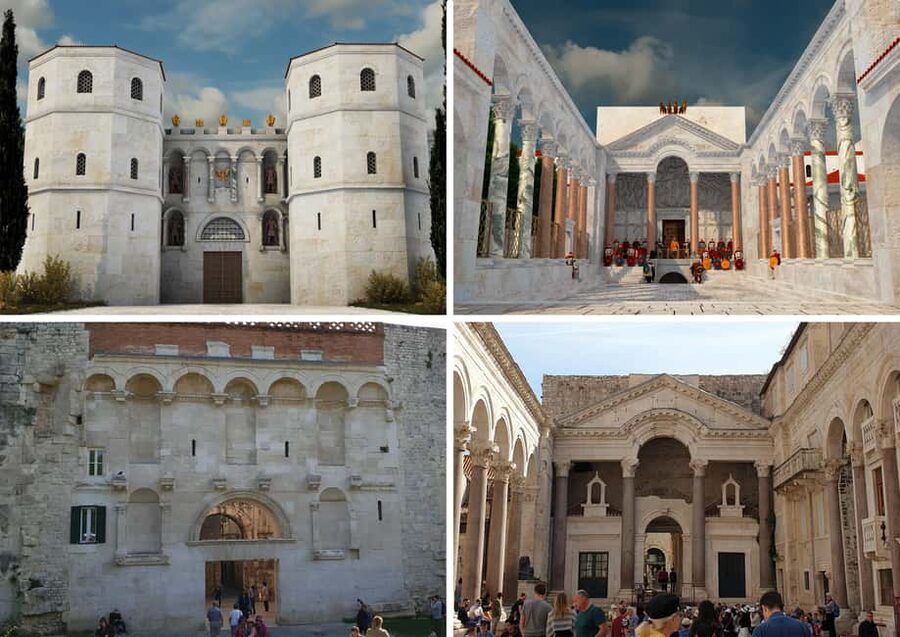
Diocletian’s Palace is not a fenced-off ruin. It is the working heart of Split, with homes, cafés, shops, lanes, and Roman stone all sharing the same space. This walking tour makes sense of that unusual mix with Toni Šare, a Split-born historian and former teacher who uses 3D reconstructions to show what the palace looked like in Roman times.
I like the way the tour moves through several periods instead of stopping at Emperor Diocletian. I also like the open question-and-answer style, plus Toni’s care with shade and crowded areas when possible. The main drawback is that you will not enter paid museums or monuments, and summer heat can make any 110-minute walk demanding.
Key points at a glance
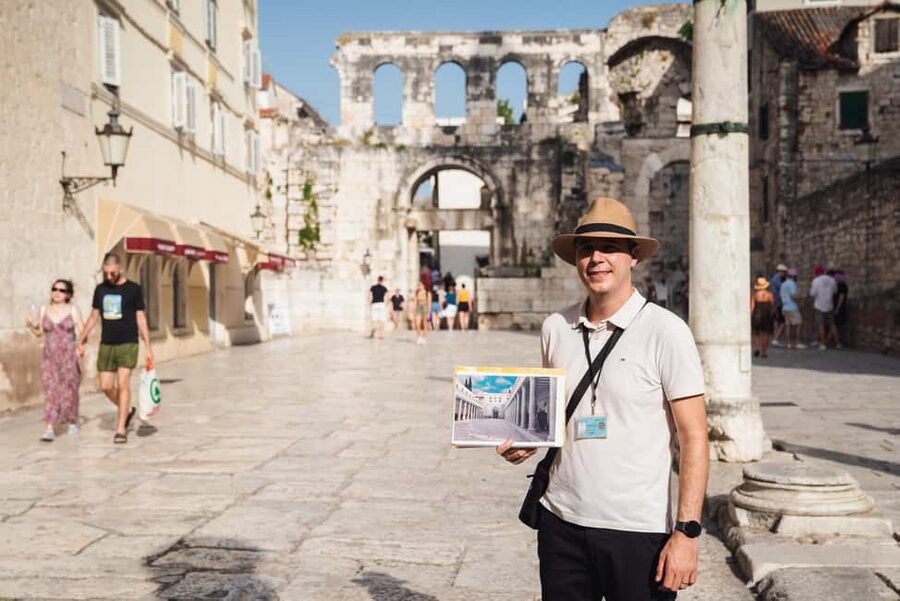
- Roman Split brought to life: Printed 3D images show how Diocletian’s Palace may have looked in its original form.
- A guide who teaches: Toni’s master’s degree in history and former teaching career shape the pace, structure, and explanations.
- Several centuries in one walk: The route connects Roman, medieval, Venetian, and modern Split.
- Questions are part of the plan: You are encouraged to ask about old and recent Croatian history.
- A practical starting point: Meet at the Bronze Gate on the Riva, then finish near the Golden Gate.
- Good value for history fans: At $33 per person, the tour costs more than some basic city walks, but adds visual material and specialist knowledge.
Why Diocletian’s Palace needs a guide
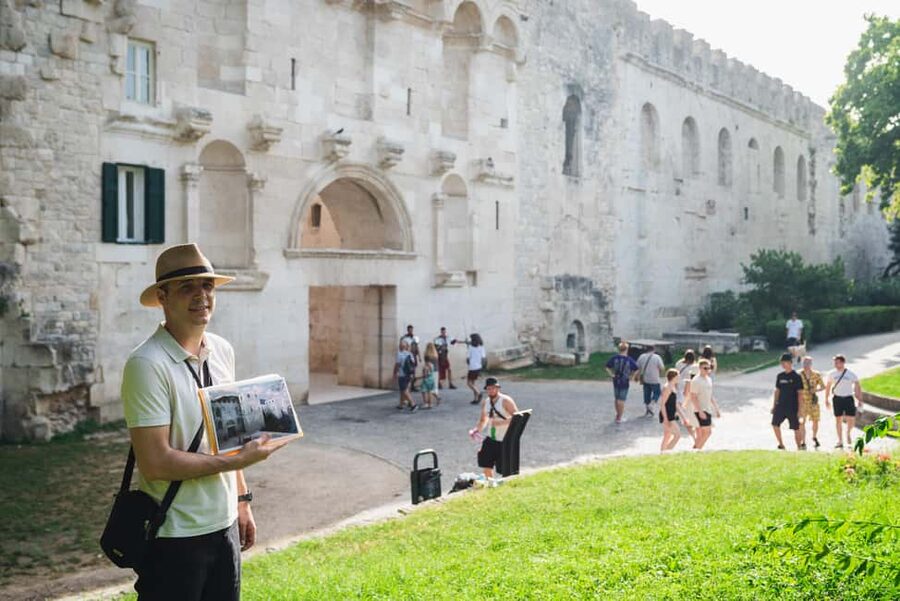
I have seen many historic sites where the main challenge is not finding the monument, but understanding what you are looking at. Split has that problem in a particularly interesting way. Diocletian’s Palace is now the old city, and later buildings have grown into, around, and over the Roman plan.
You may walk through a narrow lane and see a Roman column beside a medieval wall, a Venetian detail, and a modern apartment entrance. Without context, it can feel like a pleasant maze. With Toni’s explanations, the layers begin to connect.
The palace was built for the Roman Emperor Diocletian and later became the center of Split. This tour focuses on that transformation. You are not simply shown a list of old stones. You are asked to notice how a grand imperial residence became a living city.
That focus makes the walk useful early in your stay. After 110 minutes, you should have a better sense of where you are in the old core and why the streets look the way they do. You will also have a clearer idea of which places deserve a second look on your own.
More walks through the old quarter in Split:
- Split: Old Town and Diocletian Palace Walking Tour
★ 4.9 · 4,727 reviews - Walking Tour of Split and Diocletian’s Palace
★ 5.0 · 2,588 reviews - Krka Waterfalls tour with Trogir Walking tour and Krka panoramic boat cruise
★ 5.0 · 1,659 reviews
Meeting Toni at the Bronze Gate
The meeting point is the Bronze Gate, also called the Brass Gate, at Obala Hrvatskog narodnog preporoda 22. It sits on the southern side of the palace, directly by the Riva promenade.
The simplest approach is to find the seafront promenade first, then walk toward the palace entrance. This is a useful detail because Split’s old center can feel confusing when you first arrive, especially with the palace walls and busy waterfront competing for your attention.
The route begins with a short introduction before passing through the Bronze Gate. From there, the tour heads into the palace’s underground cellars and then toward the central areas.
Toni’s background matters here. He was born in Split and has lived there all his life, so his perspective is not limited to the ancient period. He can connect the palace to the city as it exists now, including later Croatian history and the way historic events still affect modern Split.
His former teaching career also shapes the experience. The explanations are arranged as a story, rather than as a rapid stream of dates. You can ask questions throughout, and several people specifically appreciated his willingness to discuss both old and recent history.
The cellars and the palace’s hidden foundations
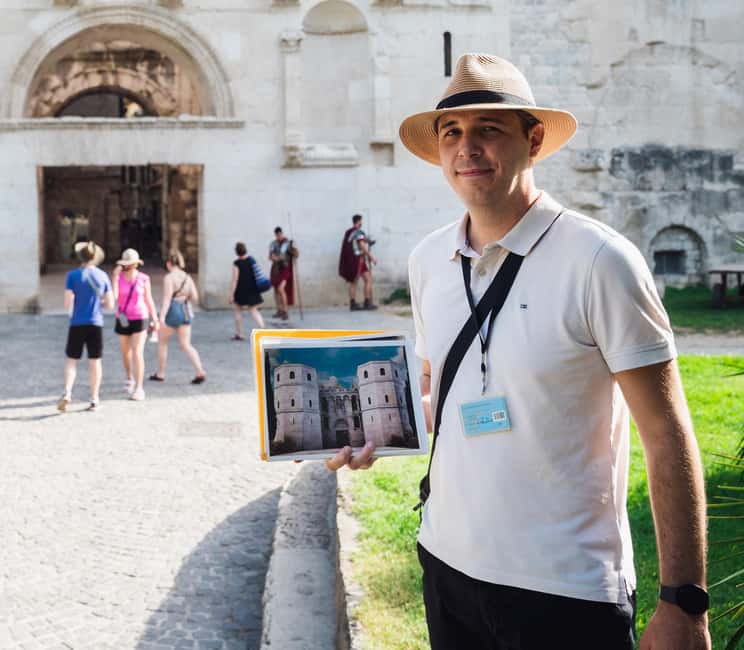
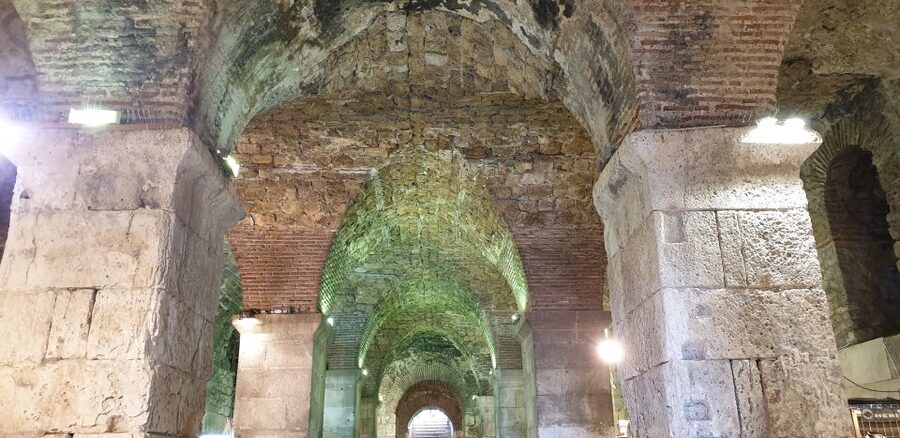
The tour briefly passes through Diocletian’s Cellars after entering by the Bronze Gate. The underground halls are an important first stop because they help explain the palace’s original layout and later development.
This section lasts about ten minutes. It is not presented as a full paid museum visit, and you do not enter a separate ticketed attraction. Still, the cellars give you a strong sense of the scale of the Roman complex and the way its lower structures supported the spaces above.
Toni uses the area to pause for questions. That pause is useful. Instead of racing from one sight to the next, you have a moment to ask what you are seeing or to clarify how the palace changed over time.
The cellars can also be a welcome break from the sun. The rest of the route is outdoors or in open public spaces, so this early indoor section gives the walk a sensible rhythm.
Peristyle, the palace’s grand central stage
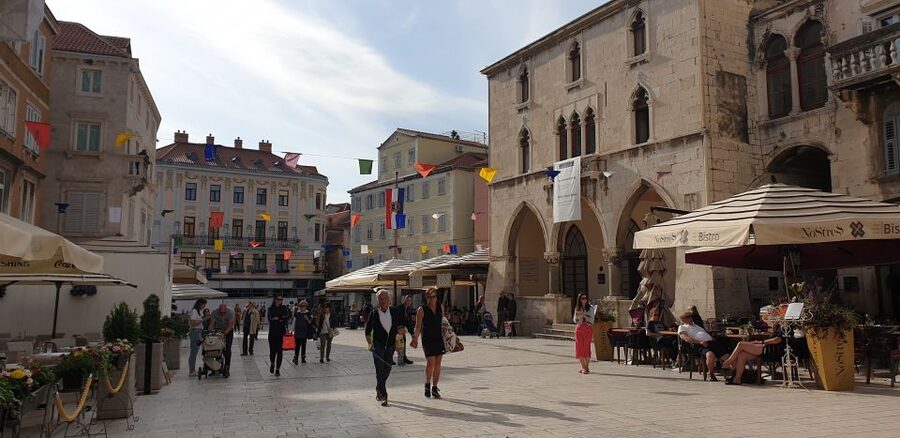
The Peristyle is the visual center of the walk. This large Roman square is surrounded by some of Split’s most important surviving structures, including Diocletian’s mausoleum, the Temple of Jupiter, and the Vestibule.
Toni spends about ten minutes explaining the square, but the wider palace visit gives it more time within the overall story. This is where the 3D reconstructions become especially useful. Looking at ruins in their current state tells you what survives. The reconstructed images help you picture the complete Roman design.
That difference is important. A column or arch can be impressive on its own, but a visual reconstruction shows how the separate pieces once worked together. You can compare the stone in front of you with the larger architectural scheme Toni presents.
The Peristyle is also one of the places where crowds can gather. An early start is a smart choice if you want more room to listen and take photographs. One useful strength of Toni’s approach is his effort to find shade and quieter corners when conditions allow, though the route cannot avoid the popularity of the palace entirely.
More history walks in Split:
- Walking Tour of Split with a ‘Magister’ of History
★ 5.0 · 1,122 reviews - Split Walking Tour with Professor of History
★ 5.0 · 926 reviews - Split: History and Heritage Walking Tour
★ 4.9 · 650 reviews - Split History and Gastro Small-Group Tour with Food and Drinks
★ 5.0 · 375 reviews
The Vestibule and Triklinij
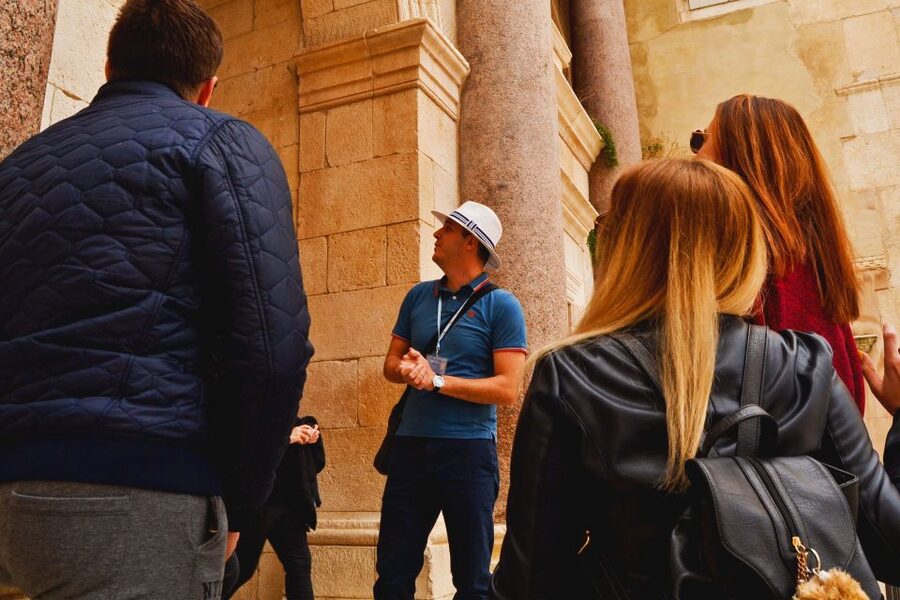
The Vestibule follows the Peristyle. This round entrance space once formed part of the approach to Diocletian’s private residence. Toni gives it about five minutes, using the structure to explain how people moved through the imperial complex.
The short stop works because it is part of a larger sequence. You first see the public ceremonial center, then move toward the private areas of the palace. That contrast helps you understand that Diocletian’s residence was not just one grand hall, but a carefully planned complex with different functions and levels of access.
The next stop is Triklinij, also covered in about five minutes. Here, the focus turns to another part of the former private residence. The remains are easier to appreciate after Toni has explained the palace’s plan and shown the visual material.
You should not expect a long stop at every building. The tour has a lot to cover, so some locations receive a short explanation before the walk continues. That keeps the pace moving, but history fans who want detailed architectural study may want to return later.
The cathedral and Jupiter’s Temple
The route passes the Cathedral of Saint Domnius and Jupiter’s Temple. These sites show how the old palace changed purpose across the centuries.
The cathedral occupies Diocletian’s former mausoleum, a striking example of how later Split was built directly into the Roman complex. The tour does not include entry into paid sites, so you see these places from the route rather than taking a full interior visit.
Jupiter’s Temple is also passed rather than entered. Toni uses the stop to continue the Roman story and explain the relationship between the palace’s religious and residential spaces.
This is one area where you should set your expectations correctly. The walk is about orientation and interpretation, not a ticketed interior tour. If you want to go inside the cathedral, museums, or other paid attractions, you will need to plan those separately and pay their admission costs.
The Silver Gate, Golden Gate, and the city beyond Rome
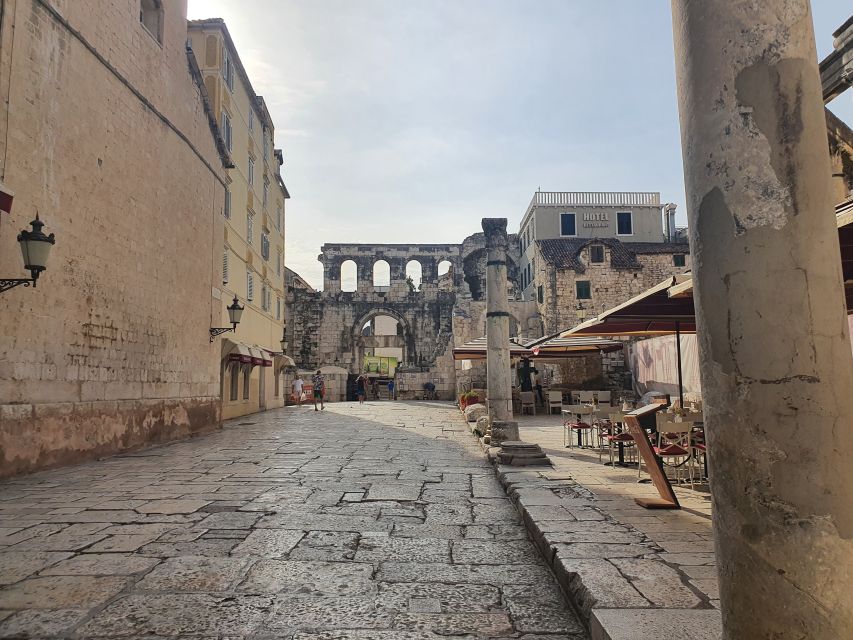
The Silver Gate receives a short guided stop before the route continues toward the Golden Gate. These entrances help you understand the palace as a fortified urban complex, with distinct access points and a clear relationship to the rest of Split.
The Golden Gate is the final stop. It is also where the tour ends, making it a practical place to continue exploring the old city afterward. From here, you can keep walking through nearby lanes or return to sights you want to examine more closely.
The route also brings you past the statue of Bishop Gregory of Nin beside the palace’s north wall, on the way toward the Piazza Square. The statue is one of Split’s best-known public monuments, and its location helps mark the transition from the Roman palace to later medieval and Venetian parts of the city.
The final section is valuable because it does not pretend Split ended with Diocletian. The palace remained the framework for later life. Medieval houses, Venetian traces, and modern streets all occupy the same area, and Toni explains how those changes accumulated.
What makes the 3D reconstructions useful

The 3D material is one of the tour’s clearest advantages. Toni brings printed computer-generated images showing the palace as it may have appeared during Roman times.
I like this approach because it answers a problem that photographs and guidebooks often leave unresolved. You can see the surviving walls, but you cannot easily picture their original color, height, arrangement, or relation to nearby structures. The images give you a reference point while you stand among the remains.
They also help younger visitors and anyone who does not usually enjoy architectural history. One family specifically found the tour suitable for a 12-year-old, and that makes sense. A visual comparison is easier to follow than a long description of missing roofs and altered facades.
Toni is also careful about the limits of historical evidence. The visualizations are used to explain the past, not to pretend every detail is certain. That is a welcome habit in a historic city, where a confident but incorrect story can sound attractive.
The teaching style and pace
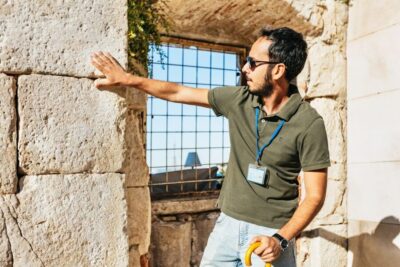
This tour is best for people who want a conversation, not just a script. Toni encourages questions and takes them seriously, from Roman architecture to more recent Croatian events.
His explanations have a classroom quality in the best sense. He selects details that fit a two-hour walk rather than trying to recite every date connected to Split. The result is focused, but still flexible when someone asks for more context.
The pace is moderate. The advertised duration is 110 minutes, and the route covers the Bronze Gate, cellars, central palace, Peristyle, Vestibule, Triklinij, cathedral, Jupiter’s Temple, Silver Gate, and Golden Gate. You will be walking and standing for most of that time.
The main practical issue is weather. The tour runs rain or shine, so bring a drink and dress for the conditions. Summer heat can be tiring, particularly in exposed sections of the old center. An early time slot is worth considering, both for cooler conditions and for smaller crowds at the start of the day.
Is $33 a fair price?
At $33 per person, this is not the cheapest way to see Split’s old town. You can walk around the palace without paying an admission fee, so the price is for Toni’s time, historical training, local perspective, and visual materials.
That added value is strongest if you want to understand what you are seeing. The 3D images are not a standard feature of every city walk, and Toni’s master’s degree in history gives him a strong base for answering detailed questions.
The price also makes more sense if you use the tour as a foundation for the rest of your visit. Afterward, you can return to the cathedral, cellars, temples, gates, or streets with a clearer idea of their purpose. The tour does not include paid entry, food, or drinks, so allow for those costs separately.
If you only want a quick introduction or prefer to explore silently, you may not need this level of guidance. If you want the old city to make sense, $33 is a reasonable outlay for a specialist-led walk.
Who should book this Split walk?
I would choose this tour if you enjoy history, architecture, or local stories that connect the past to present-day life. It is also a good match for families with older children who respond well to pictures and questions.
The walk suits curious first-time visitors especially well. It gives you a map of the old center and helps you decide where to spend extra time afterward.
You should think twice if you need step-free access. The experience is not suitable for wheelchair users, and the historic core includes uneven streets and old structures. It is also not designed for anyone who wants a museum-heavy visit, since paid interiors are not included.
English is the tour language. Bring a drink, wear comfortable shoes, and remember that the weather policy is rain or shine. Cancellation is free up to 24 hours before the start, and you can reserve now and pay later.
Final recommendation
Book this tour if you want more than a quick look at Diocletian’s Palace. Toni’s local roots, teaching background, and handmade 3D reconstructions give the walk a clear purpose: to show how Roman, medieval, Venetian, and modern Split occupy the same old core.
The best reason to choose it is the combination of visual explanation and open discussion. The main limitation is that you will not enter paid sites, and the outdoor walk can be hot or crowded. For a history-minded visit to Split, though, this is a strong first activity and a useful guide to the city you will continue exploring afterward.
FAQ
How long does the Split history tour last?
The tour lasts 110 minutes, or about one hour and 50 minutes.
Where does the tour begin?
It begins at the Bronze Gate, also called the Brass Gate, on the seafront side of Diocletian’s Palace. The address is Obala Hrvatskog narodnog preporoda 22.
Where does the tour finish?
The tour finishes at the Golden Gate of Diocletian’s Palace.
Who leads the tour?
The guide is Toni Šare, a Split-born local historian with a master’s degree in history and a background as a teacher.
What language is the tour conducted in?
The tour is conducted in English.
Are paid attractions included?
No. The tour does not include entry to paid sites or museums. Entering the general area of Diocletian’s Palace does not require admission.
Are the 3D reconstructions included?
Yes. Toni uses 3D reconstructions of important sites to show how parts of the palace may have looked in Roman times.
Is the tour suitable for wheelchair users?
No. The activity is not suitable for wheelchair users. It also is not suitable for people over 95 years old.
What should I bring?
Bring drinks. The tour takes place rain or shine, so you should also dress for the weather.
Just added around Split
- From Makarska : Wine Tasting Grabovac Tour★ 4.5 · 30 reviews
- Unique vintage Tomos moped tour Split – Back to the ’80s★ 4.8 · 17 reviews
- Walking Tour Split★ 4.7 · 61 reviews
- Essential Diocletian’s Palace Tour for First-Time Visitors★ 4.8 · 19 reviews
- Trogir; Private walking tour of higlights of Trogir★ 4.7 · 3 reviews
- Trogir: White Lagoon, Maslinica & Blue Lagoon Speedboat Tour★ 4.8 · 11 reviews
- Trogir 1.5-Hour City Tour★ 4.4 · 37 reviews
- Split: Trogir Open Top Bus Trip + Free Split Walking Tour★ 4.1 · 17 reviews
Split Old Town Walking Tours, compared.
Split: Old Town and Diocletian Palace Walking Tour
Read our review →
Walking Tour of Split and Diocletian’s Palace
Read our review →
Krka Waterfalls tour with Trogir Walking tour and Krka panoramic boat cruise
Read our review →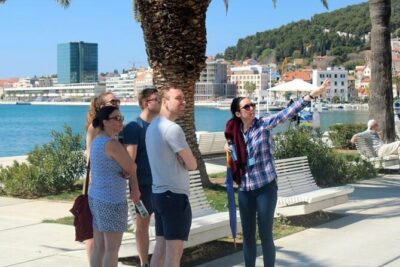

Walking Tour of Split with a ‘Magister’ of History
Read our review →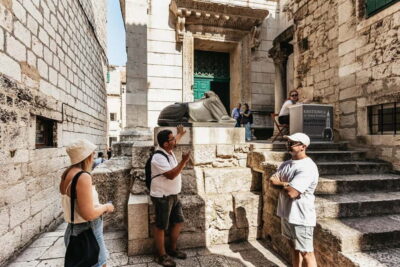
Split: Diocletian Palace & Old Town Guided Walking Tour
Read our review →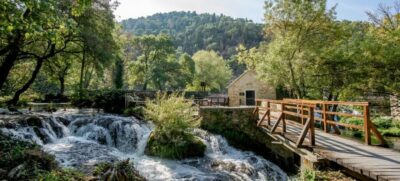
From Split: Krka Waterfalls Cruise & Trogir Walking Tour
Read our review →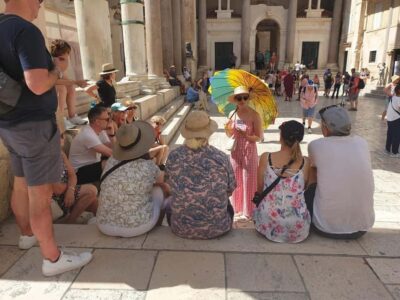
Browse the lists this tour appears in