
Reviewed · SPLIT OLD TOWN WALKING TOURS
History Split Walking Tour in French -Small group
Diocletian’s Palace is not a fenced-off ruin. It is the heart of Split, with cafés, homes, shops, lanes, and ancient stone still woven into daily life. This French-language walk gives you the useful big picture, from Emperor Diocletian’s rise from obscurity to the palace that shaped the city around it. The Peristyle and palace substructures are the central draws, but the route also reaches the Riva, Fruit’s Square, the Golden Gate, and Split’s old synagogue.
I like the way the tour connects grand Roman history with Croatian culture, including Gregory of Nin, Marko Marulić, and traditional Dalmatian singing. I also like the chance to ask questions in a small-group setting, with guides such as Antonela and Irene praised for fluent French, warmth, and clear explanations. The main caution is practical: the advertised 90 minutes may stretch beyond two hours, and the route is not ideal if high steps are difficult.
Key points to know before booking

- French-language history from Roman emperor to modern Split: Learn how Diocletian rose from an obscure background to become one of the most powerful men of his age.
- Seven stops beyond the palace core: The walk adds the Riva, Fruit’s Square, Gregory of Nin, and Split’s Jewish quarter to the main palace sights.
- Small-group format with a maximum of 30 people: This is more personal than a large city walk, though 30 is still a substantial upper limit.
- A route that can last longer than 90 minutes: Allow extra time if your guide, such as Antonela or Irene, expands on questions and local stories.
- No museum ticket included: The palace substructures are visited, but the museum section is left for you to explore afterward.
- Good value for history-focused visitors: At $69.14 per person, the price makes the most sense if you want context, a French-speaking guide, and several old-town sights in one outing.
Why this Split walk works
Split can be confusing at first. The city’s old center grew inside and around the retirement palace built for Emperor Diocletian, so Roman walls now form part of ordinary streets. A guide helps you see the plan beneath the modern city instead of treating the palace as a string of disconnected stones.
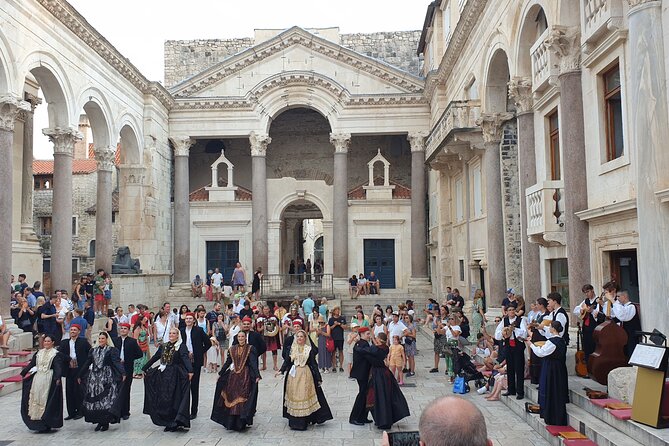
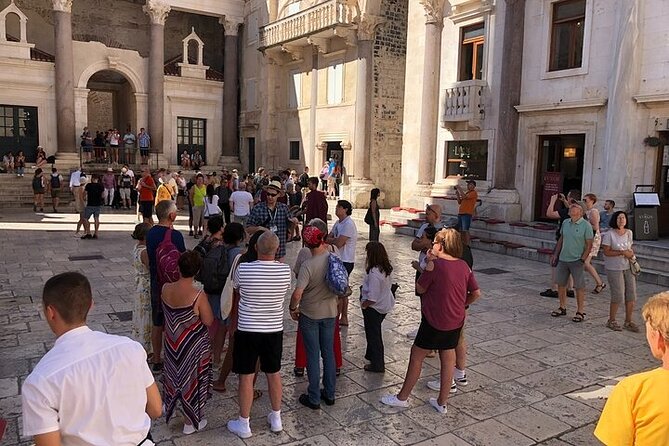
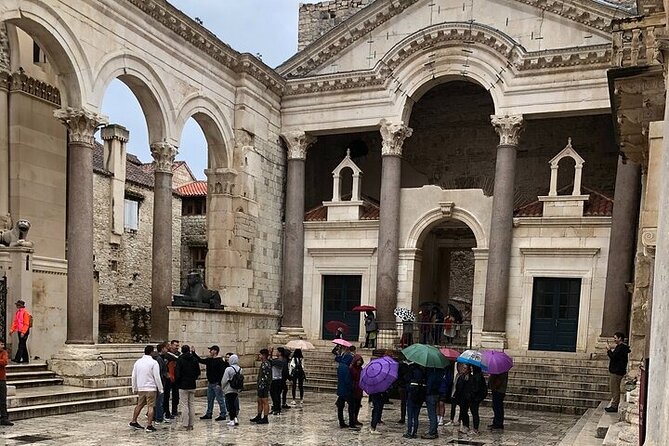
This tour is built around that idea. You begin at the Peristyle, the palace’s main ceremonial square, then move through the Vestibule and underground substructures. From there, the route heads outside the palace core toward the Golden Gate, Riva Harbor, Fruit’s Square, and the old synagogue.
I especially like the balance. You get imperial architecture, engineering, medieval and Venetian traces, Croatian literature, local religious history, and views of the waterfront. It is not only a Roman tour.
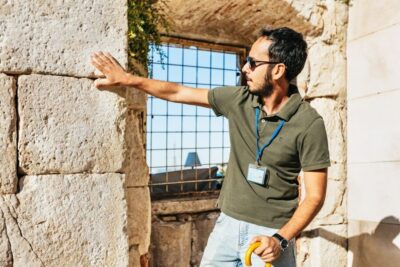
The French language is a major reason to choose this particular walk. Several guides, including Antonela and Irene, have been singled out for speaking French fluently and explaining complex history in an easy, engaging way. One guide is described as a former diplomat, which may appeal to you if you enjoy broader political and cultural context rather than a quick list of dates.
The format is called small-group, with a maximum of 30 people. That number is not tiny, so do not expect a private tour. Still, it gives the guide a better chance to address questions than a large coach group. The experience also accepts a mobile ticket and offers group discounts.
More walks through the old quarter in Split:
- Split: Old Town and Diocletian Palace Walking Tour
★ 4.9 · 4,727 reviews - Walking Tour of Split and Diocletian’s Palace
★ 5.0 · 2,588 reviews - Krka Waterfalls tour with Trogir Walking tour and Krka panoramic boat cruise
★ 5.0 · 1,659 reviews
Starting at the Peristyle, Split’s Roman stage
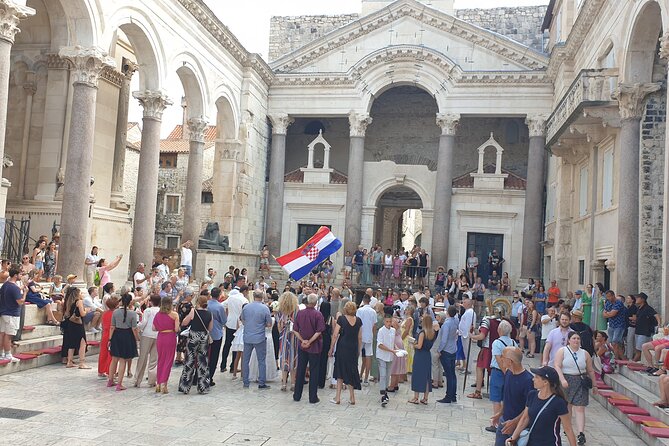
The meeting point is on Peristil ulica, at the Peristyle of Diocletian’s Palace. This is a sensible place to begin because the square acts as the palace’s main crossroads. From here, you can reach many other surviving sections of the complex.
Allow yourself time to locate the meeting point before the start. The old center is made for walking, but its lanes can feel like a maze when you first arrive. Once you are at the Peristyle, the guide can immediately point out how the palace was organized and why this square mattered.
The Peristyle is scheduled for about 15 minutes. That is enough for an introduction to the emperor, the palace plan, and the role of the square, though it is not a long architectural lecture. You will want to look up and around as well as listen. The value here is learning how to read the space before you move into the smaller passages.
Diocletian’s personal story gives the tour its strongest opening. He did not begin life as an obvious candidate for supreme power. The guide explains how he rose from a modest background to become emperor, then chose this part of the Adriatic for a retirement palace. That story gives the stone a human motive: this was not simply a fortress or government office, but a carefully planned home for a former ruler.
The Vestibule and the sound of Dalmatia
The Vestibule is a brief stop, listed at about five minutes. It was the entrance space leading toward the emperor’s private quarters, and its shape helps you understand the transition from public ceremony to private residence.
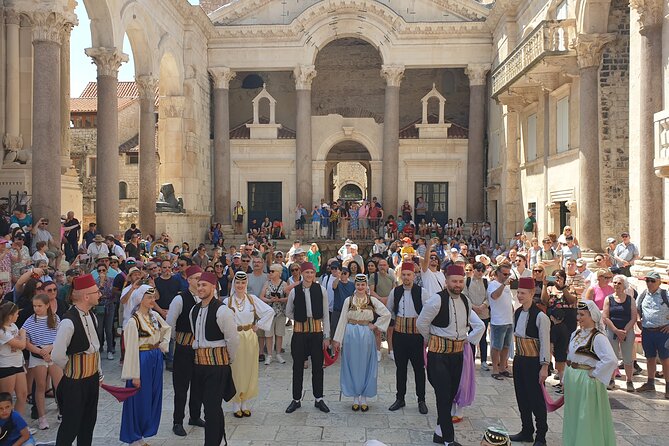
The guide may also include traditional Dalmatian singing here. The possibility is not guaranteed, but it adds a local note that a standard architecture lecture cannot provide. I like this kind of moment because it links the old building to living culture without needing a long performance.
Because the stop is short, you should not expect an extended music program or a detailed visit inside every nearby room. Think of it as a quick encounter with one of the palace’s most recognizable spaces, paired with a hint of regional tradition.
Going below ground in the palace substructures
The substructures receive about 10 minutes. These lower rooms are important because they show how the palace was built and how its underground plan relates to the rooms above. They also help explain the engineering behind the complex.
This portion can be especially useful if the upper palace feels hard to interpret. Above ground, modern shops and homes can hide the original layout. Below ground, the structure makes the plan easier to follow. You begin to see how the lower rooms supported and mirrored the imperial residence.
There is an important limit. The tour passes through the substructures but does not include the museum section. You can visit that part after the walk, but you should budget separately for it if you want a fuller underground visit. The tour price does not include admission to that museum area.
For many people, this is the point where the palace changes from an impressive old center into a readable piece of Roman planning. If you enjoy buildings and construction details, pay close attention here. If you mainly want a quick overview, the guide’s explanation should give you enough to understand the rest of the route.
More history walks in Split:
- Walking Tour of Split with a ‘Magister’ of History
★ 5.0 · 1,122 reviews - Split Walking Tour with Professor of History
★ 5.0 · 926 reviews - Split: History and Heritage Walking Tour
★ 4.9 · 650 reviews - Split History and Gastro Small-Group Tour with Food and Drinks
★ 5.0 · 375 reviews
The Golden Gate and Gregory of Nin
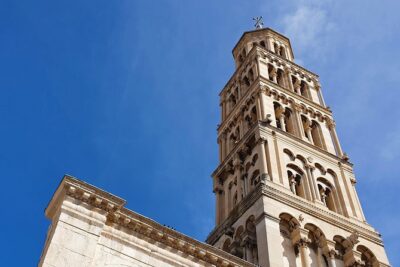
The Golden Gate is the palace’s main entrance and receives about 10 minutes. It is a useful place to see how imperial power was presented to people approaching the palace. The guide also introduces the statue of Gregory of Nin and explains his importance to Croatian history and language.
This stop shifts the focus from Roman authority to Croatian identity. Gregory of Nin is not simply another monument in a square. His role connects to the development and protection of Croatian language and religious culture, making the statue a good reminder that Split’s story continued long after Diocletian.
You may hear the familiar advice to touch the statue’s toe for luck. That particular custom is not part of the supplied tour details, so I would not count on it as an official activity. The reliable reason to pause is the explanation of why Gregory matters.
The Golden Gate is also a busy public passage. Keep your attention on the guide and be ready for people moving through the entrance. The stop is short, so it helps to arrive with a basic sense of the palace layout from the earlier Peristyle discussion.
Riva Harbor and the city beyond the walls
The walk continues to Riva Harbor for about 15 minutes. Here you see a bronze model of Diocletian’s Palace and hear about the history of Split’s waterfront promenade.
This is one of the most useful transitions on the route. Inside the palace, it is easy to think only about Roman walls. At the Riva, you can place the old center within the larger city and understand its relationship with the sea. The bronze model should help you picture the original palace footprint from a different angle.
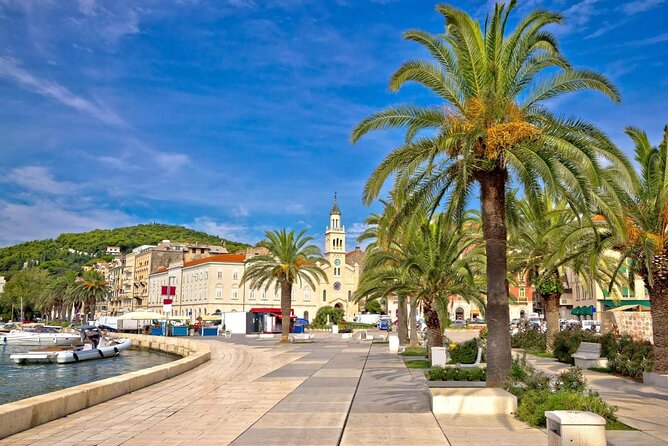
The Riva also gives the tour a change of pace. After narrow lanes and ancient rooms, the promenade opens the view and lets you consider Split as a port city rather than only an archaeological site. If you are deciding what to do next in Split, this stop can also help you get oriented for independent walks along the waterfront.
The listed time is 15 minutes, enough for the model and a short account of the promenade’s development. It is not a dedicated harbor excursion, so do not expect a long waterfront walk or a boat trip.
Fruit’s Square, Venetian power, and Croatian literature
Fruit’s Square, officially Trg Brace Radic, receives about 10 minutes. The guide discusses a 15th-century Venetian citadel and the importance of Marko Marulić, often called the father of Croatian literature.
This is a strong addition to the route because it shows Split under a later political influence. The palace may dominate the city’s image, but Venetian rule and local literary culture are also part of what you are seeing. The square helps move the story forward from Roman emperor to medieval and early modern Split.
Marko Marulić gives the guide a way to discuss Croatian culture through a specific person rather than a broad statement. If you enjoy learning how a city’s language and literature shaped its identity, this should be one of the more rewarding stops.
The visit is brief, so the guide cannot cover every detail of the citadel, the square, or Marulić’s work. Still, it supplies enough context to make the square more than a photogenic pause. After the tour, you can return on your own if you want to look more closely.
Passing Split’s historic synagogue
The final listed stop is the Split Synagogue, a 16th-century synagogue, with about 10 minutes devoted to the history of the Jewish people in the city.
This is a valuable part of the route because it widens the story again. Split was shaped by more than emperors, armies, and rulers. Jewish residents formed part of the city’s social and religious life, and the synagogue provides a place to discuss that past.
The itinerary says you pass by the synagogue rather than enter it, and admission is not included. Keep that distinction in mind when setting expectations. This is an outside explanation and historical introduction, not a full interior visit.
I appreciate the inclusion because many short old-town walks focus only on the most famous monuments. A brief account of Jewish history gives you a more balanced understanding of the people who lived in Split across different periods.
How much time to allow
The official duration is about one hour and 30 minutes. In practice, you should keep your schedule flexible. The route includes seven stops, and the guide may take extra time for questions or detailed explanations. Some sessions have lasted more than two hours.
That longer timing is not necessarily a problem. If you have a ferry, restaurant reservation, or museum entry immediately afterward, it could be inconvenient. If your schedule is open, the added time can make the walk feel less rushed.
The advertised stop times total about 75 minutes, leaving room for moving between locations, introductions, and questions. This explains why the tour can run longer than the simple sum of the stops. I would set aside two hours, especially if you want to remain engaged rather than leave early.
The route ends back at the meeting point. That makes it easy to continue exploring the palace, return to the Riva, or visit the substructure museum section that is not part of the walk.
Is $69.14 a fair price?
At $69.14 per person, this is not the cheapest way to see Split’s old center. You can walk through the Peristyle, Golden Gate, Riva, and Fruit’s Square without paying an entrance fee. The price pays for the French-speaking guide, the organized route, and the historical links between those places.
The value is strongest if you want a clear explanation rather than a quick look. You are not only being shown the palace. You are getting Diocletian’s rise, the palace’s construction, the role of the substructures, Gregory of Nin, Venetian influence, Marko Marulić, and Split’s Jewish community in one connected walk.
It is also a reasonable choice for families who want a guide to keep the story moving. The route has enough variety to hold attention, and children may respond better to the emperor’s personal story, the underground rooms, and the bronze palace model than to a long museum visit.
The price is harder to justify if you only want photographs or plan to read about Split independently. It also does not cover gratuities or the museum area of the palace substructures. Group discounts may improve the cost for several people booking together.
Who should book this French-language walk?
I would choose this tour if you want:
- French explanations rather than an English-language tour
- A first introduction to Split’s old center
- Roman architecture mixed with Croatian, Venetian, and Jewish history
- A guide who can answer questions
- A route that finishes where it begins
- A family-friendly way to give structure to an old-town visit
It suits visitors who prefer a guided overview before exploring alone. The tour can help you decide which places deserve a second look, especially the substructures, Riva, or Fruit’s Square.
It may not suit you if high steps are a concern. The activity specifically warns that it is not recommended for people who have difficulty with high steps. Most people can participate, and service animals are allowed, but the old palace setting is not a flat, modern museum route.
The group maximum is 30 people. That is small compared with a coach outing, but larger than a private walk. If close personal attention is your top priority, ask about the group size available on your date before booking.
Free cancellation is available if you cancel at least 24 hours before the local start time. Changes or cancellations inside that window are not accepted for a refund. The tour also requires a minimum number of participants, and if that requirement is not met, you are offered another date or experience, or a full refund.
My call: book it for context, not just access
Book this tour if French is important to you and you want Split to make sense as a living city built around a Roman palace. The strongest features are the fluent French guides, the range of subjects, and the way the route joins famous sights with less obvious stories about language, literature, and Jewish life.
I would allow two hours, wear comfortable shoes, and keep the rest of your day flexible. If you can manage the steps and do not mind paying for interpretation rather than admission, the $69.14 price can be worthwhile.
Skip it if you only want to wander freely or already know Diocletian’s Palace well. For everyone else, especially families and French-speaking visitors, it is a practical first look at Split that gives you plenty to follow up on afterward.
FAQ
Where does the History Split Walking Tour begin?
It begins at Peristil ulica, at the Peristyle of Diocletian’s Palace in Split, Croatia.
Where does the tour finish?
The activity ends back at the meeting point.
How long does the tour last?
The stated duration is about one hour and 30 minutes. Some tours can last more than two hours, so allow extra time.
Is the tour conducted in French?
Yes. It is a French-language walking tour. Guides named in tour feedback include Antonela and Irene, and the experience is described as being led in fluent French.
What sights are included?
The route includes the Peristyle, Vestibule, palace substructures, Golden Gate, Riva Harbor, Fruit’s Square, and the Split Synagogue.
Is admission to the palace substructure museum included?
No. The tour passes through the substructures but does not visit the museum section. You can visit that part after the tour, with admission not included.
Is the tour suitable for people with mobility concerns?
Most people can participate, but the tour is not recommended for people who have difficulty with high steps.
What is the cancellation policy?
You can cancel at least 24 hours before the local start time for a full refund. Cancellations or changes made less than 24 hours before the start are not accepted for a refund.
Just added around Split
- From Makarska : Wine Tasting Grabovac Tour★ 4.5 · 30 reviews
- Essential Diocletian’s Palace Tour for First-Time Visitors★ 4.8 · 19 reviews
- Unique vintage Tomos moped tour Split – Back to the ’80s★ 4.8 · 17 reviews
- Walking Tour Split★ 4.7 · 61 reviews
- Trogir; Private walking tour of higlights of Trogir★ 4.7 · 3 reviews
- Trogir: White Lagoon, Maslinica & Blue Lagoon Speedboat Tour★ 4.8 · 11 reviews
- Trogir 1.5-Hour City Tour★ 4.4 · 37 reviews
- Split: Trogir Open Top Bus Trip + Free Split Walking Tour★ 4.1 · 17 reviews
Split Old Town Walking Tours, compared.
Split: Old Town and Diocletian Palace Walking Tour
Read our review →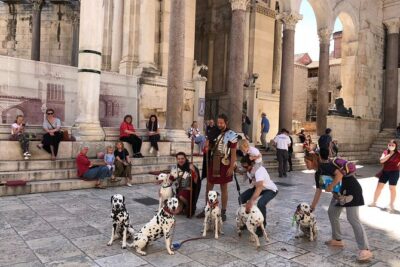
Walking Tour of Split and Diocletian’s Palace
Read our review →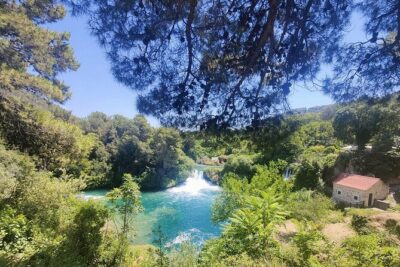
Krka Waterfalls tour with Trogir Walking tour and Krka panoramic boat cruise
Read our review →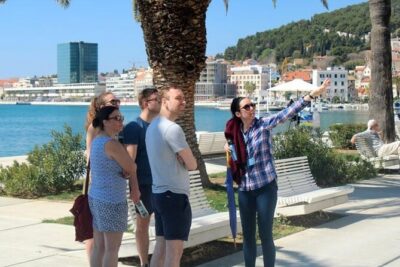
Walking Tour of Split with a ‘Magister’ of History
Read our review →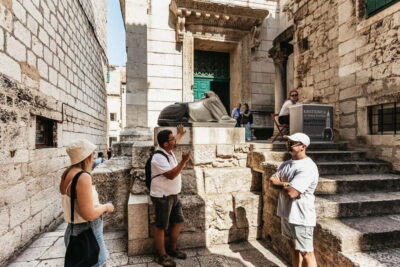
Split: Diocletian Palace & Old Town Guided Walking Tour
Read our review →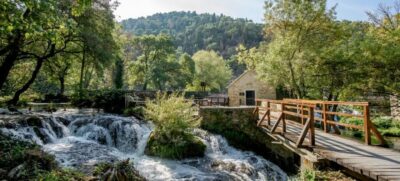
From Split: Krka Waterfalls Cruise & Trogir Walking Tour
Read our review →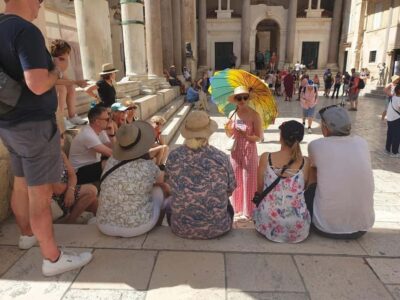
Browse the lists this tour appears in