
Reviewed · SPLIT OLD TOWN WALKING TOURS
Private History Split Walking Tour in Spanish
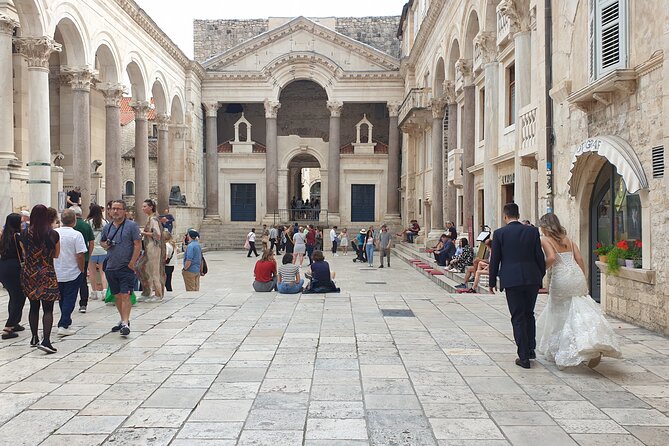
Split’s old center is not just a Roman ruin. It is a living city built inside an emperor’s palace. This private Spanish-language walk gives you the keys to that puzzle, from the Peristyle and Jupiter’s Temple to medieval gates, Venetian traces, and the waterfront.
I like two things right away: your group gets a private guide, and the route covers both the famous sights and less obvious pieces of Split’s past, including the Jewish community and Croatian writer Marko Marulić. The main drawback is the price, $63.05 per person, and the tour does not include admission to the museum section of the palace cellars.
Key points at a glance
- A private Spanish-language walk through Diocletian’s Palace: Your own group participates, so you can ask questions without keeping pace with a large crowd.
- Roman, medieval, Venetian, and modern Split in 90 minutes: The route links the emperor’s palace to the Riva, Fruit’s Square, the synagogue, and the statue of Gregory of Nin.
- The Peristyle is the main stage: This central square helps you understand how the palace was laid out and how its spaces connect.
- The cellars are explained, not fully toured as a museum: You pass through the substructures, but museum admission is not included.
- A useful Spanish option for first-time visitors: A Spanish review praised the guide’s careful answers, clear explanations, and good command of Spanish.
- High steps are the main physical concern: The tour is suitable for most people, but it is not recommended if stairs are difficult.
Why Diocletian’s Palace works best with a guide
The most interesting fact about Split’s center is that the palace did not remain a dead monument. People built homes, shops, lanes, and civic spaces into it over the centuries. As you walk, Roman stonework appears beside later buildings, and a square once designed for imperial ceremony becomes part of an everyday Croatian city.
A guide helps you see the plan behind the maze. Diocletian’s Palace can feel like a collection of narrow passages until someone points out the main axes, gates, temples, residential areas, and waterfront side. This tour also puts Emperor Diocletian’s rise into context, explaining how a man from humble beginnings became one of the most powerful rulers in the Roman world.
The private format matters here. You do not have to wait for a large group to gather, and you can ask about the details that catch your eye. If your group is interested in Roman engineering, Croatian literature, religious history, or local traditions, you can give the guide a little direction.
The tour lasts about 90 minutes. That is long enough for a well-paced introduction, but not long enough for every room or museum display. I see it as a strong first orientation, especially if you plan to explore the palace on your own afterward.
More walks through the old quarter in Split:
- Split: Old Town and Diocletian Palace Walking Tour
★ 4.9 · 4,727 reviews - Walking Tour of Split and Diocletian’s Palace
★ 5.0 · 2,588 reviews - Krka Waterfalls tour with Trogir Walking tour and Krka panoramic boat cruise
★ 5.0 · 1,659 reviews
Starting at the Peristyle, Split’s Roman heart
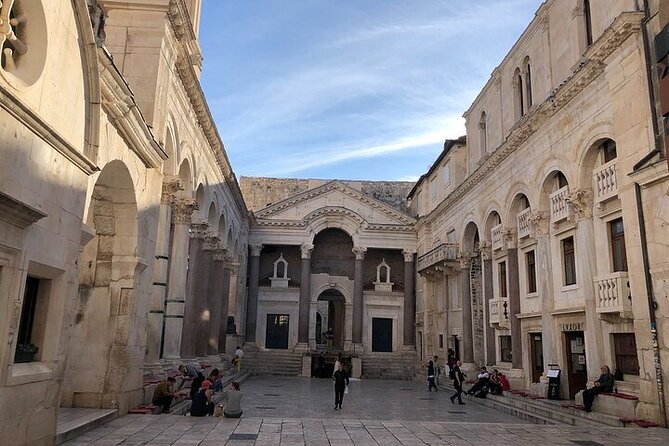
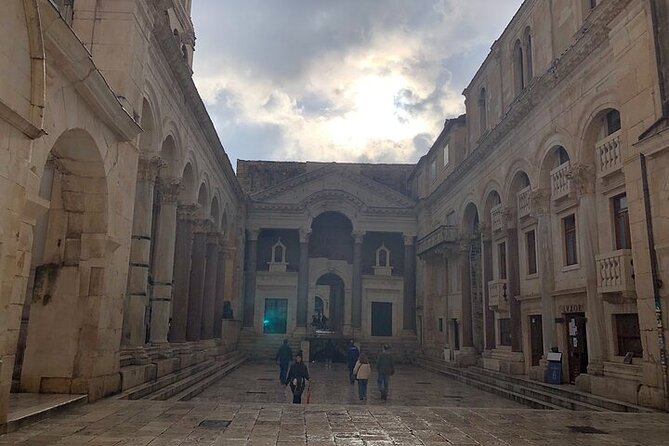
The meeting point is on Peristil ulica, at the Peristyle, the central square of Diocletian’s Palace. This is the right place to begin because so many routes inside the palace lead back here.
The Peristyle gives you an instant sense of imperial scale. It was designed as a ceremonial space connected to the emperor’s apartments and sacred buildings. Your guide explains how the square fits into the wider palace plan and how you can reach other important sections from it.
You will also learn about Jupiter’s Temple, a Roman temple linked to Diocletian’s religious ideas. The emperor considered Jupiter his divine father, so this is not just an architectural stop. It helps explain the political language of Roman power, where an emperor’s authority was tied to the gods as well as the army and state.
The stop lasts about 15 minutes. That is enough time to establish the basic layout without spending the whole tour in one square. Bring your questions early, since the private format makes this a good place to ask how the palace changed after the Roman period.
The palace cellars reveal the plan above
The substructures of Diocletian’s Palace are one of the most useful stops for understanding the building. You pass through the lower levels while hearing how they were constructed and how their function changed over time.
These spaces once supported the upper parts of the palace. Their layout also helps explain the rooms and streets above. A guide can point out how the lower structure reflects the organization of the emperor’s residence, ceremonial areas, and service spaces.
It is important to know what this tour does not include. You do not visit the museum section of the substructures as part of the walk, and no admission tickets are included. You can visit that museum after the tour if you want a closer look at the archaeological material.
The guided passage through the cellars takes about 10 minutes at one point in the route, with another substructure visit listed later. I would treat this as an architectural explanation rather than a full museum visit. That distinction matters if you are booking mainly to see exhibits underground.
The Golden Gate and Gregory of Nin
At the Golden Gate, you see the main entrance to Diocletian’s Palace. The gate is one of the clearest places to picture how people entered and moved through the Roman complex.
The stop also introduces Gregory of Nin, whose statue has an important place in Croatian history and language. The guide explains why he matters, turning what could be a quick photo stop into a lesson about Croatia’s cultural identity.
The visit lasts about 10 minutes. That may sound brief, but the tour is designed to connect several parts of Split rather than linger at one monument. If you want a photograph of the statue, you should have time to take one while the guide explains its background.
The Golden Gate also helps you understand the difference between seeing Split as a collection of sights and seeing it as a city shaped by its past. You are not simply looking at an old entrance. You are following the route from imperial Rome into Croatian memory.
More history walks in Split:
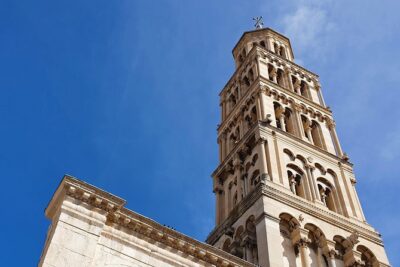
- Walking Tour of Split with a ‘Magister’ of History
★ 5.0 · 1,122 reviews - Split Walking Tour with Professor of History
★ 5.0 · 926 reviews - Split: History and Heritage Walking Tour
★ 4.9 · 650 reviews - Split History and Gastro Small-Group Tour with Food and Drinks
★ 5.0 · 375 reviews
Riva Harbor adds Split’s waterfront story
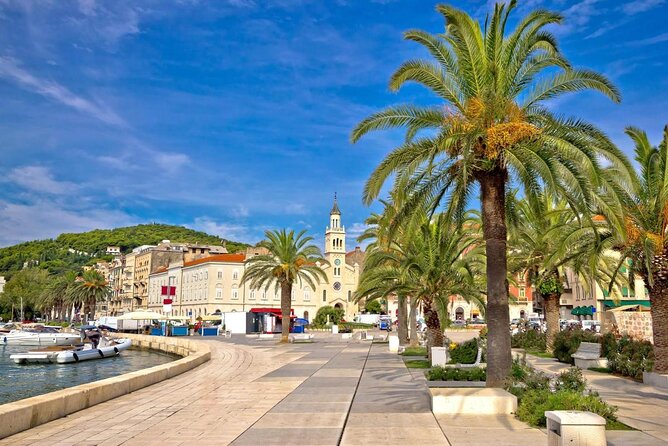
The walk continues to Riva Harbor, the broad waterfront promenade. Here you see a bronze model of Diocletian’s Palace, which gives you a useful view of the whole complex in miniature.
This is one of the smartest stops for orientation. Inside the palace, the lanes can make the original plan hard to grasp. The model lets you step back and see how the palace related to the sea, its walls, gates, and inner buildings.
Your guide also explains the story of the Riva. The promenade is one of Split’s most recognizable public spaces, but its role makes more sense when you connect it to the palace and the city’s later growth. The stop lasts about 15 minutes, giving you a little more breathing room than several of the shorter points.
I like this part because it breaks up the close quarters of the old center. You get an open view, a practical map of the palace, and a chance to reset before returning to the tighter streets.
Fruit’s Square links Venice with Croatian literature
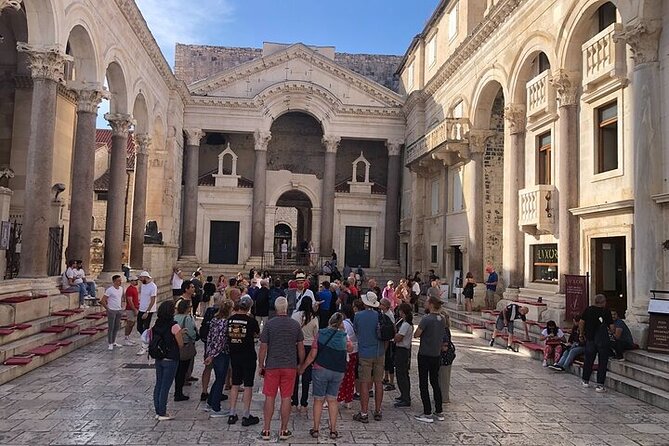
Fruit’s Square, also called Trg Brace Radic, brings in a later chapter of Split’s story. Here you learn about a 15th-century Venetian citadel and the importance of Marko Marulić, often described as the father of Croatian literature.
This pairing works well. The citadel represents the political and defensive forces that shaped the city, while Marulić points to the development of Croatian literary culture. The tour does not stop with emperors and stones. It gives you a reason to pay attention to language and local identity too.
The stop lasts about 10 minutes. It is a useful place to ask the guide how Split changed under Venetian influence and how Croatian cultural figures are remembered today.
The name Fruit’s Square can sound casual, but the setting carries serious historical weight. You get another reminder that Split’s center is not a single-era monument. Roman foundations, medieval life, Venetian defenses, and modern city life sit close together.
A short look at Split’s Jewish heritage
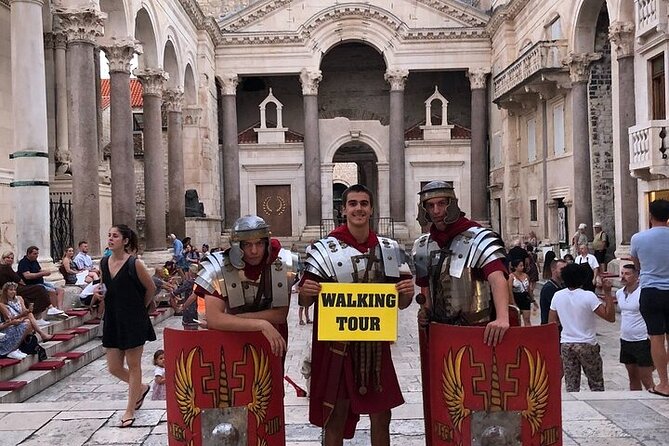
The route passes by Split Synagogue, dating to the 16th century, and introduces the history of the city’s Jewish people. Admission is not included, and the stop is presented as a pass-by rather than a full interior visit.
This is a valuable inclusion because it broadens the story beyond rulers, soldiers, and Christian monuments. A city’s past also includes communities that worshipped, worked, traded, and formed families there. Even a short explanation can help you notice a part of Split that is easy to miss while rushing between the major Roman sights.
You should keep your expectations measured. The scheduled time here is about 10 minutes, so it is an introduction, not an extended study of the synagogue or Jewish heritage in Split. If this subject matters greatly to you, ask the guide what else you can see or read about after the walk.
The Vestibule and the sound of Dalmatia

The Vestibule was part of Emperor Diocletian’s palace, and the tour uses it to explain another piece of the imperial complex. The stop lasts about five minutes, making it one of the shortest on the route.
You may also hear traditional Dalmatian singing here. That possibility adds a local touch to the Roman setting, though it should not be treated as a guaranteed performance. The Vestibule is a good example of how the tour connects physical remains with living tradition.
For me, this is the kind of small moment that makes a walking tour feel grounded in place. You are not only studying ancient walls. You are also hearing about the region’s cultural life, right inside a space built for an emperor.
What the Spanish-language guiding adds
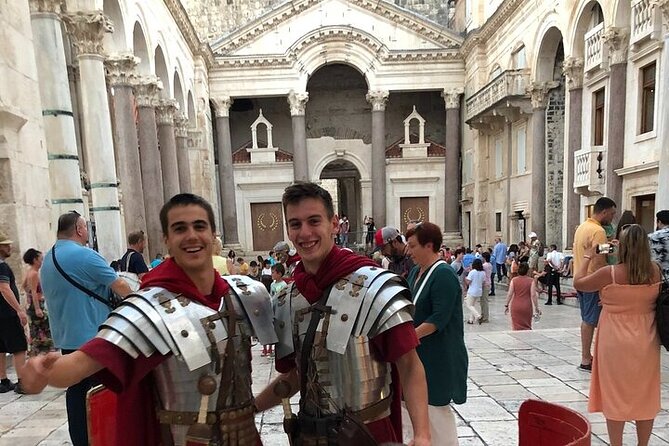
The tour is designed for Spanish speakers, and that can make a major difference in a place with layered names, dates, and cultural references. A Spanish review specifically praised the guide for being attentive, explaining the palace and emperor clearly, and answering questions well. It also noted that the guide’s Spanish was good.
That is useful information, but I would keep the wording in mind. The guide is described as having good Spanish, not necessarily as a native speaker. If you need highly specialized Spanish interpretation, you may want to confirm language details before booking.
The private setting gives the guide room to adjust explanations. You can ask for more detail about Diocletian, the Roman temple, Croatian language, Jewish heritage, or the palace’s later uses. In a large group, those questions can be hard to fit in. Here, they are part of the reason to pay for a private experience.
The tour has a 4.9 rating from 31 reviews, with 97 percent recommending it. That is a strong record, though the sample is modest. I would place the most weight on the specific praise for clear Spanish explanations, attention to questions, and the guide’s grasp of the palace and emperor.
Is $63.05 per person a fair price?
At $63.05 per person, this is not the cheapest way to see Split’s old center. The value comes from the private format and the language service, not from included admissions. There are no entrance tickets included, and gratuities are separate.
For a couple or small family, the price may make sense if you want a focused introduction without sharing the guide with strangers. Group discounts may also improve the calculation for larger parties. Since this is a private activity, the cost can feel more reasonable when divided among several people.
You should also consider what you get in 90 minutes. The route covers the palace center, cellars, Golden Gate, Riva, Fruit’s Square, synagogue, and Vestibule. It is a broad introduction rather than an extended archaeological visit.
I would book it for the explanations and structure, not because it includes special access. If you already know Diocletian’s Palace well, the price may be harder to justify. If you are new to Split and want Spanish guidance, the private attention can be worth the extra cost.
Practical details that affect your day
The walk begins at the Peristyle and ends inside Diocletian’s Palace, not far from the starting point. If you ask, the guide can take you back to the Peristyle, which is helpful if you are meeting someone there or need to continue from the same place.
Most people can participate, and service animals are allowed. The tour is near public transportation, so it fits easily into a day of sightseeing without arranging a separate transfer.
High steps are the main warning. The experience is not recommended if you have trouble with steep or high stairs. Palace streets and older structures can also require careful footing, so wear shoes that feel secure.
Confirmation is provided within 48 hours of booking, subject to availability. The tour is often booked about 115 days ahead, which suggests you should reserve early if your dates are fixed, especially during a busy season.
Free cancellation is available if you cancel at least 24 hours before the local start time. Cancellations or changes inside that window are not refunded or accepted. If the minimum number needed for the experience is not met, you are offered another date or experience, or a full refund.
Who should book this Spanish Split walk?
I would choose this tour if you want a private introduction to Split and prefer to hear the story in Spanish. It suits first-time visitors, couples, families, and small groups who value questions and a flexible conversation over a low-cost group walk.
It is also a good match if you want more than Roman ruins. The route includes the Venetian citadel, Croatian literature, Jewish heritage, Dalmatian singing, and the Riva. Those additions give you a better sense of how the city grew and changed.
I would think twice if your main goal is a long visit inside the palace museum. The substructures are explained, but the museum section is not included, and admission tickets are not part of the price. I would also choose another option if high steps are a serious problem.
Should you book it?
Book this private Spanish tour if you want a clear, compact introduction to Diocletian’s Palace with time to ask questions. The strongest reasons are the private group format, the broad route, and the guide’s reported ability to explain the palace and emperor in good Spanish.
Skip it if you want a self-guided stroll, a low price, or a full underground museum visit. For everyone else, the 90-minute route gives you a useful framework for exploring Split on your own afterward. If your schedule is set, book early and remember that the $63.05 price does not cover admissions or gratuities.
FAQ
How long does the Spanish walking tour last?
The tour lasts approximately 1 hour and 30 minutes.
Is this a private tour?
Yes. Only your group participates in the activity.
Where does the tour begin?
It begins at Peristil ulica, at the Peristyle of Diocletian’s Palace in Split.
Where does the tour end?
It ends inside Diocletian’s Palace, not far from the starting point. The guide can take you back to the Peristyle if you ask.
Are admission tickets included?
No. Admission tickets are not included. The tour passes through the palace substructures but does not include the museum section of the cellars.
Is the tour suitable for people who have trouble with high steps?
No. The experience is not recommended for people who have issues with high steps.
Are service animals allowed?
Yes. Service animals are allowed.
Can I cancel for a full refund?
Yes, if you cancel at least 24 hours before the experience’s local start time. Cancellations and changes made less than 24 hours before the start time are not refunded or accepted.
Just added around Split
- From Makarska : Wine Tasting Grabovac Tour★ 4.5 · 30 reviews
- Essential Diocletian’s Palace Tour for First-Time Visitors★ 4.8 · 19 reviews
- Unique vintage Tomos moped tour Split – Back to the ’80s★ 4.8 · 17 reviews
- Walking Tour Split★ 4.7 · 61 reviews
- Trogir; Private walking tour of higlights of Trogir★ 4.7 · 3 reviews
- Trogir: White Lagoon, Maslinica & Blue Lagoon Speedboat Tour★ 4.8 · 11 reviews
- Trogir 1.5-Hour City Tour★ 4.4 · 37 reviews
- Split: Trogir Open Top Bus Trip + Free Split Walking Tour★ 4.1 · 17 reviews
Split Old Town Walking Tours, compared.
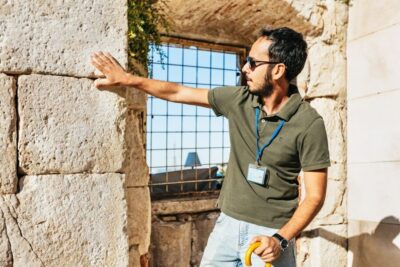
Split: Old Town and Diocletian Palace Walking Tour
Read our review →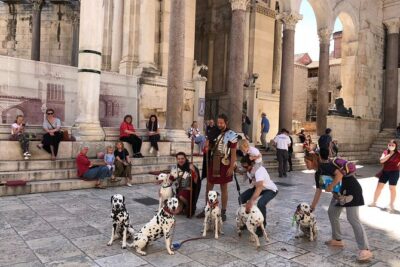
Walking Tour of Split and Diocletian’s Palace
Read our review →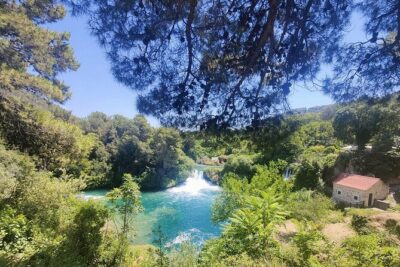
Krka Waterfalls tour with Trogir Walking tour and Krka panoramic boat cruise
Read our review →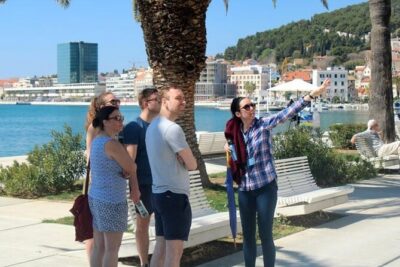
Walking Tour of Split with a ‘Magister’ of History
Read our review →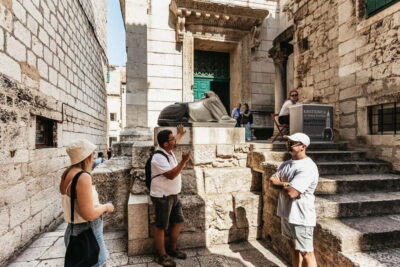
Split: Diocletian Palace & Old Town Guided Walking Tour
Read our review →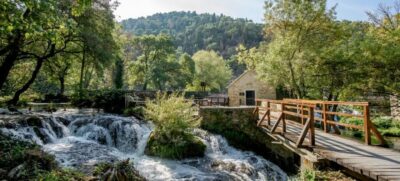
From Split: Krka Waterfalls Cruise & Trogir Walking Tour
Read our review →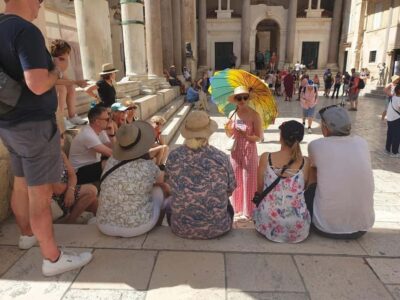
Browse the lists this tour appears in