
Reviewed · DIOCLETIAN'S PALACE TOURS
Split: Diocletian’s Palace Private walking tour
Diocletian’s Palace is not a quiet ruin behind museum glass. It is the heart of Split, where ancient stone surrounds homes, shops, churches, and everyday city life. This private walking tour takes you through that remarkable mix, explaining how a Roman emperor’s retirement palace became the center of a modern Croatian city.
I like the tour’s clear route through the main sights, especially the Peristyle, cathedral, Vestibule, and North Gate. I also like the small-group format, which gives you room to ask questions and adjust the walk to your interests. The main consideration is access: parts of the palace are not wheelchair accessible, and church services or special events can change the route.
Key points at a glance
- The Peristyle reveals Diocletian’s imperial image: Learn how the emperor was presented as the son of Jupiter in the palace’s grand central space.
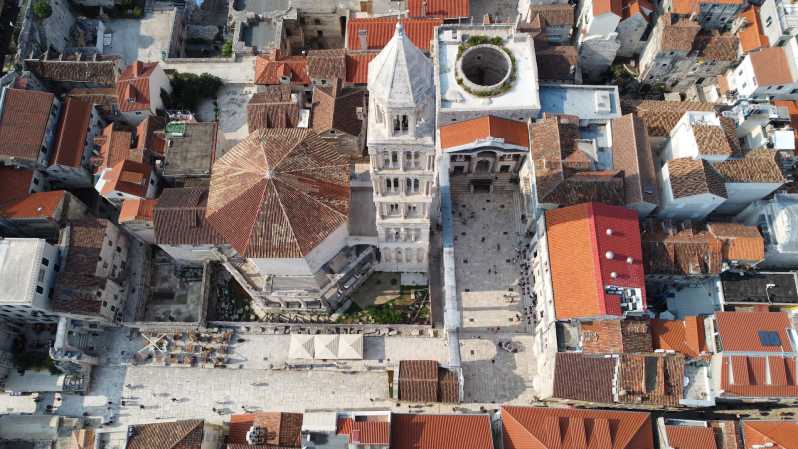
- The cathedral began as a mausoleum: Split Cathedral occupies the former tomb of Diocletian, whose remains disappeared after Christianization.
- The Vestibule led to private imperial rooms: This round entrance once welcomed dignitaries before they entered the emperor’s personal quarters.
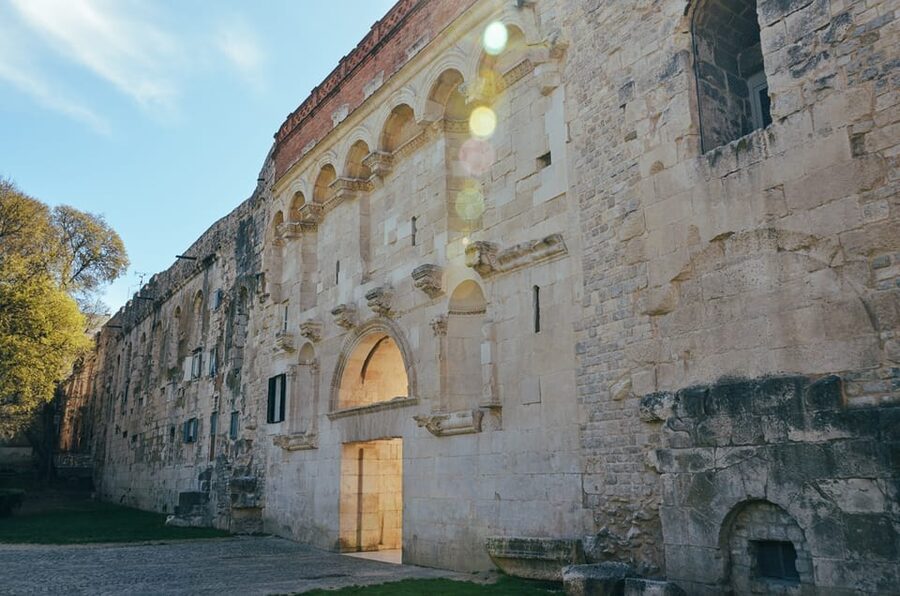
- The Golden Gate was the palace’s key entrance: The North Gate, or Porta Aurea, gives you a sense of how people entered and moved through the Roman complex.
- Tiny St. Martin’s Church fits inside a guard corridor: This unusual stop adds a human scale to the huge palace.
- A maximum of 10 people keeps the walk personal: The route can be individually adjusted, and guides speak English, German, or French.
Why Diocletian’s Palace feels different from a museum
The first thing to understand is that Diocletian’s Palace is still part of Split. You are not walking through an abandoned archaeological site with every object labeled and separated from modern life. You are moving through a working city built into and around a Roman structure roughly 1,700 years old.
That changes the experience. Ancient walls may frame a shop entrance, a lane, or a resident’s home. The palace’s original purpose was imperial, but its later life is urban and practical. A guide helps you read the layers instead of seeing only old stone.
The tour begins at the bronze model of Split at the eastern end of the Riva promenade. This is a useful meeting point because the model gives you a quick sense of the city before you enter the palace. You can see how the historic core relates to the waterfront and how Diocletian’s complex shaped the center of Split.
The walk ends back at the same meeting point. Since no transportation is involved, you spend your time on the site itself rather than getting shuttled between attractions.
More ways to see Diocletian's Palace:
- Split: Old Town and Diocletian Palace Walking Tour
★ 4.9 · 4,727 reviews - Walking Tour of Split and Diocletian’s Palace
★ 5.0 · 2,588 reviews - Split & Diocletian’s Palace Walking Tour
★ 5.0 · 1,125 reviews
Entering the palace through its living streets
A private guide is especially useful here because the palace can feel confusing at first. Roman walls, medieval changes, modern buildings, and narrow lanes all overlap. Without context, you may see an impressive collection of stones. With a guide, you can better understand how the parts connect.
The small group size matters. With up to 10 participants, you should be able to hear explanations without the feel of a large procession. You can also ask about details that catch your eye, such as the way later buildings were fitted into the Roman plan.
The tour is individually customizable. That does not mean every request can be guaranteed, but it does give the guide room to shape the emphasis. You might spend more time on architecture, imperial history, Christian reuse, or the practical development of Split, depending on your interests.
The experience is available in English, German, and French. If Dana is your guide, you can expect an energetic presentation. The available feedback specifically praises Dana’s enthusiasm and describes the walk as an effective way to see the main sights and get your bearings in central Split.
The Peristyle and Diocletian’s public image
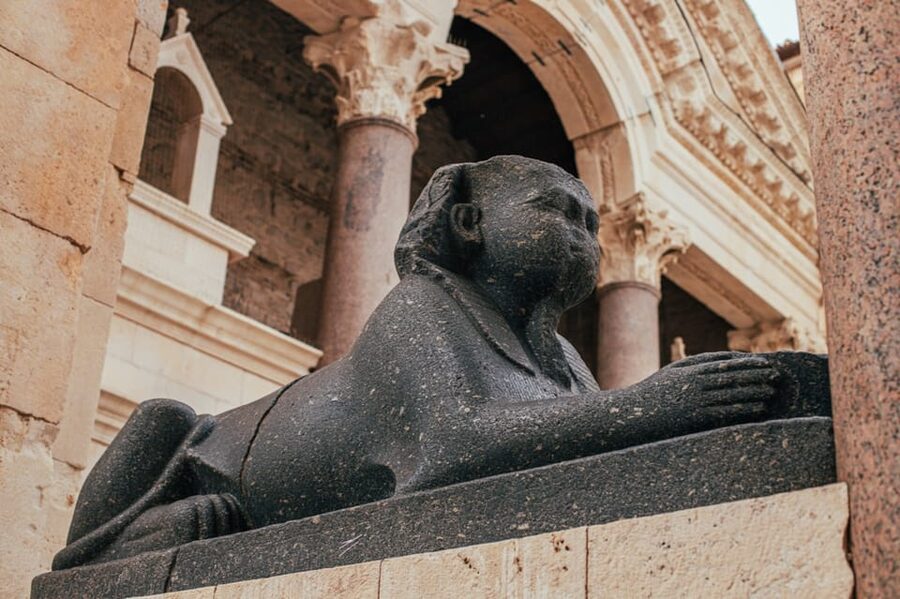
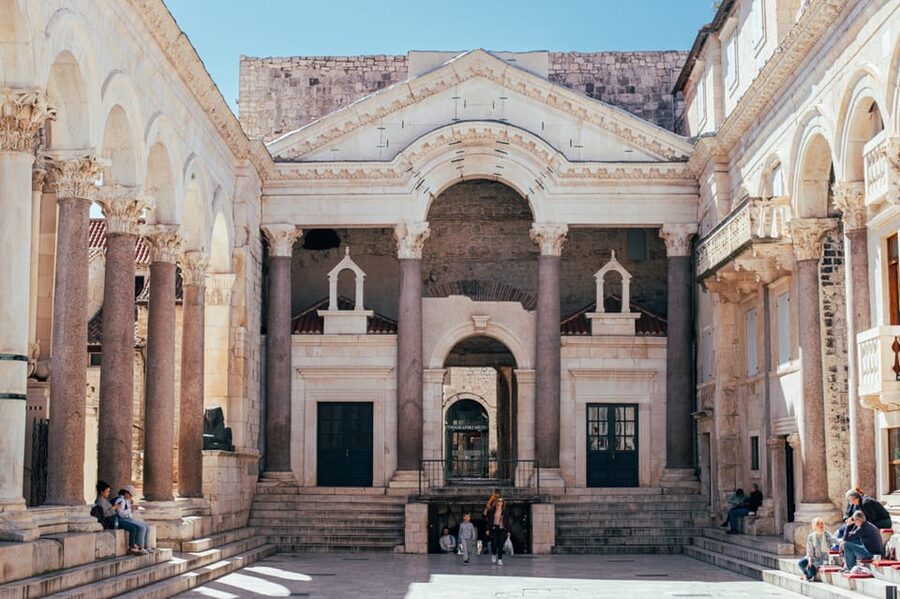
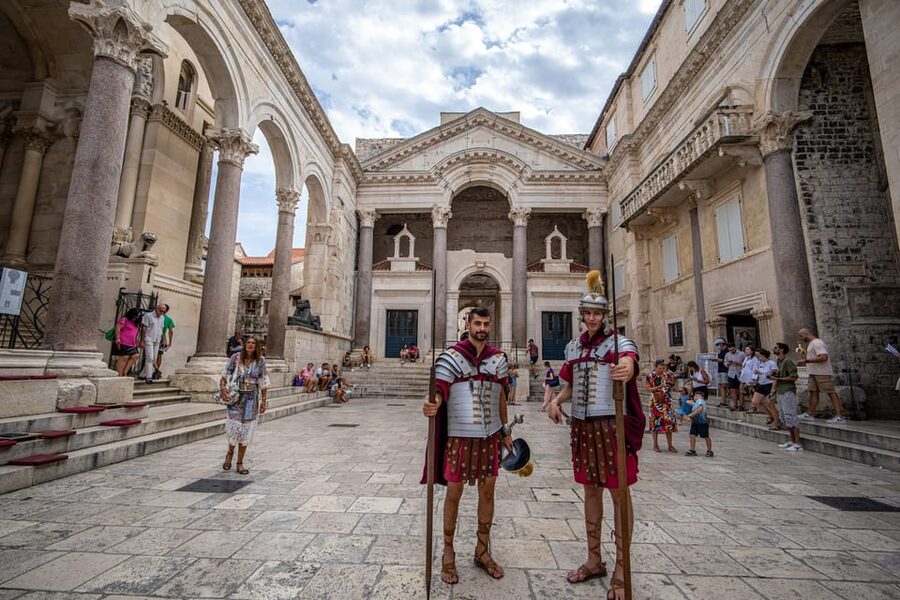
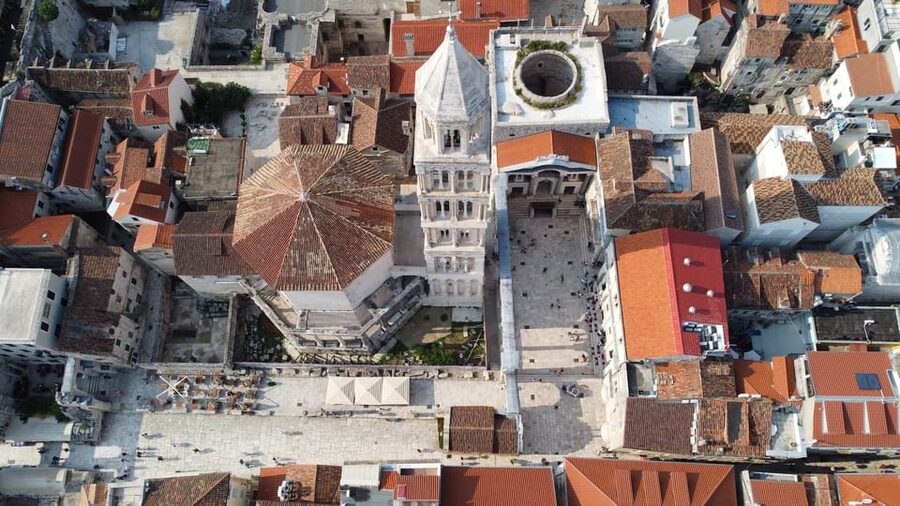
The Peristyle is the central dramatic stop. In Diocletian’s time, this was more than an attractive courtyard. It was a formal meeting place where the emperor appeared before his subjects and was honored as the son of Jupiter.
That religious and political message is the point. Diocletian was not presenting himself as an ordinary ruler. The setting helped place him above everyday life, closer to the gods. The architecture gave ceremony a stage, and the emperor’s position in that stage reinforced his authority.
Today, the Peristyle gives you one of the clearest impressions of the palace’s original ambition. Your guide can explain how the open space worked, what role it played in imperial ceremony, and why it remains one of the essential places to pause.
I would pay close attention here rather than rushing through for photographs. The value of the stop is not just the columns or the stone underfoot. It is seeing how architecture was used to control a public encounter between ruler and people.
The Peristyle can also feel busy, since it remains part of the city’s active center. That is not a flaw in the site. It is part of what makes the palace unusual. You are seeing an ancient ceremonial space that has not been frozen in time.
Split Cathedral, from imperial tomb to Christian church
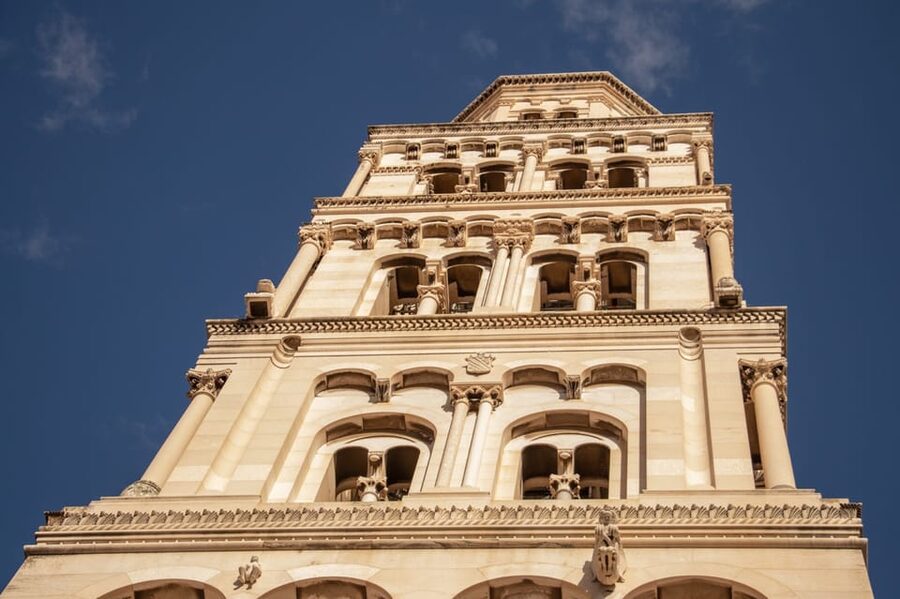
The cathedral offers the tour’s strongest example of historical change. The building began as Diocletian’s mausoleum, a tomb created for the emperor himself. After Christianization, the emperor’s remains disappeared, and the structure was converted into a cathedral.
That change tells you a great deal about the shifting power of the city. A monument built to honor a Roman emperor was given a new religious purpose. The building survived, but its meaning changed.
The tour focuses on the cathedral’s history and exterior. That distinction is useful because access inside can be affected by church services or other events. If the cathedral cannot be entered, the guide may adjust the program rather than interrupting the whole experience.
Look for the contrast between the building’s original imperial purpose and its later Christian role. You are not simply seeing a cathedral placed inside old Roman walls. You are seeing one structure carry different identities across centuries.
For many visitors, this is the moment when Split’s history becomes easiest to grasp. The palace was not replaced by the medieval city. It was reused, adapted, and absorbed into it.
More walks through the old quarter in Split:
- Krka Waterfalls tour with Trogir Walking tour and Krka panoramic boat cruise
★ 5.0 · 1,659 reviews - Walking Tour of Split with a ‘Magister’ of History
★ 5.0 · 1,122 reviews - Split Walking Tour with Professor of History
★ 5.0 · 926 reviews - Split: Diocletian Palace & Old Town Guided Walking Tour
★ 4.7 · 882 reviews
The Vestibule and the route to private power
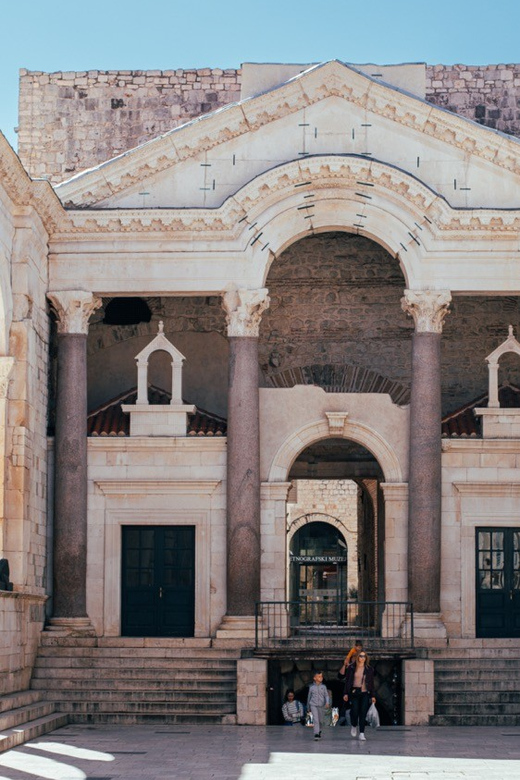
The Vestibule was the grand entrance to Diocletian’s private chambers. It acted as a threshold between public ceremony and the emperor’s personal world.
That makes it an important stop even though its function was different from the Peristyle. The Peristyle projected imperial power to a wider audience. The Vestibule controlled access to the private quarters and welcomed dignitaries who had been admitted to see the emperor.
I like this part of the tour because it adds a sense of movement through the palace. You are not just visiting separate monuments. You are following the route from the public face of the emperor toward his private rooms.
A guide can also help you notice the difference between a ceremonial entrance and an ordinary doorway. The scale and position of the Vestibule were meant to prepare visitors for an imperial audience. It was part of the experience of approaching Diocletian.
The North Gate and Split’s smallest church
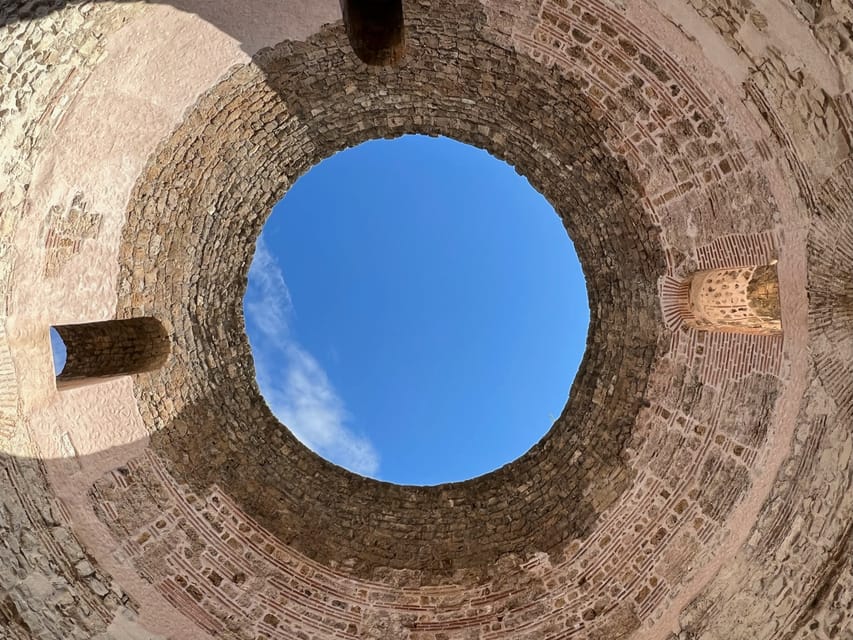
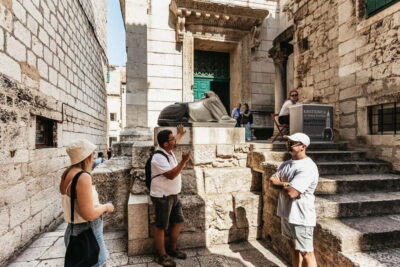
The North Gate, also called the Golden Gate or Porta Aurea, was the most important city gate in the Roman era. It gives you a practical view of the palace as a fortified and organized complex, not only as a royal residence.
Gates control movement. They connect the city to the outside world, direct arrivals, and protect the interior. The North Gate therefore helps explain how the palace functioned as a place of power and as a real urban settlement.
Inside the former guard corridor is the Church of St. Martin, described as the city’s smallest church. Its location is one of those details that makes a guided walk worthwhile. You might otherwise pass through the gate area without realizing that a compact church occupies space once used by guards.
This stop also brings the palace down to a more human scale. The Peristyle and Vestibule express imperial ambition. St. Martin’s shows how later residents made use of whatever space the old palace provided.
The North Gate is also a good place to think about changing priorities. A Roman guard corridor became a Christian place of worship, just as the mausoleum became a cathedral. Split’s story is less about one era replacing another than about successive communities using the same structure.
What the private format is worth at $135
At $135 per person, this is not the budget way to see Split’s old town. The price makes the most sense if you value a private guide, a small group, and the ability to shape the emphasis of the walk.
For a group of friends or family, the cost can feel more reasonable because the experience is built around your party, with a maximum of 10 participants. You are paying for interpretation and attention rather than simply admission to a monument.
The value is strongest if you are new to Split and want a fast, organized introduction. One available rating describes the walk as a good way to see the highlights, learn a lot, and get the lay of the land in the city center. That is a useful way to judge it: this is both a history tour and an orientation walk.
The value is weaker if you prefer to wander alone, read at your own pace, or spend a long time inside one sight. The tour is designed to connect the major points, not to replace a full independent visit to every church or historical feature.
No duration is provided, so you should confirm the expected length when booking. That matters at this price, particularly if you are comparing it with other walking tours in Split.
Practical details that can change your route
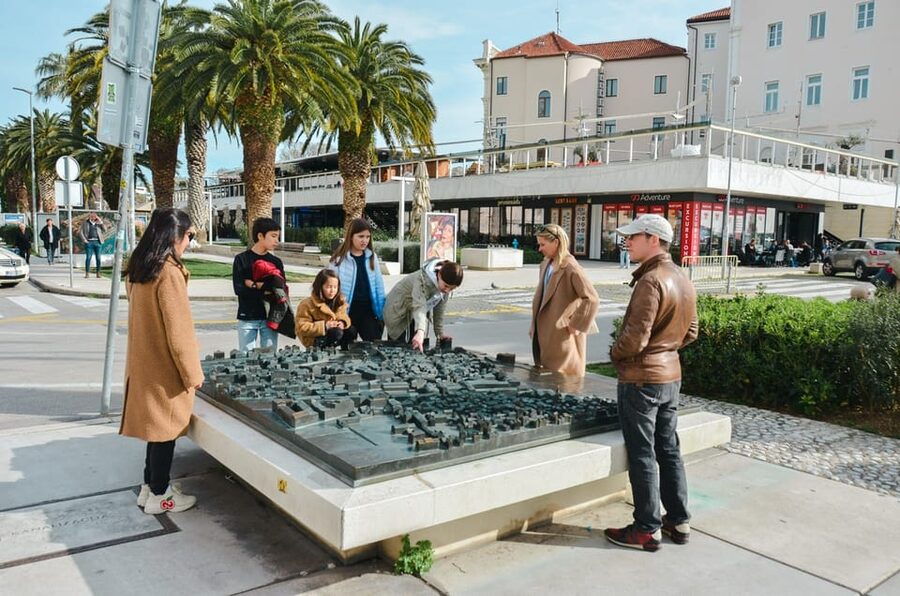
The tour is conducted on foot and starts at the bronze city model at the eastern end of the Riva. It returns to that same meeting point. Wear shoes suitable for uneven historic streets, though the supplied information does not specify the exact surface or distance.
Parts of the site are not wheelchair accessible. The route can be adapted to special needs, but you should tell the provider in advance. This is important because the palace developed over many centuries, and not every passage or area is easy to reach.
Church services and special events can also limit access to some sights. If that happens, the program may change slightly. This is a normal issue at a living religious and urban site, but it is worth knowing before you book. You should not expect every interior area to be guaranteed on every departure.
You can reserve now and pay later, and cancellation is available up to 24 hours in advance for a full refund. Those terms are helpful if your Split plans may shift.
Who will get the most from this walk
I would recommend this tour to first-time visitors who want a clear introduction to Split’s historic center. It is also a good match for anyone who enjoys understanding why a building matters, rather than simply collecting photographs.
Families and small groups may appreciate the private format, especially if they want the guide to adjust the pace or answer specific questions. The multilingual option makes it practical for English, German, and French speakers.
History fans will get the most from the connections between Roman imperial life, Christian reuse, and the modern city. The tour does not treat the palace as a single frozen period. It shows how one place changed purpose over time.
You may prefer a self-guided visit if you want complete freedom or if the $135 price feels high for a walking introduction. You should also ask about accessibility before committing if anyone in your group has limited mobility.
Should you book the Diocletian’s Palace tour?
Book it if you want to understand Split quickly and prefer a personal guide to a large group. The best reasons are the focused route, the maximum of 10 participants, and the chance to connect the Peristyle, cathedral, Vestibule, Golden Gate, and St. Martin’s Church into one story.
I would be especially interested in booking if Dana is available, since the available feedback highlights her enthusiasm. Just confirm the guide, tour length, and any access limits before paying.
Skip it if you mainly want to wander without commentary or spend your time inside one building. For a first visit, though, this is a useful way to get your bearings and see why Diocletian’s Palace remains the living center of Split.
FAQ
Where does the tour start?
The tour starts at the bronze model of the city of Split at the eastern end of the Riva promenade.
Where does the tour end?
The activity ends back at the same meeting point.
How many people can join the tour?
The tour is designed for a maximum of 10 participants.
Which languages are available?
Guiding is available in English, German, and French.
Can the route be adapted for wheelchair users?
Parts of the site are not wheelchair accessible, but the tour can be adapted to special needs. You should inform the provider in advance.
Can the route change during the visit?
Yes. Some sights may be unavailable because of events or church services, in which case the program may be changed slightly.
Just added around Split
- From Makarska : Wine Tasting Grabovac Tour★ 4.5 · 30 reviews
- Unique vintage Tomos moped tour Split – Back to the ’80s★ 4.8 · 17 reviews
- Walking Tour Split★ 4.7 · 61 reviews
- Essential Diocletian’s Palace Tour for First-Time Visitors★ 4.8 · 19 reviews
- Trogir; Private walking tour of higlights of Trogir★ 4.7 · 3 reviews
- Trogir: White Lagoon, Maslinica & Blue Lagoon Speedboat Tour★ 4.8 · 11 reviews
- Trogir 1.5-Hour City Tour★ 4.4 · 37 reviews
- Split: Trogir Open Top Bus Trip + Free Split Walking Tour★ 4.1 · 17 reviews
Diocletian's Palace Tours, compared.
Split: Old Town and Diocletian Palace Walking Tour
Read our review →
Walking Tour of Split and Diocletian’s Palace
Read our review →
Split: Diocletian Palace & Old Town Guided Walking Tour
Read our review →
Split: Game of Thrones Tour with Diocletian’s Palace Cellar
Read our review →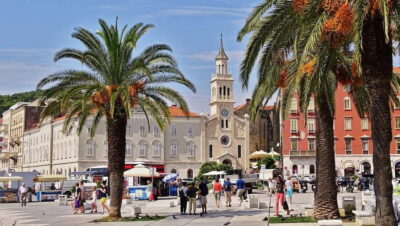
Diocletian’s Palace and Old Town SMALL GROUP Walking Tour
Read our review →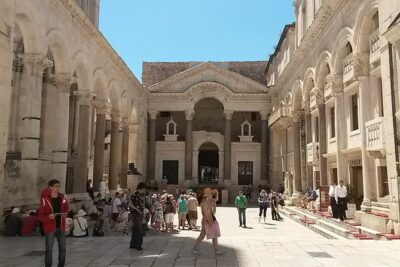
SPLIT-PRIVATE Walking Tour of Diocletian’s Palace & Old Town
Read our review →
Browse the lists this tour appears in