
Reviewed · SPLIT OLD TOWN WALKING TOURS
Split: Private Walking Tour in the Historical Town Center
Split’s old town is not a museum set apart from daily life. It is a working neighborhood built inside and around a Roman emperor’s palace, with washing hanging above ancient stone, cafés tucked beside columns, and medieval houses pressed against Roman walls. This private 105-minute walk gives you a quick, well-organized way to make sense of it all.
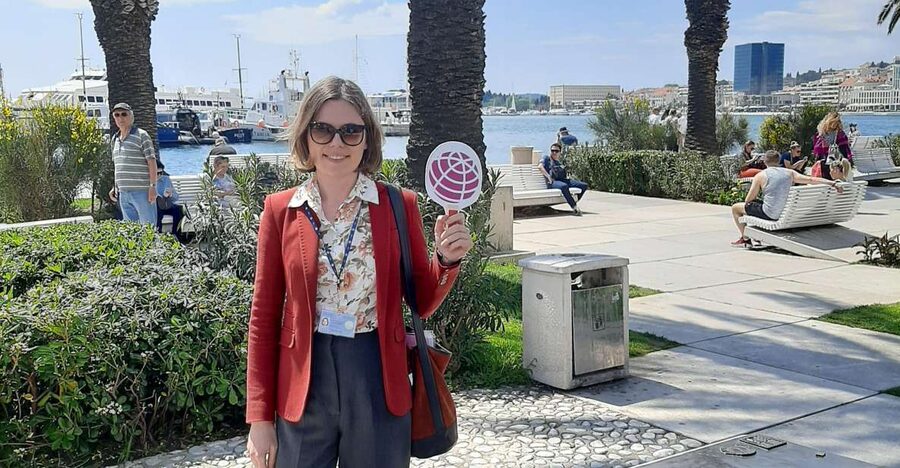
I like the route for two reasons: it covers the main sights without wasting time, and guide Sanja explains how Roman, Venetian, French, Austro-Hungarian, and Yugoslav rule shaped the city. I also like that you can ask questions as you go, rather than trying to keep up with a large group. The main drawback is that the Substructures require a separate entrance fee, and the tour is not suitable for wheelchair users.
Key points
- Diocletian’s Palace is still part of the city: You walk through Roman remains, medieval homes, shops, and public squares in one living old town.
- Sanja brings a strong language choice: Tours are available in English, French, Italian, and Spanish, and her French has been especially well received.
- The route covers Split’s essential sights: Expect Peristil, St. Domnius’s Cathedral, Jupiter’s Temple, the Golden Gate, People’s Square, Fruit Square, and Riva.
- The private format helps you hear and ask questions: The group can include up to 15 people, but a smaller party makes the guide’s explanations easier to follow.
- The history goes beyond Roman ruins: You learn how later Venetian, French, Austro-Hungarian, and Yugoslav periods affected Split.
- It works best early in your stay: The route gives you a useful map of the old town and ideas for places to revisit on your own.
Starting by the Bronze Model on Riva
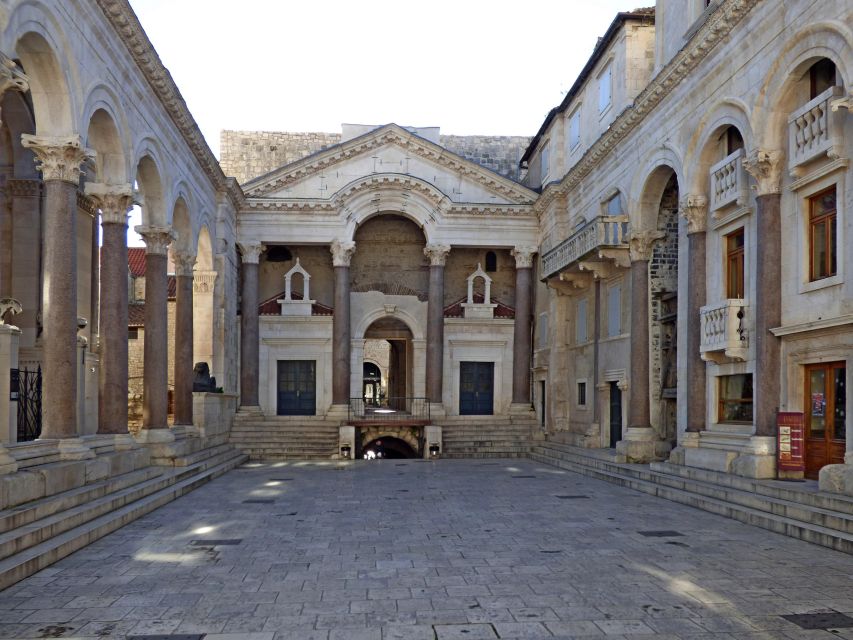
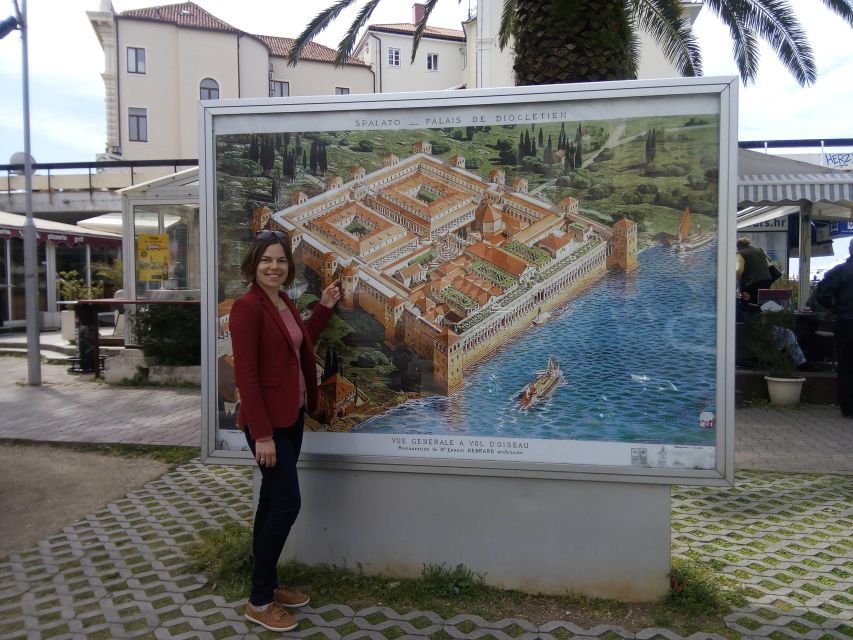
The tour begins on Riva promenade, beside the bronze model of Split’s historical core. You will find it by the sea, in front of the south entrance to Diocletian’s Palace.
This is a sensible meeting point. The model gives you a quick visual picture of the palace and the streets that grew around it before you enter the old town. Riva also makes the location easy to identify, though you should allow a little time to find the exact bronze model if the promenade is busy.
From here, Sanja leads you toward the palace and explains how the Roman complex became the center of modern Split. This first step matters because the palace is not simply a collection of ruins. Its old corridors, gates, courtyards, and walls have been absorbed into the town.
More walks through the old quarter in Split:
- Split: Old Town and Diocletian Palace Walking Tour
★ 4.9 · 4,727 reviews - Walking Tour of Split and Diocletian’s Palace
★ 5.0 · 2,588 reviews - Krka Waterfalls tour with Trogir Walking tour and Krka panoramic boat cruise
★ 5.0 · 1,659 reviews
Entering Diocletian’s Palace After Seventeen Centuries
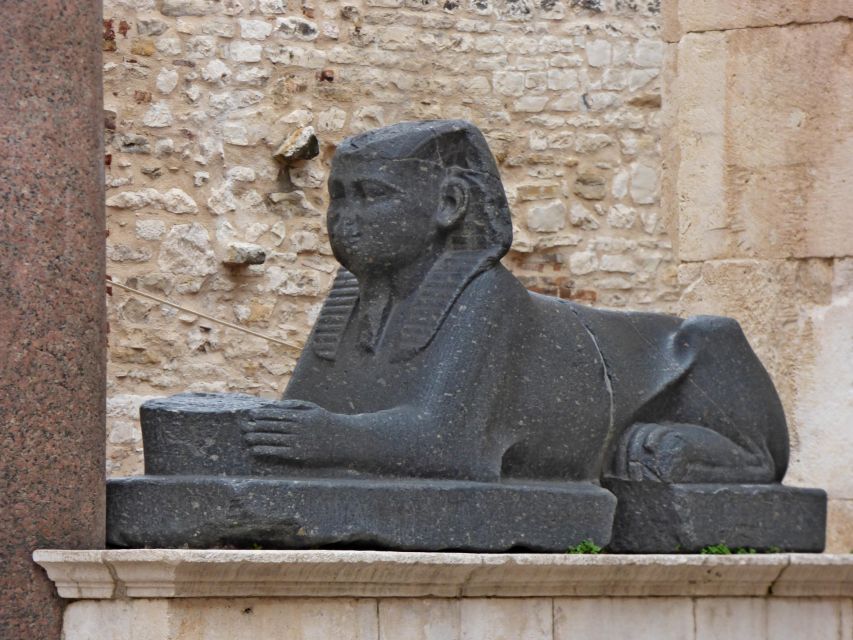
The first major part of the walk focuses on the 4th-century palace built for Roman emperor Diocletian. It is the oldest part of Split’s urban core, but the experience is not limited to Roman architecture.
Inside the palace area, you will see a mix of Roman remains and a small medieval neighborhood that developed within them. Noble family houses, narrow streets, later additions, and active city life all sit close together. Sanja’s task is to help you separate the different periods without turning the walk into a string of dates.
I find this sort of explanation especially useful in Split because the old town can feel confusing at first. A Roman column may be beside a medieval doorway, while a later building uses older stone. With a guide, you get a clearer idea of what you are looking at and why the town developed in this unusual way.
The palace portion lasts about 30 minutes, making it the longest single stop on the route. That gives Sanja time to establish the basic story before you move on to individual sights.
The Substructures and the Cost of Going Below
The Substructures, also called the Palace Basements, are included in the route but not in the tour price. You will need to pay the entrance fee separately.
These lower rooms are important because they help show the original plan of Diocletian’s Palace. They are also one of the few parts of the complex where you can get a stronger sense of the palace’s construction and layout. Sanja includes a visit here, so you should decide in advance if you want to budget for admission.
The separate fee is the clearest extra cost on this tour. The main price is $153 per private group of up to 15 people, but that price does not cover the Substructures. If you are comparing tours, count this additional admission when working out your total.
Peristil, Split’s Roman Showpiece
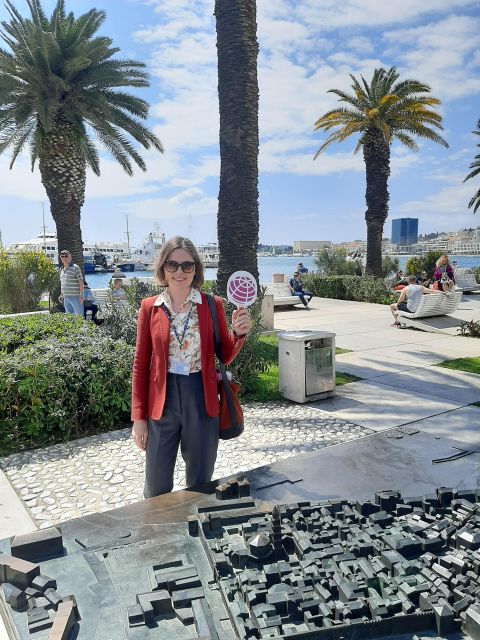
Peristil is the palace’s main square and one of the most memorable stops on the walk. This is where the Roman design feels most formal, with stone architecture arranged around an open central space.
Sanja spends about 10 minutes here, explaining the square and pointing out how later generations reused the Roman setting. Peristil is not only an archaeological site. It is also part of the town’s public life, so you get a good look at how old and new Split overlap.
This stop is compact, but it rewards careful attention. Look up, look at the stonework, and notice the way the surrounding buildings frame the square. The guide’s explanation helps you see details that could otherwise blur into a general impression of old stone.
More history walks in Split:
- Walking Tour of Split with a ‘Magister’ of History
★ 5.0 · 1,122 reviews - Split Walking Tour with Professor of History
★ 5.0 · 926 reviews - Split: History and Heritage Walking Tour
★ 4.9 · 650 reviews - Split History and Gastro Small-Group Tour with Food and Drinks
★ 5.0 · 375 reviews
St. Domnius’s Cathedral and Jupiter’s Temple
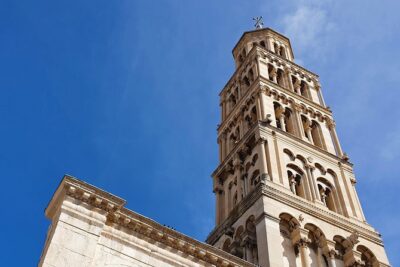
The route next takes in the Mausoleum of Diocletian, now the Cathedral of Saint Domnius. The tour includes a guided look and a pass by the cathedral, but the information provided does not promise interior admission.
The building’s identity tells you a great deal about Split. It began as part of a Roman imperial complex and later became a Christian cathedral. That change is one of the clearest examples of how the city reused and adapted its earlier buildings.
Nearby, Jupiter’s Temple is visited from the outside. It now serves as the Baptistery, another example of a Roman structure given a later religious role. No entrance fee is listed for the external visit.
I like these two stops together because they show that the old town’s story is not a simple line from Roman times to the present. Buildings changed purpose, and each period left something behind.
Four Gates and the Golden Gate
The palace walls and four gates are part of the tour, with a specific stop at the Golden Gate. These entrances help you understand how the palace was organized and how people moved through it.
The Golden Gate is especially useful as a reference point because it connects the palace to the later city beyond its original walls. Sanja explains the gates as part of the wider Roman plan, rather than treating each one as an isolated photo stop.
The route allocates about 10 minutes to the Golden Gate. That is enough for orientation and an explanation, but not a long architectural study. If you want to inspect every section of the walls at leisure, you will need to return after the tour.
A Medieval Neighborhood Inside Roman Walls
One of the most interesting features of Split is the small medieval quarter that developed inside the palace. You will pass houses associated with noble families and streets where later residents made use of Roman structures.
This is where the private format earns its keep. You can stop to ask Sanja how a later house fits into the older palace plan, or ask about the social groups that shaped the neighborhood. The supplied information also includes a small former Jewish ghetto and an active synagogue, adding another layer to the town’s story.
The synagogue is an especially useful reminder that Split’s history includes communities and daily lives, not only rulers and monuments. The tour does not promise an interior visit, so think of this as an exterior point of interest and a chance to learn about the former neighborhood.
People’s Square and Split Beyond the Palace
The second part of the tour moves outside the palace to the medieval town that grew around it. People’s Square, also called Pjaca, is the first major square on this portion of the route.
Here, the focus shifts from Roman planning to the social and political life of the later city. Sanja discusses the periods of Venetian, French, Austro-Hungarian, and Yugoslav rule, showing how each era affected Split’s buildings and public life.
That wider political context is one of the tour’s strongest features. You are not only told that a building is old. You learn how different governments influenced the city, and why the architecture does not look uniformly Roman or uniformly medieval.
The stop lasts about 15 minutes. It is the longest of the later square visits, giving you time to absorb the transition from the palace to the broader medieval center.
Fruit Square and the Short Walk Back to Riva
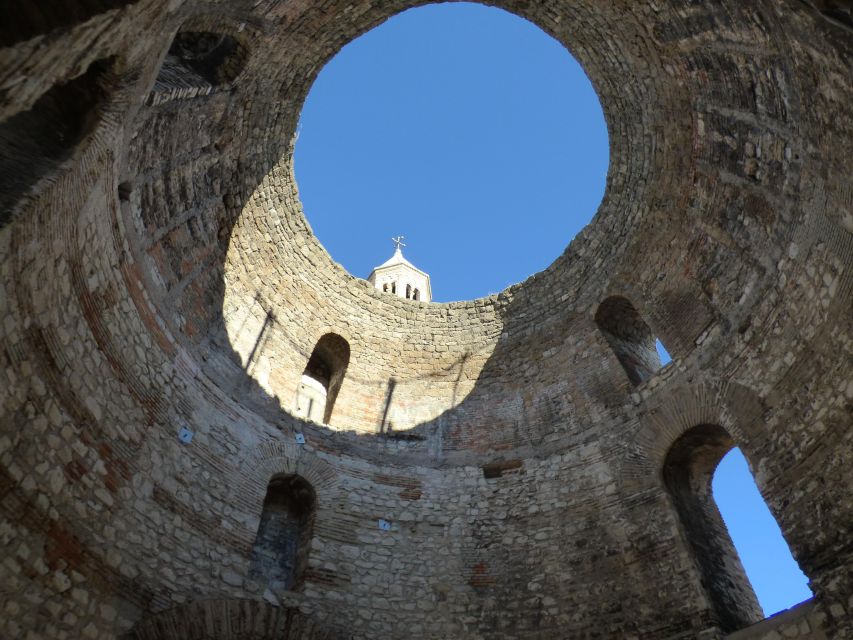
Fruit Square, or Voćni trg, comes next. It is another compact public space in the historic center, and the guide uses it to continue the story of Split outside the palace walls.
The planned visit lasts about 10 minutes. That is enough for a guided explanation and a look around, though you should not expect extended free time at each square. The tour is designed as an overview, not as a slow photographic walk.
The final section returns to Riva promenade. You finish by the sea, back near the area where the tour began. Ending here makes it easy to continue your own exploration, stop for a drink, or retrace a favorite part of the route.
What the Private Format Adds
The advertised price is $153 for a group of up to 15 people. For a full group, that works out to about $10 per person before the separate Substructures admission. For a smaller party of four, the group cost is much higher per person, but you gain a guide focused only on your party.
That tradeoff is worth considering. A private guide is most useful when you want to ask questions, need a particular language, or have limited time in Split. It also avoids the problem of standing at the back of a large group while trying to hear an explanation in a narrow street.
Sanja holds a master’s degree and is a licensed local guide. The strongest praise in the supplied feedback centers on her explanations, her excellent English, and her French. French-speaking visitors can expect a fluent tour that connects Split’s story with French culture as well as local history.
The tour also runs in Italian and Spanish. Since the activity is private, you should select the language that suits your group when checking availability.
Why 105 Minutes Is a Useful Length
An hour and 45 minutes is long enough to cover the main historic center without taking over your whole day. You get an organized introduction, then plenty of time afterward to revisit the palace, enter additional sights, or explore nearby streets on your own.
The pace is fairly purposeful. The itinerary gives about 30 minutes to Diocletian’s Palace, then shorter periods at the major squares, cathedral, temple, and gate. You should expect walking and standing rather than long seated explanations.
This length works particularly well on your first full day in Split. Sanja can give you the basic map and historical framework, then you can make better choices with the rest of your time. One couple specifically found that the tour helped them appreciate their stay inside the palace walls, which is a useful reason to schedule it near the beginning of a visit.
Practical Details Before You Book
The tour is not suitable for wheelchair users. The supplied information does not give a detailed surface description, but the route passes through historic streets, palace spaces, and public squares, so anyone who has difficulty walking or standing should consider that limitation carefully.
Wear comfortable shoes and keep the group’s walking pace in mind. The route returns to the starting area, but it is not a hop-on, hop-off experience. You will be moving through the old town for most of the 105 minutes.
The Substructures are the only stated admission not included. The professional guide, private format, and commission tax are included in the advertised price.
You can cancel up to 24 hours before the start for a full refund, and the reserve-now, pay-later option gives you some flexibility while finalizing your plans. Starting times vary, so check availability for your preferred date.
Who Will Get the Most From This Walk
I would choose this tour if you want a clear first look at Split rather than a narrow focus on Roman archaeology. It suits couples, families, and small groups who value the ability to ask questions and set their own pace within a guided route.
It is also a strong choice for anyone who wants history in French, Italian, Spanish, or English. Sanja’s ability to explain the city across several periods is more useful than a guide who only points out the most famous stones.
You may want a different plan if you prefer to wander without structure, need a fully accessible route, or want long interior visits at each monument. The cathedral and Jupiter’s Temple are presented as guided sights and pass-by stops, while the Substructures have a separate entrance fee.
Should You Book Sanja’s Split Walking Tour?
Book it if you have limited time, want the main sights in one efficient route, or would like a private explanation of how Roman, medieval, Venetian, French, Austro-Hungarian, and Yugoslav Split fit together.
The strongest reason to choose it is Sanja’s teaching style, especially if you need French or want a guide who can answer questions in a small group. The main cautions are the extra Substructures fee, the walking demands, and the fact that some major sites are viewed externally rather than explored at length.
For a first visit, I like the balance: a Roman palace, medieval lanes, public squares, later political history, and practical ideas for exploring on your own. Schedule it early, listen closely, then use the rest of your stay to return to the corners that caught your eye.
FAQ
Where does the Split private walking tour begin?
It begins beside the bronze model of Split’s historical core on Riva promenade by the sea, in front of the south entrance to Diocletian’s Palace.
How long does the tour last?
The tour lasts 105 minutes, or about 1 hour and 45 minutes.
What languages are available?
The live guide is available in English, Italian, French, and Spanish.
Is the tour private?
Yes. It is a private group tour, with space for up to 15 people.
Is admission to the Palace Substructures included?
No. Entrance to Diocletian’s Palace Substructures, also called the Basements, costs extra.
Does the tour visit Diocletian’s Palace?
Yes. The route includes the Palace, its walls and four gates, Peristil, the Mausoleum and Cathedral of Saint Domnius, Jupiter’s Temple, medieval houses, and the former Jewish neighborhood with its active synagogue.
Is the tour suitable for wheelchair users?
No. The activity is listed as not suitable for wheelchair users.
Just added around Split
- From Makarska : Wine Tasting Grabovac Tour★ 4.5 · 30 reviews
- Essential Diocletian’s Palace Tour for First-Time Visitors★ 4.8 · 19 reviews
- Unique vintage Tomos moped tour Split – Back to the ’80s★ 4.8 · 17 reviews
- Walking Tour Split★ 4.7 · 61 reviews
- Trogir; Private walking tour of higlights of Trogir★ 4.7 · 3 reviews
- Trogir: White Lagoon, Maslinica & Blue Lagoon Speedboat Tour★ 4.8 · 11 reviews
- Trogir: Old Town Guided Walking Tour★ 4.6 · 76 reviews
- Trogir 1.5-Hour City Tour★ 4.4 · 37 reviews
Split Old Town Walking Tours, compared.
Split: Old Town and Diocletian Palace Walking Tour
Read our review →
Walking Tour of Split and Diocletian’s Palace
Read our review →
Krka Waterfalls tour with Trogir Walking tour and Krka panoramic boat cruise
Read our review →
Walking Tour of Split with a ‘Magister’ of History
Read our review →
Split: Diocletian Palace & Old Town Guided Walking Tour
Read our review →
From Split: Krka Waterfalls Cruise & Trogir Walking Tour
Read our review →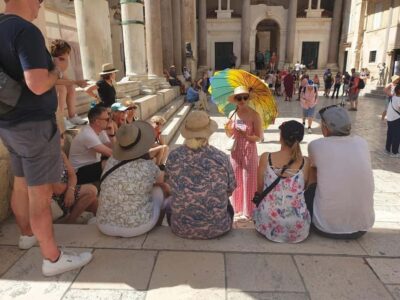
Browse the lists this tour appears in