
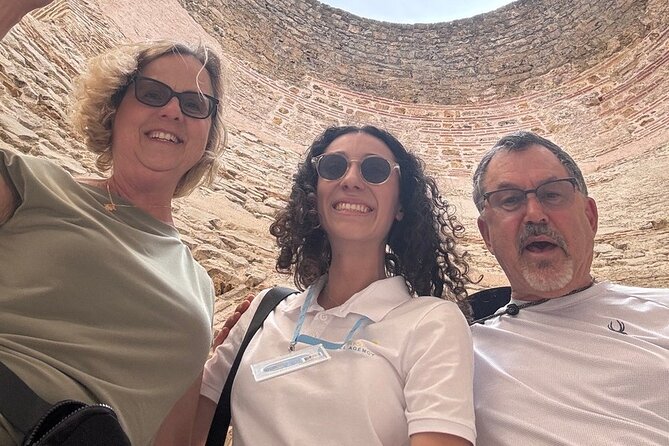
Reviewed · SPLIT OLD TOWN WALKING TOURS
Split Walking Tour: History, Legends & Tales
Split’s most useful first lesson is that Diocletian’s Palace is not a museum. It is the old heart of the city, where people still walk, live, gather, and pass through streets shaped more than 1,700 years ago. This 1.5-hour tour connects the emperor’s retirement home with modern Split, using the Riva, palace courtyards, gates, and squares as one unfolding story.
I like two things right away: the local perspective and the small-group format. Lucija was born and raised in Split, so you can ask about present-day life as well as Roman history. I also like the sensible route, which gives first-time visitors a clear map of the Old Town without asking them to buy entrance tickets during the tour.
The main consideration is pace. In 90 minutes, you’ll see many important places, but you will not have time for a long visit inside every cultural or religious site. The tour is conducted in English, requires comfortable walking shoes, and is not suitable for wheelchair users.
Key points to know before you book
- Lucija’s local connection: Your English-speaking guide was born and raised in Split and can discuss both the city’s past and daily life today.
- A strong first-day route: The walk links the Riva, Diocletian’s Palace, Peristil, Golden Gate, People’s Square, and Fruit Square.
- Palace history without a museum-only approach: You learn how an imperial residence became the center of a living city.
- Small-group setting: The format is intended to let you enjoy each stop and ask questions along the way.
- A focused 1.5-hour introduction: You get orientation and context, then can return later to explore sites at your own pace.
- Good practical value: At $28 per person, the price pays for a licensed guide and a useful overview, while entrance fees remain separate.
Why start with Split’s ancient palace?
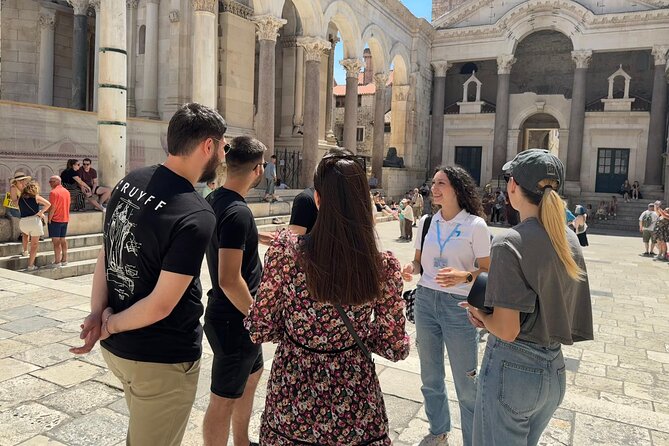
A walk through Split can feel confusing at first. The old streets are compact, but the Roman plan, medieval changes, modern shops, apartments, cafés, and public squares all overlap. A guide helps you read what you are seeing instead of simply passing through attractive stone walls.
Diocletian’s Palace is the natural center of the experience. Emperor Diocletian chose Split as a luxurious residence, and the palace complex has remained part of the city for more than 1,700 years. That long use is what makes it interesting. You are not looking at a perfectly preserved ruin separated from daily life. You are moving through a place that has changed and adapted over time.
I find this especially helpful on a first visit. Once you understand the main gates, courtyards, streets, and squares, you can return on your own and explore with more confidence. The tour gives you a framework for the rest of your stay.
More walks through the old quarter in Split:
- Split: Old Town and Diocletian Palace Walking Tour
★ 4.9 · 4,727 reviews - Walking Tour of Split and Diocletian’s Palace
★ 5.0 · 2,588 reviews - Krka Waterfalls tour with Trogir Walking tour and Krka panoramic boat cruise
★ 5.0 · 1,659 reviews
Meeting at the Split model near the Riva
The meeting point is at Obala Hrvatskog narodnog preporoda 22, beside the model of Split. Your guide waits there with a Tour4You sign. This is a practical starting point because the walk begins near the Riva, the waterfront promenade that forms one of the city’s most familiar gathering places.
The Riva gives you an immediate sense of Split’s setting and public life before the route moves inland toward the palace. From here, the tour connects the seafront with the older streets behind it. That transition matters: you see how the city’s public face leads directly into its ancient core.
Arrive ready to walk. The tour covers cobbled streets and historic surfaces, so comfortable shoes are important. The walk returns to the same meeting point, which makes it easier to continue your own sightseeing afterward or head back toward the waterfront.
Riva: an easy introduction to the city
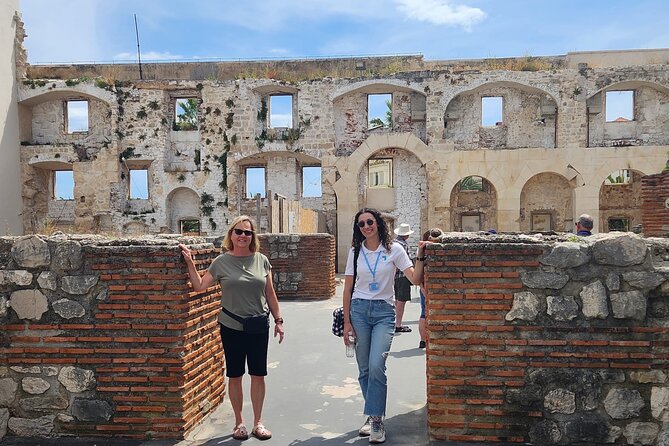
The Riva is more than a place to take a quick photograph. It is a useful orientation point, and the guide uses it as part of the story of Split’s transformation from Diocletian’s time to the present.
You begin with the city in its modern setting, then move toward the palace and Old Town. That order helps you understand the relationship between the waterfront and the historic center. You are not dropped straight into a maze of alleys without context.
This first section should suit you if you want a broad introduction before choosing where to spend more time. It is less useful for someone seeking an extended waterfront history or a slow architectural study, since the full route has several stops to cover in 90 minutes.
Diocletian’s Palace: an imperial residence that became a city

The palace is the main subject of the tour. Diocletian did not choose Split simply as a temporary stop. He selected it as a luxurious residence, and the complex was built with the scale and authority expected of an emperor.
The important point is how the palace works today. Its walls and architecture are not just background scenery. They form the structure of the Old Town, with streets and public spaces fitted into and around the ancient complex.
Your guide explains the palace’s heritage and how it has changed over time. This is where local guidance earns its keep. Without context, you may see a grand gate or stone passage and move on. With an explanation, you can connect the structure to the larger story of Split.
The tour does not include entrance tickets to cultural or religious sites. That keeps the walk focused and allows you to decide later which interiors deserve your time and money. The tradeoff is that the experience is mainly an outdoor orientation, with information about places you may choose to enter afterward.
More history walks in Split:
- Walking Tour of Split with a ‘Magister’ of History
★ 5.0 · 1,122 reviews - Split Walking Tour with Professor of History
★ 5.0 · 926 reviews - Split: History and Heritage Walking Tour
★ 4.9 · 650 reviews - Split History and Gastro Small-Group Tour with Food and Drinks
★ 5.0 · 375 reviews
Vestibul: the palace’s dramatic passage
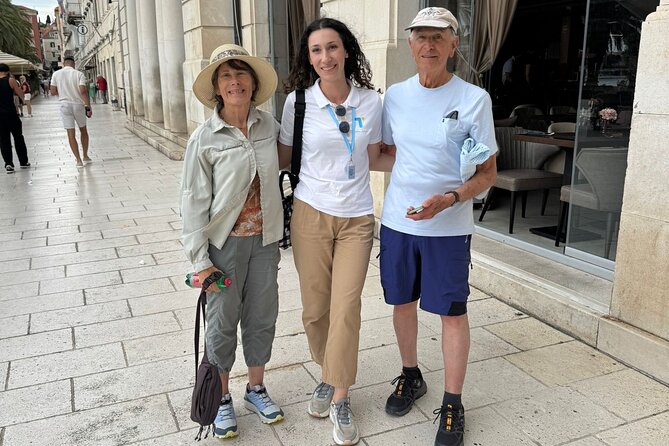
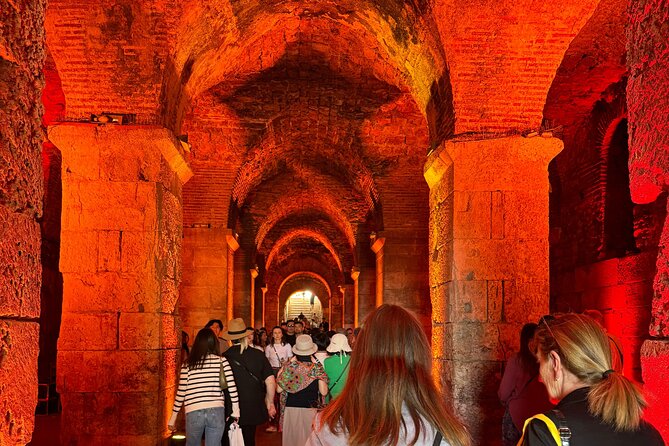
The Vestibul is one of the key stops inside the palace area. Its position makes it a natural place to discuss how the imperial complex was organized and how visitors moved through it.
This stop is useful because it shows the difference between simply walking through the Old Town and understanding its layout. You can pay attention to how the passage relates to the surrounding spaces and palace structures.
Expect a guided explanation rather than a long independent visit. The route continues through several important landmarks, so the guide must keep the group moving. If a particular architectural detail interests you, this is a good moment to ask a question before the walk advances.
Peristil: the palace’s great public space
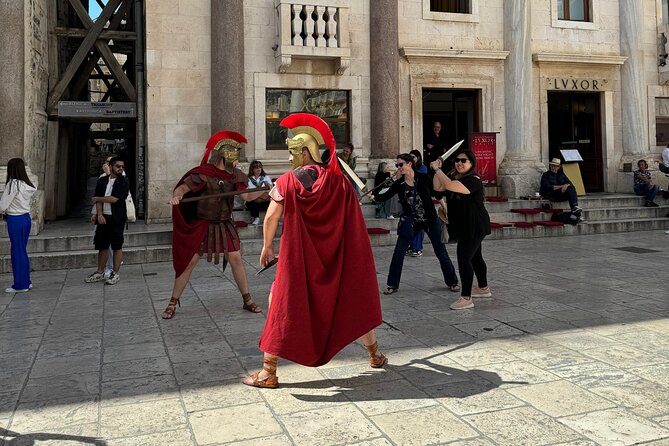
Peristil is another central stop, and it helps bring the scale of Diocletian’s project into view. It is one of the places where the palace’s imperial purpose is easiest to imagine.
Here, the guide can connect architecture, power, and ceremony with the later life of the city. Split’s Old Town is compelling because the same historic spaces have not remained frozen. They are part of the city’s continuing public life.
Peristil also gives you a clear reference point for future exploring. Once you know where it is, you can use it to orient yourself inside the palace area. The tour’s value is partly practical: it helps turn a complicated old center into a place you can navigate.
Golden Gate: one of the clearest links to the Roman plan

The Golden Gate offers another look at the palace’s defensive and ceremonial design. It is one of the must-see landmarks included on the route, and it gives the tour a strong sense of structure.
As you visit the gate, listen for how the guide explains the palace’s walls and access points. The stop makes more sense when connected to the rest of the route, especially the relationship between the palace interior and the streets beyond it.
You will not spend the entire tour at any one gate. That is a benefit if you want a broad first look, but a limitation if your main interest is military architecture or detailed stonework. For that, you would need to return independently after the tour.
People’s Square: Split beyond the palace walls
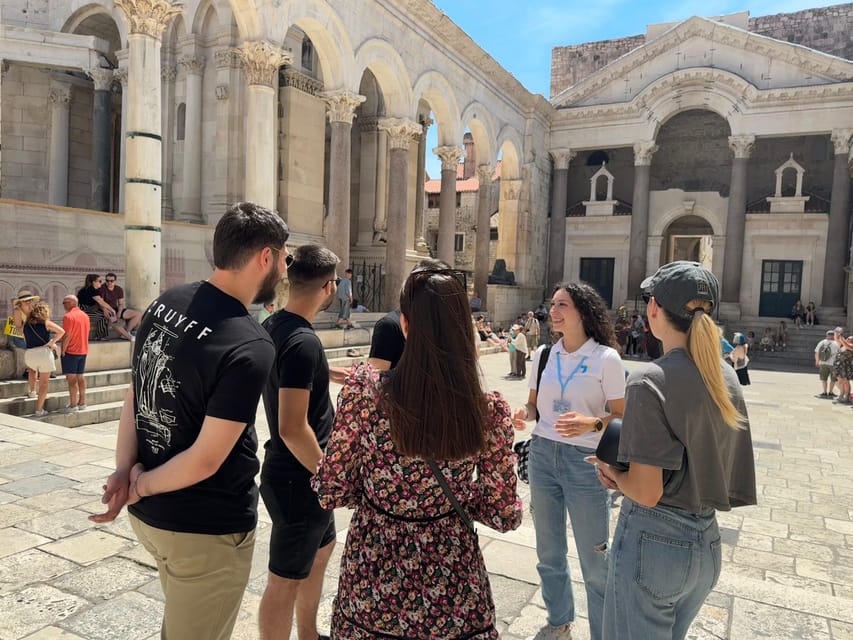
People’s Square widens the story beyond Diocletian’s original complex. The route shows that Split’s identity is not limited to Roman remains. Later city life, public spaces, and local traditions also shape the Old Town.
This is one reason I prefer a city walk that moves beyond a single monument. You see how the ancient center connects with places that belong to the wider life of Split. The guide can also answer questions about the city today, an area where Lucija’s local background is particularly useful.
The square helps break up the palace-focused portion of the tour. You are still learning about the historic center, but the subject becomes the city as a whole rather than only the emperor’s residence.
Fruit Square: a short route with a wider view

Fruit Square is the final major stop before the route returns to the starting point. Like People’s Square, it gives you another angle on Split’s public spaces and the way the Old Town developed around the palace.
By this stage, the route has introduced you to the waterfront, palace complex, major interior spaces, gate architecture, and central squares. That sequence gives you a useful mental map. You can later return to the spots that caught your attention instead of trying to see everything at once.
The route ends back at Obala Hrvatskog narodnog preporoda 22. Ending where you began is convenient, especially if this is your first activity in Split and you want to continue along the Riva afterward.
What Lucija adds to the experience
Lucija’s strongest advantage is not just that she can explain dates and buildings. She grew up in Split, and that gives you the chance to ask about life in the city beyond the formal story of emperors and monuments.
That local connection was a repeated strength in the feedback about the experience. Lucija was described as kind, approachable, and able to answer questions about everyday life in Split as well as its past. If you like to ask how a place works today, that matters.
The small-group format should also make the walk feel more personal than a large procession through the Old Town. You can hear the guide more easily and ask questions without waiting for a long line of people to move. The exact group size is not stated, so do not assume an especially private tour, but the experience is designed around a small group.
Is $28 a fair price?
At $28 per person, this is a reasonable price for a licensed guide and a 90-minute introduction to central Split. You are paying for explanation, orientation, and local access, not for admission to every historic building.
The value is highest if you are visiting Split for the first time. A good opening walk can save you from missing the main landmarks or misunderstanding how the palace fits into the city. It also helps you choose which places deserve a second visit.
The value is lower if you already know the Old Town well or prefer to explore entirely at your own pace. Since entrance fees are separate, budget extra if you plan to visit cultural or religious sites after the walk. The guide provides information so you can make those choices later.
Who should book this walk?
I would choose this tour if you want a clear introduction to Split before exploring on your own. It fits couples, families with children, and independent visitors who want a local guide but do not want a full-day commitment.
Children must remain with an adult throughout the tour. The route is suitable for most people, but it is not suitable for wheelchair users. Historic streets and cobblestones also make supportive shoes a sensible choice.
This is a good match for anyone interested in both famous landmarks and local life. It is less suitable if you want long interior visits, extensive archaeological detail, or a completely flexible route with no fixed timing.
Weather can affect the activity. If poor conditions force a cancellation, you can reschedule or receive a full refund. You can also cancel up to 24 hours in advance for a full refund, and the reserve-now, pay-later option keeps your plans flexible.
My verdict on the Split walking tour
Book this tour if you want to get your bearings quickly and understand why Diocletian’s Palace remains the center of Split. The route covers the essential landmarks, the guide is local, and Lucija’s ability to discuss present-day Split adds something beyond a standard monument walk.
Just keep your expectations in line with the 90-minute format. You will see and discuss many important places, but you will not tour every interior or linger at every stop. For most first-time visitors, that is a useful tradeoff: begin with the big picture, then return to Peristil, the Vestibul, the Golden Gate, or other sites that deserve more of your time.
FAQ
How long does the Split walking tour last?
The tour lasts 1.5 hours.
What language is the tour conducted in?
The tour operates in English with a live English-speaking guide.
Who guides the tour?
The experience is led by a licensed guide. Lucija, who was born and raised in Split, is identified as the local guide for the experience.
Where does the tour start?
The tour starts at Obala Hrvatskog narodnog preporoda 22, next to the model of Split. Your guide will hold a Tour4You sign.
Where does the tour end?
The tour ends back at the original meeting point at Obala Hrvatskog narodnog preporoda 22.
Which Split landmarks are included?
The route includes the Riva, Diocletian’s Palace, the Vestibul, Peristil, the Golden Gate, People’s Square, and Fruit Square.
Are entrance tickets included?
No. Entrance tickets to cultural and religious sites are not included. The guide provides information so you can decide what to visit later.
Is the tour suitable for wheelchair users?
No. The activity is not suitable for wheelchair users. Comfortable shoes are recommended, and children must be accompanied by an adult throughout the tour.
Just added around Split
- From Makarska : Wine Tasting Grabovac Tour★ 4.5 · 30 reviews
- Essential Diocletian’s Palace Tour for First-Time Visitors★ 4.8 · 19 reviews
- Unique vintage Tomos moped tour Split – Back to the ’80s★ 4.8 · 17 reviews
- Walking Tour Split★ 4.7 · 61 reviews
- Trogir; Private walking tour of higlights of Trogir★ 4.7 · 3 reviews
- Trogir: White Lagoon, Maslinica & Blue Lagoon Speedboat Tour★ 4.8 · 11 reviews
- Trogir 1.5-Hour City Tour★ 4.4 · 37 reviews
- Split: Trogir Open Top Bus Trip + Free Split Walking Tour★ 4.1 · 17 reviews
Split Old Town Walking Tours, compared.
Split: Old Town and Diocletian Palace Walking Tour
Read our review →
Walking Tour of Split and Diocletian’s Palace
Read our review →
Krka Waterfalls tour with Trogir Walking tour and Krka panoramic boat cruise
Read our review →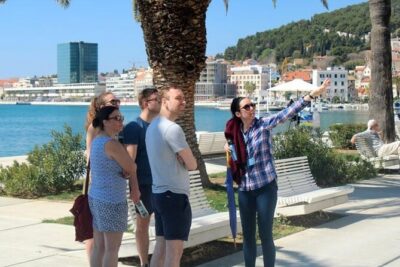

Walking Tour of Split with a ‘Magister’ of History
Read our review →
Split: Diocletian Palace & Old Town Guided Walking Tour
Read our review →
From Split: Krka Waterfalls Cruise & Trogir Walking Tour
Read our review →
Browse the lists this tour appears in