
Reviewed · SPLIT OLD TOWN WALKING TOURS
Split Walking Tour with Professor of History
Split’s old town is not a museum behind ropes. People live among Roman walls, medieval lanes, cafés, shops, and laundry lines. This tour makes that unusual setting easier to read, with a history professor explaining how Diocletian’s Palace became the center of modern Split. Mario’s lively teaching style and Anita’s warm, careful group management are major draws.
I like the small maximum of 17 people, which gives you a better chance to hear the guide in narrow streets and ask questions. I also like the route’s range: you get Roman architecture, Croatian culture, Napoleon-era planning, local food talk, and a few odd details such as the famous toe-rubbing ritual at the Grgur Ninski statue. The main caution is timing. Though listed at about 2 hours 20 minutes, the tour can run close to three hours when the guide adds stories and questions.
Key points at a glance

- Roman Split in a living city: Walk through Diocletian’s Palace while daily life carries on around you.
- History professors as guides: Mario and Anita bring academic context without limiting the tour to dry dates.
- A route with plenty of variety: See the Riva, palace substructures, Peristyle, Vestibule, cathedral exterior, Golden Gate, Prokurative, and Fruit’s Square.
- Small-group format: The group can include up to 17 people, with a private upgrade available.
- Useful local advice: The tour can include suggestions for food, onward travel, banks, ATMs, and sights to revisit.
- Good value at $24.19: You receive about two hours and twenty minutes of guided walking, with taxes and fees included.
Why a history professor changes the way you see Split
The best reason to take this walk early in your stay is simple: Split can look confusing at first. A Roman palace, a medieval town, a seafront promenade, and modern cafés all occupy the same compact center.
A professor can explain those layers in a way that makes the stones easier to understand. You are not just shown a column or an arch. You learn what it was built for, how its purpose changed, and why people still use the space today.
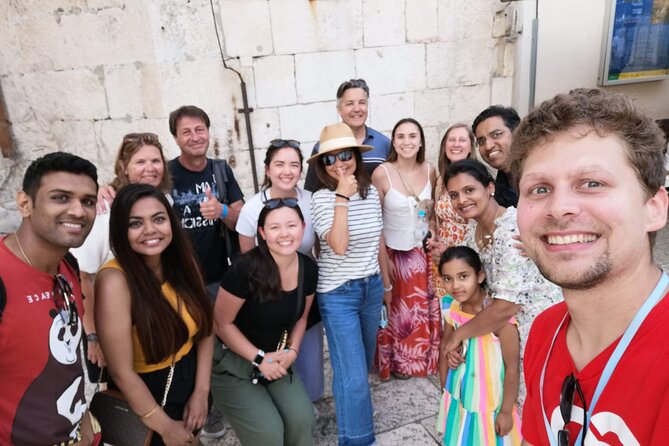
Mario receives especially strong praise for combining facts with humor, trivia, and questions. He is also known for advice beyond the formal route, including places to eat, things to do around Split, and which banks or ATMs to use. Anita is described as attentive and proud of her Croatian background, with a thoughtful way of looking after a group.
That does not mean every departure will feel identical. The guide may be Mario, Anita, or another member of the team. Still, the format is clear: expect an educational walk led in English, not a quick photo stop at the city’s headline sights.
More walks through the old quarter in Split:
- Split: Old Town and Diocletian Palace Walking Tour
★ 4.9 · 4,727 reviews - Walking Tour of Split and Diocletian’s Palace
★ 5.0 · 2,588 reviews - Krka Waterfalls tour with Trogir Walking tour and Krka panoramic boat cruise
★ 5.0 · 1,659 reviews
Starting on the Riva, where Split meets the sea
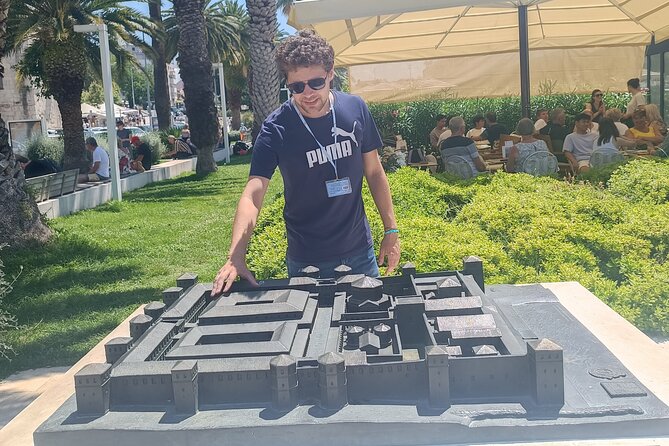
The tour begins at the Brass Gate, also called Porta Aenea, on Obala Hrvatskog narodnog preporoda 22. The meeting point is beside the Riva promenade and near a model of the palace.
The Riva is a good opening scene because it shows you how Split functions now. Locals sit with coffee, enjoy the sun, and use the promenade as a social center. From here, the guide can place Diocletian’s Palace in its coastal setting before taking you into the old town.
You spend about 15 minutes here. That is enough time to get oriented without using up the whole tour before reaching the main ruins. If you arrive early, the waterfront also gives you a clear place to find the meeting point.
The palace substructures reveal the Roman plan
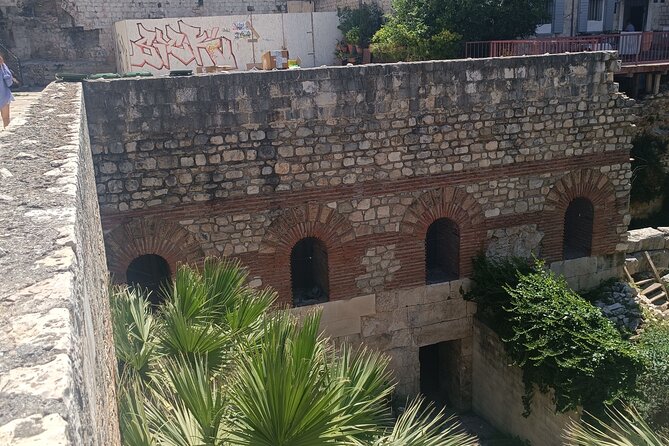
The basement halls of Diocletian’s Palace are among the best-preserved ancient complexes of their kind. They also help explain the shape of the streets above.
The substructures supported the imperial apartments and followed the layout of the palace overhead. As you walk through them, you can better understand the palace as a planned residence and ceremonial complex, rather than a loose collection of old walls.
The stop lasts about 15 minutes. The tour includes all fees and taxes, but you should pay attention to the distinction between the guided stops and individual admission. The cathedral and Temple of Jupiter are viewed from outside, and their entry fees are not included. The supplied details do not state a separate admission charge for the substructures, so confirm any access arrangements at booking if this part matters most to you.
Peristyle and Vestibule: ceremony written in stone
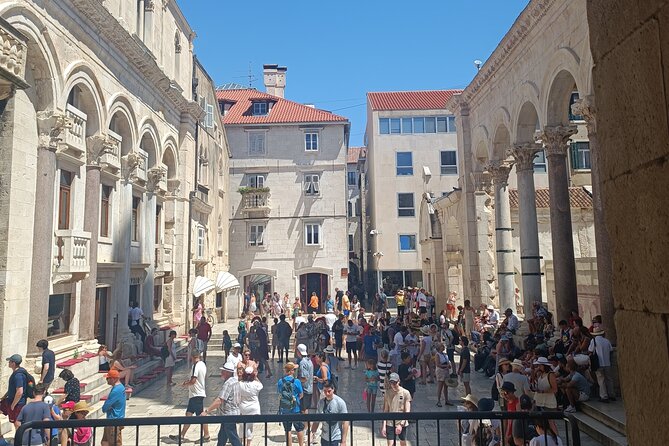
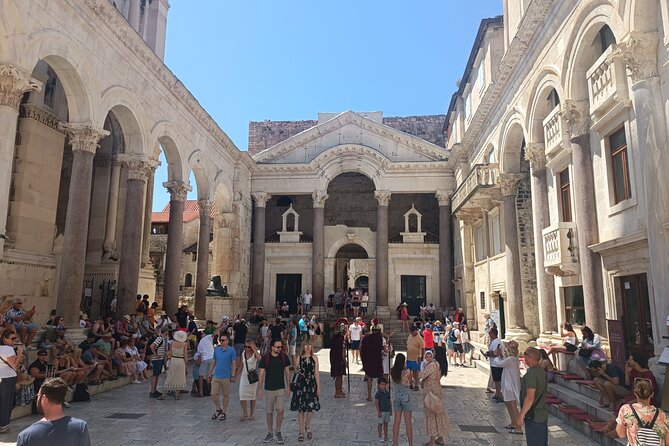
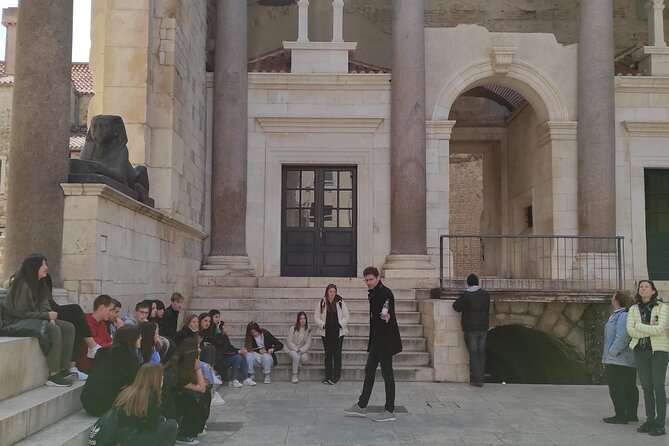
The Peristyle is the palace’s central square and one of the clearest places to picture imperial power. Diocletian was presented as the living son of Jupiter, and the architecture helped reinforce that image.
The guide explains how the emperor appeared beneath the architrave of the central Protyron. Subjects might kneel, kiss the edge of his red cloak, or lower themselves fully before him. That detail turns an apparently quiet square into a stage for ceremony and control.
You spend about 10 minutes here, followed by another 10 minutes at the Vestibule. The Vestibule, also called the Rotonda, was the formal entrance to the imperial apartments. It was built by the early fourth century and once had a dome rising about 17 meters above a circular room 12 meters across.
This was not simply a hallway. It was a grand meeting space for selected visitors, including ambassadors. I like this section because it connects scale with purpose. The high, round chamber was designed to make an entrance feel important.
More history walks in Split:
- Walking Tour of Split with a ‘Magister’ of History
★ 5.0 · 1,122 reviews - Split: History and Heritage Walking Tour
★ 4.9 · 650 reviews - Split History and Gastro Small-Group Tour with Food and Drinks
★ 5.0 · 375 reviews - SPLIT-PREMIUM Emperor’s Walking Tour for History Lovers + Museum
★ 5.0 · 333 reviews
Saint Domnius and the long afterlife of Roman buildings
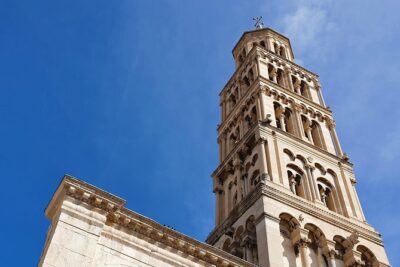
At the Cathedral of Saint Domnius, the tour stays outside. Your guide explains the building’s changing identity as a Roman temple, Diocletian’s mausoleum, and Christian church.
That sequence is one of the most useful ideas on the walk. Buildings in Split were not frozen at the moment they were built. Later generations reused them, changed their meaning, and fitted new religious and civic life into the old Roman shell.
The stop lasts about 20 minutes, making it one of the longer pauses. Detailed information is provided so you can decide if you want to pay for a separate visit after the tour. This is a smart approach for people who prefer to choose their interior visits rather than have every entrance included in the walking price.
Jupiter, a narrow lane, and the Golden Gate
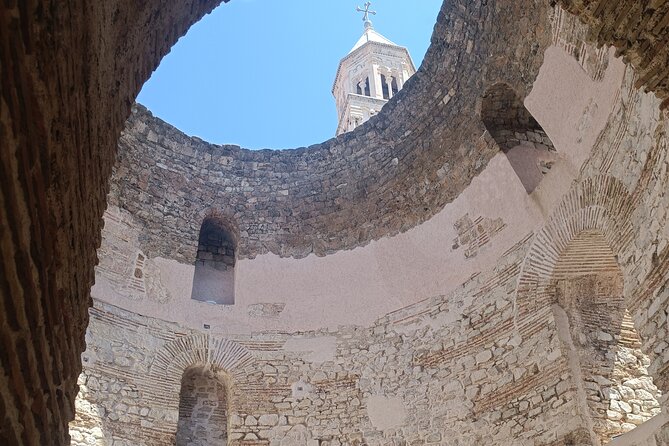
The Temple of Jupiter is another Roman structure with a later life. Jupiter was the Roman sky and thunder god, and the temple was later converted into a baptistery dedicated to Saint John the Baptist.
Again, the main explanation is from outside. The group then passes through a tiny lane between the ancient temple and a medieval building. Locals call it Let Me Pass Street and believe it may be the narrowest street in the world.
Treat that claim as part of the city’s local character rather than a measurement you need to settle. It is a quick, memorable stop, and the contrast is useful: a monumental Roman temple can sit beside a lane so tight that its name describes the only sensible conversation.
The Golden Gate, or Northern Gate, follows. It was one of four main Roman entrances into the palace and the route used by Diocletian when entering the complex. Its original decoration included columns and statuary, though much was lost after the gate was sealed during the Middle Ages.
The gate was later reopened and repaired. Today it is a busy photo stop, but the guide’s context helps you picture it as a controlled entrance to an imperial residence. You spend about 15 minutes here.
The toe of Gregory of Nin and a Croatian cultural figure
The 8.5-meter statue of Gregory of Nin by Ivan Meštrović is one of Split’s most popular meeting points. Its polished toe is easy to spot. Rubbing it is said to bring good luck, and countless hands have worn the metal smooth.
The superstition is a small detail, but it makes the stop fun. It also gives the guide a chance to discuss a major Croatian cultural and religious figure without turning the moment into another lecture about Roman stonework.
Allow about 10 minutes. If you want a photograph, this is one of the places where a little patience helps, since the toe is the focus of the ritual.
Marmontova, Prokurative, and the city beyond Rome
Marmontova Street changes the subject from ancient emperors to modern urban planning. It is named for Napoleon’s marshal Marmont, who helped shape Dalmatian cities during the French period. The street is regarded as one of Split’s most attractive.
This is an important part of the route because Split’s story does not end with the Roman era. The city also carries Venetian, medieval, French, and modern layers. A guide who moves between these periods helps you understand why the old town feels mixed rather than perfectly uniform.
The walk then reaches Republic Square, better known as the Prokurative. Three sides of the square are lined with elaborate neo-Renaissance buildings. Its broad, open layout offers a change from the tight palace lanes and gives the group room to pause.
You spend about 10 minutes at each stop. These shorter sections keep the tour moving and help prevent the experience from becoming an architectural lecture inside the palace alone.
Finishing at Fruit’s Square with food and local life
The final stop is Fruit’s Square, or Trg Braće Radić. Its name recalls the women who once sold fruit there. Today, the compact square also offers a good setting for stories about Croatian culture, food, and everyday life.
The guide discusses monuments such as the statue of Marko Marulić, often called the father of Croatian literature. This is a fitting finish because it moves from imperial power and religious buildings toward language, markets, and local identity.
The tour ends back at the meeting point, though the route description identifies Fruit’s Square as the last stop. You may want to confirm the exact end location with the guide on the day. The practical value of this final conversation is high. Mario, in particular, is known for adding suggestions about food and onward plans, and some groups receive follow-up advice after the walk.
What the $24.19 price buys you
At $24.19 per person, this is a strong price for a guided introduction to Split’s historic center. You are paying for about 2 hours 20 minutes of instruction, a route covering major sights, and an English-speaking guide with a history background.
The value improves if you use the tour as a first-day orientation. Afterward, you can decide which places deserve a separate entry fee, where you want to eat, and which streets you can explore on your own.
The price does not cover alcoholic drinks, and entry to the Cathedral of Saint Domnius and Temple of Jupiter is not included. That keeps the basic cost low, but budget extra if you want to go inside those sites.
A private upgrade is available for a more personal experience. No private-tour price or group limit is provided, so you should check those details before booking. The shared version allows up to 17 people, which is still fairly manageable, though the experience will feel more intimate if the departure is smaller.
Timing, walking comfort, and group size
The stated duration is approximately 2 hours 20 minutes. One account describes a tour lasting about three hours, so I would keep a little extra time free, especially if you have a ship, transfer, or timed admission afterward.
That longer finish may be welcome if you enjoy questions and extra stories. It may feel tiring if you want a quick orientation. The route includes standing at historic sites, walking through narrow streets, and moving between open squares. Good shoes and water make sense, though the provided details do not give a formal difficulty rating.
The tour has a maximum of 17 people. Most people can participate, and service animals are allowed. The route is near public transportation, but no detailed accessibility information is supplied for the old palace lanes or individual sites.
Good weather is required. If poor weather cancels the experience, you are offered another date or a full refund. You can cancel for a full refund up to 24 hours before the start time. Changes or cancellations inside that window are not accepted.
Who will get the most from this walk
I would choose this tour if you are visiting Split for the first time and want the old town to make sense before exploring alone. It also suits anyone who prefers history with humor, questions, and local advice rather than a list of dates.
It is especially useful for people interested in Roman architecture, Croatian culture, religious history, and the way cities reuse old buildings. Food-focused visitors may also appreciate the final stop and the guide’s suggestions about where to eat.
You may want another format if you dislike standing, prefer to enter every major building, or need the tour to finish at an exact time. The cathedral and Temple of Jupiter are explained from outside, and the walk can run longer than the stated estimate.
Should you book the Split history walk?
Yes, if you want a well-priced first look at Split led by someone who can explain more than the obvious Roman ruins. The strongest features are the professor-led commentary, the broad route, the small-group limit, and the useful advice that can continue after the formal walk.
Book it early in your stay and leave room afterward for your own palace visits. If you want more personal attention, ask about the private upgrade. If you want a short, tightly timed tour with every admission included, this may not be the right fit.
FAQ
How long does the Split walking tour last?
The listed duration is approximately 2 hours 20 minutes. It can run closer to three hours when the guide adds more stories and discussion.
What language is the tour offered in?
The tour is offered in English.
Where does the tour begin?
It begins at the Brass Gate, or Porta Aenea, at Obala Hrvatskog narodnog preporoda 22 in Split.
Where does the tour end?
The activity ends back at the meeting point. Fruit’s Square is described as the final sightseeing stop.
Is admission to Saint Domnius Cathedral included?
No. The cathedral is visited from outside, and entry is not included. The guide provides information for anyone who wants to visit afterward.
Is entry to the Temple of Jupiter included?
No. The temple is viewed from outside, and its admission is not included.
How many people can join the shared tour?
The tour has a maximum of 17 people. A private upgrade is also available.
What is the cancellation policy?
You can cancel up to 24 hours before the start time for a full refund. Cancellations or changes made less than 24 hours before the start time are not accepted. If poor weather causes cancellation, you are offered another date or a full refund.
Just added around Split
- From Makarska : Wine Tasting Grabovac Tour★ 4.5 · 30 reviews
- Essential Diocletian’s Palace Tour for First-Time Visitors★ 4.8 · 19 reviews
- Unique vintage Tomos moped tour Split – Back to the ’80s★ 4.8 · 17 reviews
- Walking Tour Split★ 4.7 · 61 reviews
- Trogir; Private walking tour of higlights of Trogir★ 4.7 · 3 reviews
- Trogir: White Lagoon, Maslinica & Blue Lagoon Speedboat Tour★ 4.8 · 11 reviews
- Trogir 1.5-Hour City Tour★ 4.4 · 37 reviews
- Split: Trogir Open Top Bus Trip + Free Split Walking Tour★ 4.1 · 17 reviews
Split Old Town Walking Tours, compared.
Split: Old Town and Diocletian Palace Walking Tour
Read our review →
Walking Tour of Split and Diocletian’s Palace
Read our review →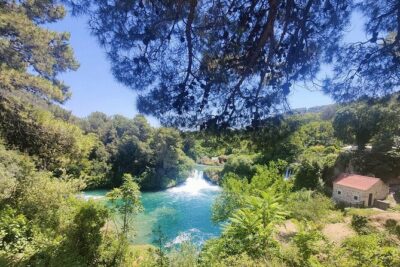
Krka Waterfalls tour with Trogir Walking tour and Krka panoramic boat cruise
Read our review →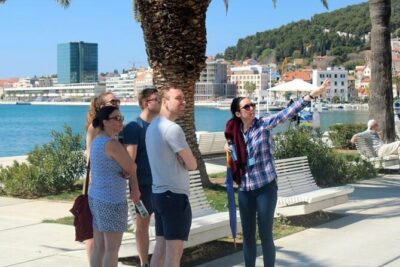
Walking Tour of Split with a ‘Magister’ of History
Read our review →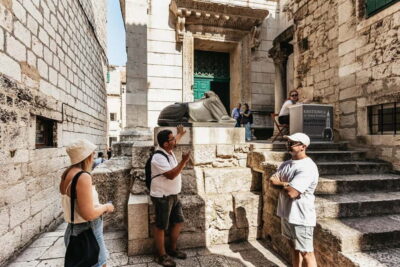
Split: Diocletian Palace & Old Town Guided Walking Tour
Read our review →
From Split: Krka Waterfalls Cruise & Trogir Walking Tour
Read our review →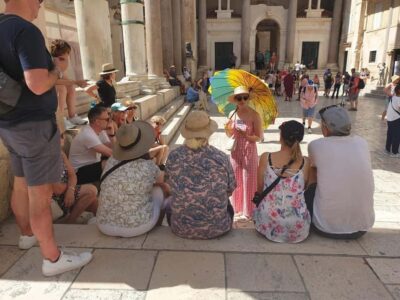
Browse the lists this tour appears in