
Reviewed · DIOCLETIAN'S PALACE TOURS
History & Cultural Walking Tour of Split and Diocletian’s Palace
Diocletian’s Palace is not a fenced-off ruin. It is the heart of modern Split, with homes, cafés, shops, and narrow lanes built into a Roman emperor’s retirement palace. This small-group walking tour helps you read the city around you, from the Peristyle and underground chambers to the Riva waterfront and the old Jewish quarter.
I like the route for two clear reasons: it gives you a useful first look at Split in only about 90 minutes, and it connects Roman remains with Croatian culture, language, music, and medieval history. Guides including Darko, Ante, and Ivana have been praised for clear storytelling, humor, and good advice on what to see next.
The main consideration is the pace and setting. This is a walking tour through old stone streets, and some areas include high steps. The substructures visit also does not include the museum section, so you will need extra time and a separate visit if you want the full underground display.
Key points to know before booking
- The Peristyle is your starting map: This central palace square leads toward many of Split’s most important sights.
- Traditional klapa singing may be part of the visit: The Vestibule can offer a memorable taste of Dalmatian musical culture.
- The tour links Roman and Croatian stories: You hear about Diocletian, Gregory of Nin, Marko Marulić, Venetian rule, and Split’s Jewish community.
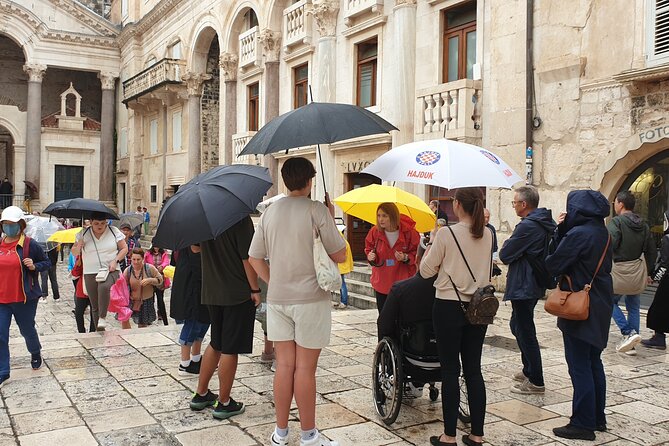
- A maximum of 15 people keeps it personal: Smaller groups make it easier to ask questions and hear the guide in tight lanes.
- The route ends where it begins: Start at Peristil ulica and finish back at the meeting point, making it easy to continue exploring.
- The $22.98 price is reasonable for an orientation: You get a guide-led introduction to several major sights without separate entry charges along the route.
Why Split makes more sense with a guide
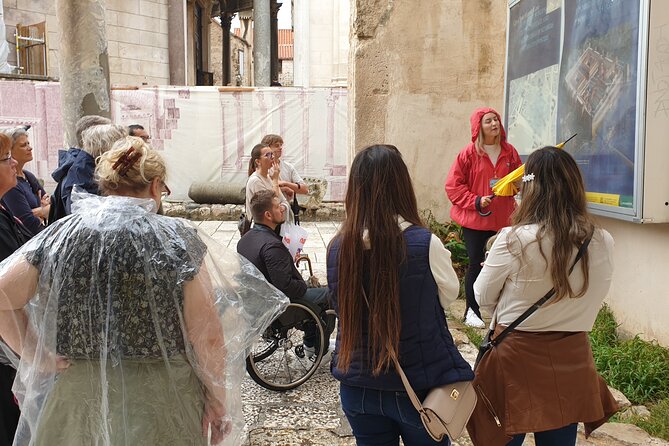
Split can seem easy to understand at first. Follow the crowds into Diocletian’s Palace, find the main square, walk downhill to the sea, and you have seen the basics. But the city’s best feature is also its puzzle: Roman columns sit beside medieval homes, modern businesses occupy ancient walls, and a palace built for one emperor became the center of a living city.
That is where this tour earns its keep. You are not simply checking off the Golden Gate and the Riva. You are given the connections between them. The Peristyle explains the palace plan. The Vestibule shows how imperial spaces were designed. The substructures reveal how later generations adapted the building. The Golden Gate then brings the story back into the wider history of Croatia.
I would use this as an orientation walk near the start of your stay. It gives you names, landmarks, and local context that make a later independent stroll more rewarding. The timing also works well for someone with only a couple of days in Split, especially if you choose an early departure and want to see the center before it becomes more crowded.
The experience is offered in English and is limited to 15 people. That cap matters in Split’s narrow lanes. A guide can answer questions without turning the walk into a large moving crowd, and you have a better chance of hearing explanations in the palace’s echoing spaces.
More ways to see Diocletian's Palace:
- Split: Old Town and Diocletian Palace Walking Tour
★ 4.9 · 4,727 reviews - Walking Tour of Split and Diocletian’s Palace
★ 5.0 · 2,588 reviews - Split & Diocletian’s Palace Walking Tour
★ 5.0 · 1,125 reviews
The Peristyle, where the palace story begins
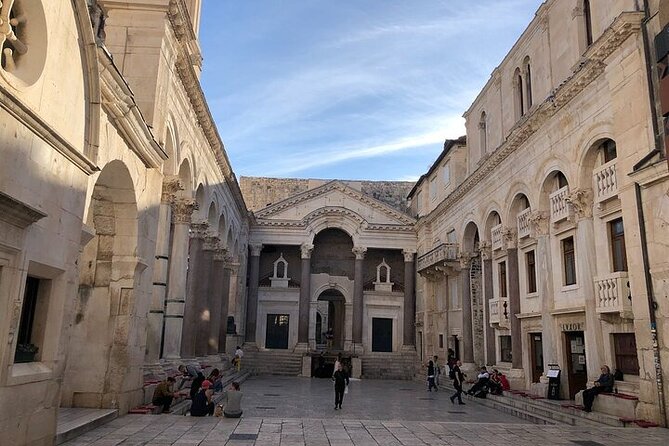
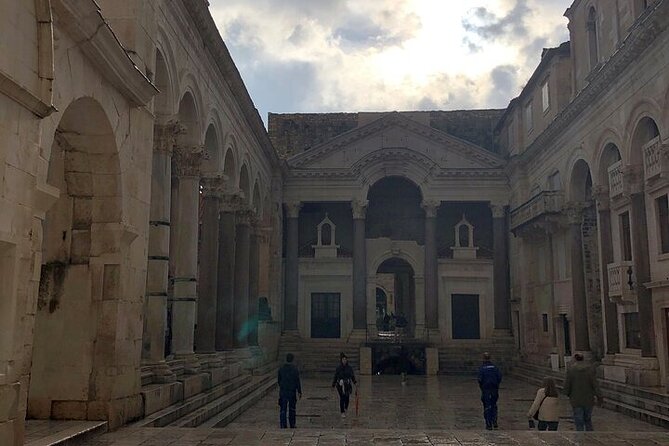
The tour starts at the Peristyle, the central square of Diocletian’s Palace. This is the right place to begin because it gives you a physical sense of how the palace worked. From here, routes lead toward major sections of the complex, and the surrounding stonework makes the Roman plan easier to picture.
You spend about 15 minutes here. That is enough time for an introduction to the emperor and the palace without getting stuck in a long lecture before the walk has properly started. A good guide can point out how the square functioned and why this space remains the natural center of Split.
I especially like this stop for first-time visitors who might otherwise mistake the Peristyle for a conventional archaeological site. It is not isolated from daily life. You are standing in a public square that still helps organize the city, which makes the ancient structure feel practical rather than distant.
The open square can be exposed to sun, and the stone paving is uneven in places. Wear shoes that will handle old streets comfortably. The tour is short, but you are on your feet for the full route.
The Vestibule and the sound of Dalmatia
The next stop is the Vestibule, a rounded entrance space associated with the emperor’s apartments. You spend about five minutes here, learning how it fit into the palace and why its shape and acoustics matter.
This is also the point where you might hear traditional Dalmatian klapa singing. The tour does not promise a performance every time, but the possibility adds a distinctly local note. Klapa is closely tied to Dalmatian musical culture, so a few voices in this old stone chamber can tell you something about the region that a standard architectural explanation cannot.
The Vestibule is compact, so a small group helps. With up to 15 people, you have a better chance of staying close to the guide and hearing what is said. If singing takes place, keep your expectations sensible. It is an added possibility, not the central product of the tour.
The palace substructures and the limits of the visit
The substructures offer one of the most useful stops for understanding Diocletian’s Palace. You walk through the lower spaces and learn how they were built and how their purpose changed over the centuries. The rooms mirror parts of the palace above, helping you see how the ancient structure was supported and organized.
About 10 minutes are set aside here. That is enough for a focused explanation, but not enough for a full underground museum visit. The museum section is not included in this walk, so plan to return if you want a longer look at the archaeological displays.
That limitation is worth noting before you book. If your main goal is an extended examination of Roman construction, you may want to add the museum separately. If you want a compact explanation of why the lower levels matter, this stop does the job without taking over the whole morning.
The underground setting also reinforces the need for sensible footwear and care on steps. The tour information specifically cautions people who have trouble with high steps. Most people can take part, but this is not a completely flat city walk.
More walks through the old quarter in Split:
- Krka Waterfalls tour with Trogir Walking tour and Krka panoramic boat cruise
★ 5.0 · 1,659 reviews - Walking Tour of Split with a ‘Magister’ of History
★ 5.0 · 1,122 reviews - Split Walking Tour with Professor of History
★ 5.0 · 926 reviews - Split: Diocletian Palace & Old Town Guided Walking Tour
★ 4.7 · 882 reviews
The Golden Gate and Gregory of Nin
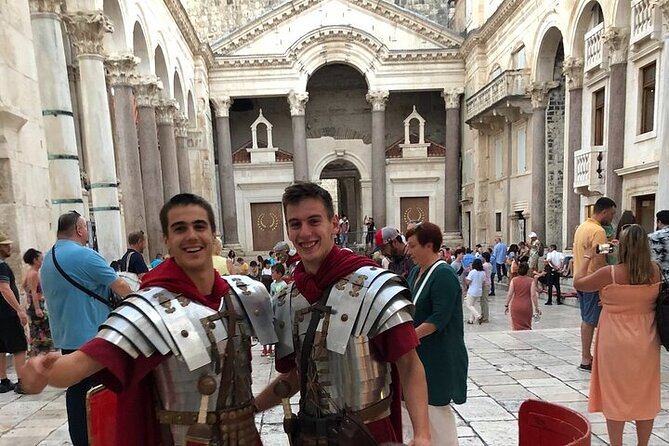
The Golden Gate was the main entrance to the palace, and the tour gives you about 10 minutes to understand its place in the complex. It is more than a handsome photo stop. The gate shows how the palace controlled movement and how its original design shaped the later city.
Nearby, you see the statue of Gregory of Nin. The guide explains his importance to Croatian history and language, giving you a break from the Roman period and a look at national identity. This is one of the route’s useful shifts. Split is not only an ancient imperial site, and the story does not end when Roman power fades.
A tour guide can also help you notice how much of Split’s past is packed into a small area. The Golden Gate, the palace walls, later urban growth, and the Gregory of Nin statue all sit within a short walk. You get a clearer sense of time layered on top of time.
Riva Harbor and the city by the sea
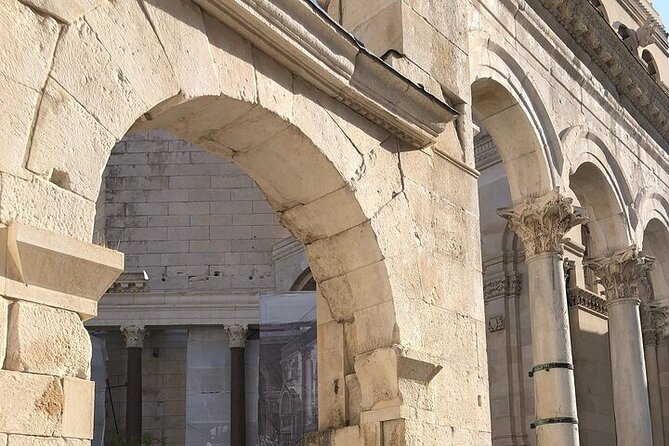
The walk continues to Riva Harbor, Split’s broad waterfront promenade. You spend around 15 minutes here, including a look at a bronze model of Diocletian’s Palace. The model is useful because it lets you step back from the maze of streets and see the palace as a planned whole.
Riva also provides a change of mood. Inside the palace, the emphasis is stone, corridors, and enclosed spaces. By the water, you can think about Split as a port city and see how the waterfront connects the old center to modern life.
I would pay close attention to the guide’s explanation of the promenade rather than treating this as a simple scenic pause. The Riva helps explain why Split feels like a city with both a strong local center and an outward-looking coastal identity.
This is a good point for photos, but the walk does not turn into a long free period. If you want time to sit along the waterfront, have a drink, or study the harbor, plan to do that after the tour.
Fruit’s Square, Venetian power, and Croatian literature
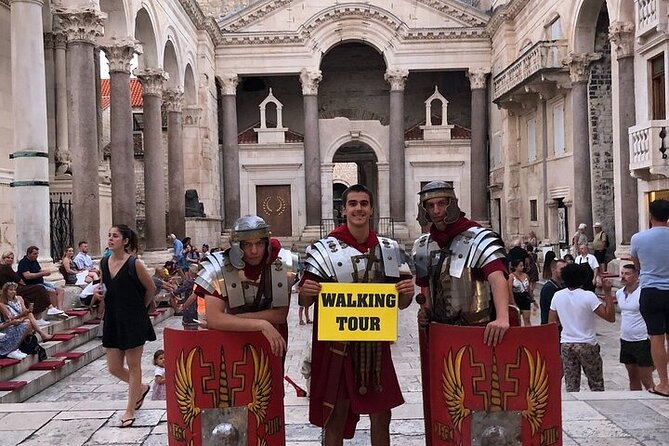
Fruit’s Square, officially Trg Brace Radic, adds another period to the story. Here you learn about a 15th-century Venetian citadel and the role of Marko Marulić, often called the father of Croatian literature.
The stop lasts about 10 minutes. It is valuable because it moves beyond the familiar Roman headline. Venice shaped much of the Adriatic coast, and Split’s later history cannot be understood through Diocletian alone. Marko Marulić also gives the tour a cultural angle, showing how language and literature matter alongside walls and monuments.
This is the kind of detail that can disappear if you explore only by following a map. You may see the square on your own, but without the story, the citadel and the literary reference can pass as background scenery. The guide supplies the reason to pause.
The route also gives you a useful balance of famous and less obvious subjects. The Peristyle and Golden Gate are essential sights, while Fruit’s Square asks you to look at how Split developed after the imperial period.
The old synagogue and Split’s Jewish community
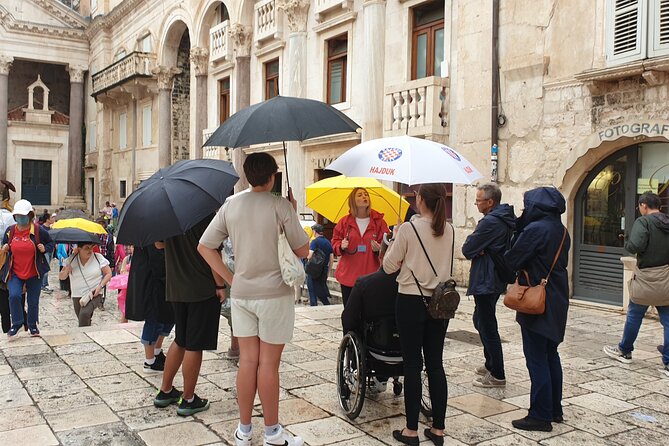
The final listed stop is the Split Synagogue, dating to the 16th century. You pass by the site and learn about the history of the Jewish people in Split. About 10 minutes are devoted to this part of the walk.
This stop broadens the tour again. It reminds you that the city’s story includes religious and cultural communities that are easy to overlook when the palace dominates every guidebook. The synagogue is not presented as a separate museum visit, and admission is not included, but the stop gives you context for the place and its role in the city.
For me, this is one of the strongest reasons to choose a cultural walking tour instead of a palace-only explanation. You see how Split’s identity was shaped by many eras and communities, not just by the emperor who built the original complex.
After the synagogue stop, the activity ends back at the meeting point. That makes the route simple to fit into your day. You can return to a favorite palace courtyard, continue along the Riva, or visit the substructures museum that was not part of the guided route.
Guides, group size, and the feel of the walk
The tour is led by an educated English-speaking guide, and the personal style matters as much as the facts. Darko has been singled out for his enthusiasm and strong sense of local pride. Ante, who may introduce himself as Anthony in English, has been praised for showing historical details beyond the obvious route. Ivana is noted for clear storytelling, questions that help you remember what you hear, and useful suggestions for further exploring Split.
Those names do not guarantee who will lead your departure, but they give you a sense of the guide style to expect: factual, friendly, and engaged rather than dry. Humor is part of the appeal. That matters in a history tour, since dates and rulers can blur together when they are delivered without a human angle.
The maximum group size is 15. Some departures may be much smaller. One early morning group had only three people and ran close to three hours because the guide spent extra time answering questions. The advertised duration is about 90 minutes, so treat any longer visit as a possible bonus, not something to plan your day around.
I would choose an early start if your schedule allows it. An earlier walk can offer fewer people around the palace and gives you the rest of the day to revisit anything that caught your attention. The tour is also a sound choice for a first evening in Split, when a short introduction can help you understand what you are seeing during the rest of your stay.
Is $22.98 good value?
At $22.98 per person, this is a fair price for a guided introduction to Split’s core sights. You are paying for an English-speaking guide, a small-group setting, and a route that covers Roman, Venetian, Croatian, Jewish, literary, and musical subjects in one compact walk.
The value is strongest if you want context. You can walk past the Peristyle, Golden Gate, Riva, and Fruit’s Square for free, but the fee saves you from having to piece together each location yourself. It also gives you a chance to ask questions, which is especially useful when the same stone street may reflect several different periods.
No gratuity is included, so budget for that separately if you feel the guide provided a good experience. There are no admission charges listed for the main stops, though the synagogue is viewed from outside and the museum portion of the substructures is not part of the tour.
Group discounts are available, and booking confirmation is provided at the time of booking. The tour is also offered with a mobile ticket, which keeps the arrival process simple.
Who should book this Split walk?
I would recommend it to first-time visitors, people with limited time, history fans, and anyone who wants a clear introduction before exploring alone. It also suits people who enjoy local culture, since the route includes possible klapa singing, Croatian literature, language, and the story of Split’s Jewish community.
It is a good match for families and mixed-age groups who prefer a shorter walk over a long museum visit. The guide can add humor and answer questions, which helps keep the history moving.
You may want something else if you want a deep archaeological examination of every room, a long museum tour, or a completely flat route. The lower levels and old streets can include high steps, and the substructures museum requires a separate visit.
The experience is near public transportation, service animals are allowed, and most people can participate. It ends at the starting point, which keeps the logistics easy. Free cancellation is available up to 24 hours before the start time, but changes or cancellations inside that window are not accepted. A minimum number of people is required, so a cancellation by the operator can result in another date or a full refund.
My recommendation
I would book this tour early in your Split stay, especially if you want the city to make sense before you explore it on your own. The route is short, the price is modest, and the small group gives you a better chance of hearing the guide in the palace’s tight spaces.
Choose it for connections: Roman architecture beside modern life, Croatian language beside imperial power, and local music inside an ancient chamber. Skip it only if you already know Split well or want a longer, museum-focused archaeological visit.
FAQ
How long does the History and Cultural Walking Tour of Split last?
The tour lasts approximately 1 hour and 30 minutes. Some departures may run longer if the guide spends extra time answering questions.
Where does the tour start and end?
The tour starts at Peristil ulica, Peristil ul., 21000 Split, Croatia. It ends back at the same meeting point.
What language is the tour offered in?
The tour is offered in English.
How many people can join the tour?
The activity has a maximum of 15 people. Group discounts are available.
Are admission tickets included?
The listed stops do not require separate admission during the walk. The museum section of the Diocletian’s Palace substructures is not included, and the synagogue is viewed as a stop along the route rather than an included museum visit.
Is the tour suitable for people with mobility concerns?
Most people can participate, but the tour is not recommended for people who have difficulty with high steps. It takes place on old streets and through palace areas.
What is the cancellation policy?
You can cancel up to 24 hours before the experience starts for a full refund. Cancellations or changes made less than 24 hours before the start time are not accepted for a refund.
More History Walks in Split
- Split: History and Heritage Walking Tour
★ 4.9 · 650 reviews - Split History and Gastro Small-Group Tour with Food and Drinks
★ 5.0 · 375 reviews - SPLIT-PREMIUM Emperor’s Walking Tour for History Lovers + Museum
★ 5.0 · 333 reviews - Split: Local History and Culture 90-Minute Walking Tour
★ 5.0 · 194 reviews
Just added around Split
- From Makarska : Wine Tasting Grabovac Tour★ 4.5 · 30 reviews
- Essential Diocletian’s Palace Tour for First-Time Visitors★ 4.8 · 19 reviews
- Unique vintage Tomos moped tour Split – Back to the ’80s★ 4.8 · 17 reviews
- Walking Tour Split★ 4.7 · 61 reviews
- Trogir; Private walking tour of higlights of Trogir★ 4.7 · 3 reviews
- Trogir: White Lagoon, Maslinica & Blue Lagoon Speedboat Tour★ 4.8 · 11 reviews
- Trogir 1.5-Hour City Tour★ 4.4 · 37 reviews
- Split: Trogir Open Top Bus Trip + Free Split Walking Tour★ 4.1 · 17 reviews
Diocletian's Palace Tours, compared.
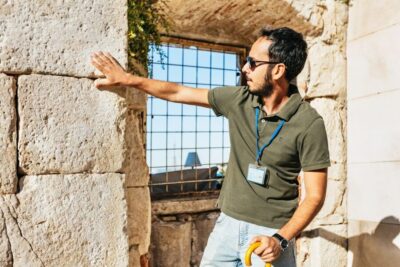
Split: Old Town and Diocletian Palace Walking Tour
Read our review →
Walking Tour of Split and Diocletian’s Palace
Read our review →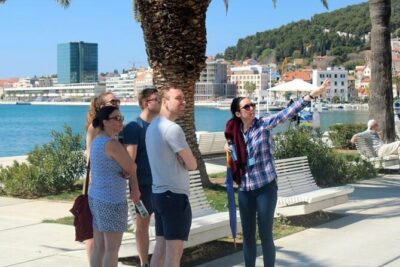
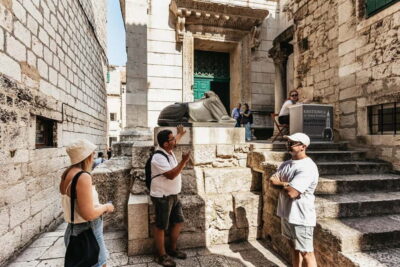
Split: Diocletian Palace & Old Town Guided Walking Tour
Read our review →
Split: Game of Thrones Tour with Diocletian’s Palace Cellar
Read our review →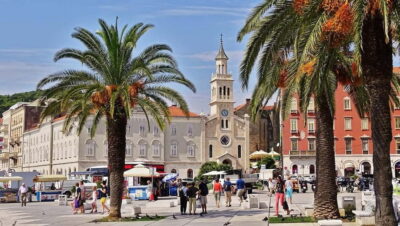
Diocletian’s Palace and Old Town SMALL GROUP Walking Tour
Read our review →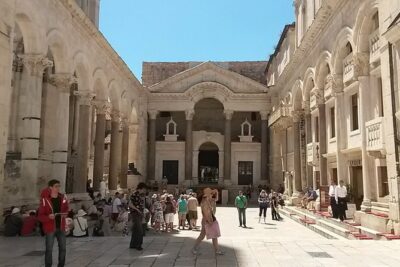
SPLIT-PRIVATE Walking Tour of Diocletian’s Palace & Old Town
Read our review →
Browse the lists this tour appears in